

Armies
Korath passes, lock gates and evacuation
Mountain defence rests on controlled closure, reserves and the ability to get out.
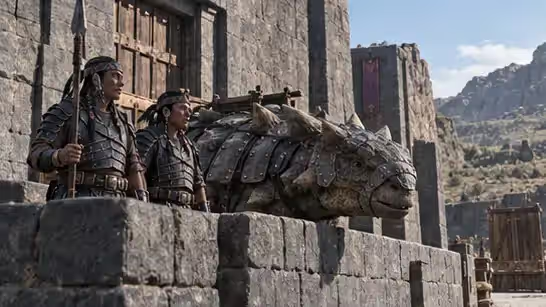
Close without trapping
Lock-gate citadels use double doors, airlocks, counterweights and manual emergency operation. Their function is not only to stop passage: they organise what must remain breathable and accessible when a sector is isolated.
Air, water and heat are defensive reserves
In a pass or closed district, air, water and heat determine how long people can work, wait or evacuate. These needs require maintenance of ducts, shutters, drains and closure systems.
Animals do not abolish the mountain
Animals in the lower marches need turning yards, passage arcs and rest areas. They do not make deep urban areas automatically usable. Equipment, winches and access-regulating people remain central to pass transport.
Anatomy of a lock-citadel
A lock-citadel closes a pass or a district with a succession of obstacles. The first door, thick and slow, stops the mass; between it and the second lies an airlock, where whatever has entered can be checked, held back or isolated; the second door protects the interior. The counterweights that move them run down shafts carved alongside, and an emergency manual control, winch and crank, allows closure even when the main mechanism is jammed.
Around the doors, everything is arranged for knowing and warning: observation slits, gongs whose codes announce closure, clocks that measure its duration, registers recording every crossing and every manoeuvre. A Korathian lock door is therefore as much a measuring instrument as an obstacle: it tells those who guard it what is passing, when, and how fast it can close.
The count of hours
Each district and each pass post keeps its count of hours: the time for which its reserves of air, water and heat allow its population to hold once the doors are shut. The count is posted in the refuge hall, recalculated by the Breath teams whenever population or stock changes, and every district commander knows it by heart.
This figure governs decisions. A district that can hold three days can wait; a post that can hold only a few hours must be evacuated before it is closed. Korathian officers think of defence in sequences and durations rather than in metres of wall: the question is not only whether a door stops the enemy, but how long those behind it can breathe.
Getting people out
A space that can be isolated must always be able to be evacuated: the rule is one of the most respected in the country. Each district has its exit routes, its fallback galleries towards neighbouring districts or the deep levels, and an evacuation order known to all. Children and those who cannot carry arms leave first; then come the workshops’ registers and plans, saved before the furniture.
The system also has its cruelty. To save a city, the command may decide to close a door on a district that has not finished leaving, or to sacrifice a garrison tasked with delaying the enemy. Korathians know this and do not hide it: a defensive closure can save the city and condemn a district, and the accident steles keep the memory of those who remained on the wrong side.
The right to close the door
In Korath, everything can be debated except one thing. A door’s mechanism can be the subject of passionate debates, articles, songs and lawsuits; the decision to close it belongs to the military command and to it alone. The saying every Korathian knows puts it in one sentence: one may debate the fourth hinge for three months, but one does not debate who holds the right to close the door.
This separation gives the locks their effectiveness. Engineers, workshops and the press have made every door an object of precision, checked, corrected and tested; when the alarm comes, no one has to defend or justify it. A single order is enough, and the door closes in the time foreseen.
Practising closure
Closures are practised. Several times a year, districts rehearse their alarms: gongs sound, inhabitants make for their refuge halls or exit routes, and doors close while a clockmaker measures the time. The results are published, compared from district to district, discussed in the papers and sometimes sung in the taverns.
It was in this culture of measurement that the famous quarrel of the Eighteen Seconds door arose, when the country split between supporters of closure in seventeen and in nineteen seconds. Korathians kept expressions from it: “seventeen seconds” describes a reckless person, “nineteen” someone overcautious, and “eighteen” one who seeks the mechanical middle ground.