
The Pirates du Nord
A sovereign seafaring civilisation of the northern coasts, with its own history, territory and institutions. Its three black Mosasaurus, present for decades, are its symbol and its strength.
A civilisation, not a band
The Pirates du Nord form an autonomous seafaring civilisation, with their own history, territory, institutions and pirate culture. They are neither Volonia’s privateers nor a mere Volonian privateering organisation. Their domain is the northern coasts.
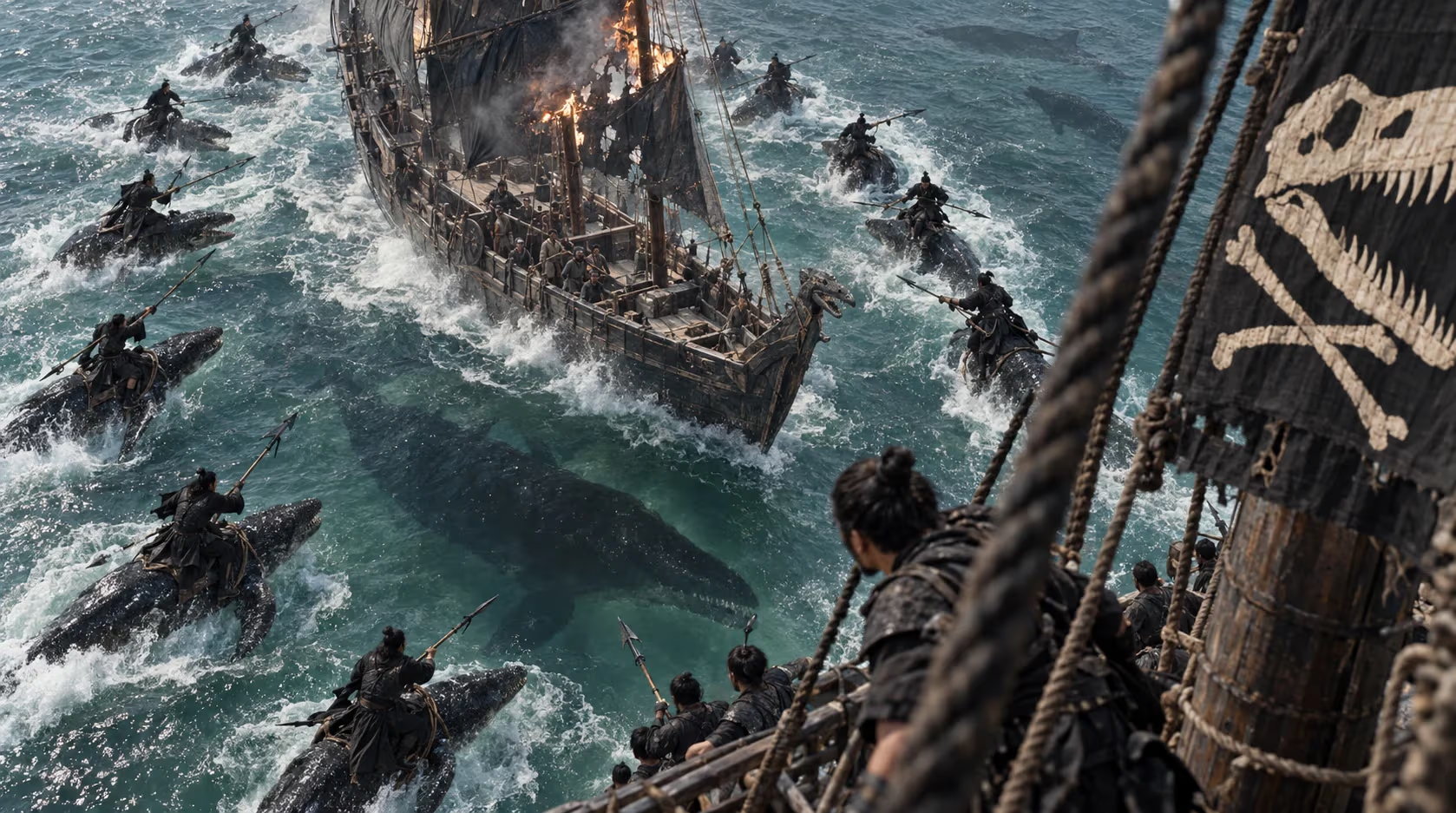
Their crews have an East Asian phenotype. Their black flags bear a saurian skull and repeat the silhouettes of the Trois Noirs. Together with sea monsters, smugglers and private insurers, they are part of what keeps Volonia from ruling the seas alone.
The Trois Noirs
The three black Mosasaurus are the historic very-large animals of the Pirates du Nord. They have been there for decades, since before the present generation, and have become a national symbol. They are not counted among Volonia’s thirty very-large animals.
The whole civilisation knows them one by one. Several generations of captains have seen them fight, children know their names, and to say of a sailor that “he sailed under the Second Black” gives him a title of prestige.
Their blackness is natural: they are said to come from a local melanic line, extremely rare and kept up for a long time. Their backs are almost uniformly black, their flanks anthracite, their bellies a very dark grey; their scars show only when they surface. Their harness is kept to a minimum, without ornament. When one of them passes under a ship, the first thing seen is a black mass changing the colour of the water.
The Double Cercle
The Double Cercle technique is built around them. Fast riders carrying fire close the surface around the target ship; then one of the Blacks attacks beneath the hull. The surface is forbidden, and so are the depths. This is what allows the Pirates du Nord to exist beside Volonia without being swallowed.
Facing Volonia
Volonia has its institutional mosasaurs; the Pirates du Nord have had their three black monsters since before the present generation. These are not recently acquired animals, and their age underpins a genuine maritime rivalry between the republic and the pirate civilisation.
The northern coasts
The domain of the Pirates du Nord is a fringe of cold coasts far north of the Volonian routes: dark cliffs, coves of split rock, storm-beaten islets, conifer forests running down to the water. It rains often, fog lingers for whole days, and the sea is harder there than in the south. Between these coasts and the ports of Volonia, as elsewhere between two powers, there is no border, only weeks of empty sea.
The settlements are cove villages, set against the cliff and invisible from offshore. The houses are low, of wood and stone, roofed with turf or blackened shingles; the largest serve as halls where sails are mended and the council meets. Each cove has its timber quay, its careening slips and, at the back of the inlet, a deep basin where a Black can come to rest near the people. The ships stay sheltered behind the rocks, and from the sea all one sees is an empty coast.
A society of coves
The Pirates du Nord form neither a kingdom nor a republic in the Volonian manner. Each cove governs itself under the authority of its captains, and the coves federate through a common council of the most respected shipmasters of the whole coast. No one sits there by birth: a captain has a seat because crews follow him.
The council decides on distant expeditions, truces and wars, the sharing of fishing and raiding waters, and everything that commits the three Blacks. In the middle of its table lie three black tokens, one per animal; a decision that commits the Blacks passes only if the captains in charge of them raise their tokens. Everything else is settled by voice, often loudly. Women sit there as captains, pilots or mistresses of coves, and the cut and knots of a black outfit tell each person’s rank. This loose organisation has one advantage: no foreign house can buy the Pirates du Nord in a single stroke.
Keeping three monsters
Each Black has its own crew, a line of riders and keepers who hand the charge down from generation to generation. The captain who holds a Black is one of the most esteemed figures on the coast, and the most closely watched: losing the animal would be a loss for the whole people. The keepers know the beast’s scars, its moods, its way of prowling under a hull, and follow it in light boats on campaign.
Feeding a grown mosasaur takes a fishing fleet on its own. The coves owe it a share of their catch, and a prosperous village is said to “feed its Black well”. The melanistic line the three come from is kept up with jealous care; no one outside the families in charge knows exactly where or how. Their true names are known to every child on the coast and almost never spoken in front of strangers: in the southern ports people simply speak of the First, the Second and the Third Black.
Living off the cold sea
Raiding is only part of the northern economy. The coves live first on cold-water fishing — fatty fish, cephalopods, shellfish — from which they draw oil, dried and salted fish for the winter, and marine leathers. The conifer forests supply timber for hulls and pitch for caulking; in the halls the black sails are woven on great looms.
Raiding comes on top of that base. Each season the northern ships sail down towards the convoy routes, take cargoes, metals, cloth, everything the coast does not produce, and head home before the winter storms. One share of the loot goes to the crews, another to the cove, yet another to the Blacks, that is, to the families who feed them. The Pirates du Nord also trade, discreetly, with merchants who are not afraid of them; northern black cloth turns up as far as some ports of the Îles Brisées.
The hatred of the contract
What sets the Pirates du Nord against Volonia is not only competition at sea: it is a way of treating people. Volonia does not practise slavery; it practises the contract — standardised ransoms, debts, “freely agreed” labour under disproportionate clauses, on the model of the Îles Brisées. To the northerners that is almost worse than a chain, and that revulsion is the root of their hatred.
Their own custom is harsher and simpler. A captive is returned for a ransom fixed once and for all, or else stays and works on the coast until a cove accepts him; no one sells his debt to a third party, and no one sells him on. The Pirates du Nord should not be confused with the privateers who cruise the north-western routes under Volonian charters: the two frequent the same waters, and often fight each other there.