

Armies
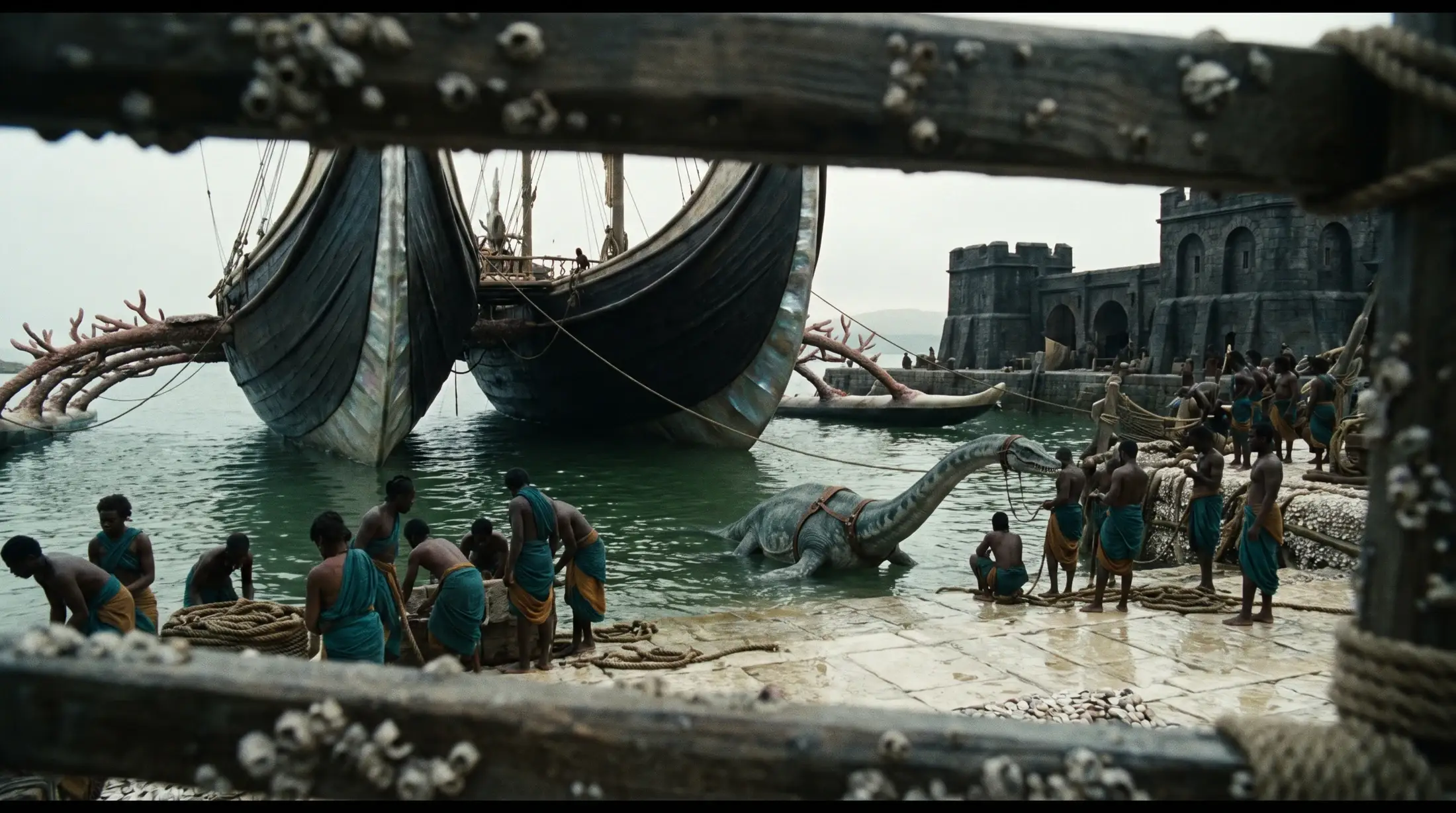
The Baliseur de Courants
The charting ship (“Current Marker”): it lays buoys, measures currents and surveys routes.
Measuring before passing
The Baliseur de Courants lays buoys, takes measurements and surveys routes. Small, at twenty to forty metres and without heavy armament, it sails with the help of small sea animals.
Its mission is the condition of the others: a fleet does not commit to a route it has not measured. A marked route matters as much as the number of armed ships gathered for a departure.
The Baliseur’s instruments
The Baliseur de Courants works with simple instruments, used with extreme patience. The sounding line, weighted and greased with tallow at its end, brings back both the depth and a little of the bottom: sand, mud, coral or shells. Current floats, small weighted and painted logs, are released in a chain and followed by eye to measure the direction and speed of a current. A sandglass and a knotted log-line give the ship’s speed; the astrolabe and cross-staff, the height of the sun and stars.
Its small sea animals do part of the work. Flèches-mer and Icthylames, ridden or led, carry sounding lines into waters too shallow for the ship, tow the survey boats and check a buoy in moments. The buoys themselves, painted in agreed colours and weighted with stone, are stacked by the dozen on deck, with their chains and anchors.
A season of surveys
A Baliseur spends a season on the same area. It begins with the busiest passes and channels, which the previous season’s storms may have changed, then turns to the shifting banks, river mouths and anchorages. Each evening the surveys are entered in a log, in figures, sketches and remarks; a draughtsman transfers them to a working chart. Shifted buoys are put back, lost buoys replaced, and new dangers marked.
At the end of the season, the log goes to the College of Pilots, which compares the surveys with those of earlier years and updates the coasting charts and notices to pilots. The cartographers of the Navigators’ quarter in Port Volon draw from them the charts sold to shipowners. Volonians say they owe their dominance to their charts before their ships; the Baliseur crews are convinced of it.
Marking and unmarking
In war, the Baliseur goes ahead of the fleet. It sounds the approaches to a coast before a landing, locates the beaches where the Porte-Barges can ground and the bottoms where a Brise-Port can anchor, and lays buoys that only Volonian pilots can read. It often works by night, without lights, under the protection of Frégates d’Écume, for the enemy knows what its presence means.
It also knows how to undo its work. When an enemy fleet threatens a Volonian pass, the Baliseurs raise or move the buoys, so that the adversary finds only misleading marks. The ruse is known to all: the pirates of the Récif-Faux have made it their speciality. That is why the College regularly changes the colours and layout of its buoys in sensitive passes.
A crew of patient people
The sixty to a hundred and forty people of a Baliseur form a small, specialized crew: sounders, draughtsmen, trainee pilots, divers who check the buoys’ moorings, riders for the small beasts, and a few sailors. Life aboard is monotonous: whole days spent repeating the same measurements, at the same tide, over the same bank. The youngest learn patience there; the oldest say it is the only school worth anything for a pilot.
The trade is poorly paid but respected. A Baliseur does not fight, brings back no prize and makes no fortune; yet no captain will venture on a route its buoys have not marked. In the taverns of the Pilots’ Isles people gladly drink to the sounders’ health, adding that their hands are always cold.
The language of the buoys
League buoys speak through their colours and shapes. A red buoy marks the side of a channel left to port when entering harbour, a green buoy the other; a black buoy signals a wreck or a reef, a white buoy the limit of a quarantine zone, a striped buoy a waiting anchorage. The figures painted on their sides refer to the College’s charts. Port children learn this code before they can read, and a foreigner lost in a pass is said “not to know his colours”.