

Families and social ties
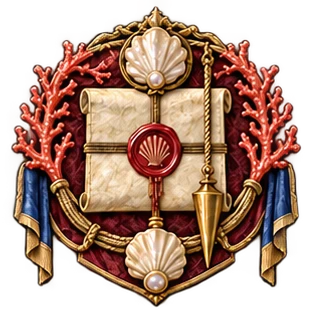
House Calystrëa
Insurance and law in contact with the risks of the maritime world.
Insurance and law
Calystrëa is the Volonian House associated with insurance and law. The House’s function belongs to a society governed by the Council of the Five Families, where houses, banks, insurers and ports participate in power. Maritime risk therefore has an identified legal and insurance sphere among Volonia’s major family functions.
Documents fermés sur une table face au port
Vue de détail.
The sea comes before the contract
Volonian finance developed around fleets, deep fishing and mass transport. These activities circulate fish, oils, biological materials and precious cargoes. Insurance belongs to this economy of material risks: the concerns of maritime law accompany hulls, crews, animals and goods exposed to the conditions of a voyage.
Several ways to commit money
Volonia distinguishes funding a political decision, a campaign share providing a material return and a bet on an outcome. The public framework requires political contributions to be declared, taxed and traceable. These objects must be distinguished to understand the environment of legal and insurance work: an expedition, support and a bet do not create the same relationship.
A house of the Pact
Calystrëa is among the oldest houses of the Pact of the Houses of Port-Volon, at about 2,600 years. Its legitimacy comes from insuring routes and from the continuity of contracts. It holds route insurance, commercial security and contracts between civilisations, from Port Volon to Port de Sable.
This power requires no large continuous territory: by insuring a route or refusing to, the house can make an expedition possible or prevent it. Cassian Calystrëa, master of Port de Sable, is its most visible figure.
The sword under contract
Calystrëa does not merely write contracts: it can also enforce them. The house maintains an armed company, hired out to convoys and to houses that want to pass without losses; House Marévant pays it to escort its fishing fleets against pirates. Toma Calystrëa, a private security lieutenant, rides Rouge, an imported guard iguanodon whose harness is hung with clause pennants, and which obeys the authorisation colours carried on the lance rather than the person.
At sea the house has its own animals: broad-jawed guard pliosaurs, marked in its colours, escort the live cargoes of the Sand Harbour route on the high seas, and scouting ichthyosaurs carry the fast mail along the Calystrëa routes. Its emblematic weapon, the Harpoon of Calystrëa, combines sea tooth, wood, treated tendon and a metal point. The Volonian armed contract finds its most complete form here: the same house insures a route, escorts it, and then examines the claims made against it.
Contracts between civilisations
Calystrëa’s oldest field is the contract that must hold between two worlds. A Volonian merchant, an Arkhan khan, an intendant of Urnok and a Korathi forge master recognise neither the same script nor the same kind of proof. The house’s jurists have developed customs to bridge that gap: the two-column deed, with Quay Notation on one side and the partner’s language or signs on the other; witnesses chosen from both camps; reading aloud before the seal.
At Sand Harbour these customs apply to the live trade and its claw clauses. With Urnok they must match imperial registers of great precision. With peoples who swear by spoken word, the house has the commitment repeated before witnesses and notes down who heard it. Calystrëa’s reputation rests on a simple promise: a contract signed under its roof will be understood the same way on both sides of the table.
An exceptional name
Calystrëa has an unusual name. The old maritime houses of Volonia favour V and R sounds, as in Vornëa or Velasar, and popular speech prefers M, B and L; Calystrëa’s initial is an exception, recognised as an old-house anomaly that has always been accepted. The house was once called Ansemer: the old name survives in the archives and on some deeds, but the house no longer uses it.
This age shows in its gestures. At the Two Tides, when the oaths of exchange and of route are pronounced at the Great Counting House, Calystrëa jurists are among those heard last, because they reread the formula. Their motto, “Loss always has a price”, is one of the most quoted in the counting houses, often the wrong way round: it does not say that everything is for sale, but that nothing is lost without someone answering for it.