

Places and landscapes
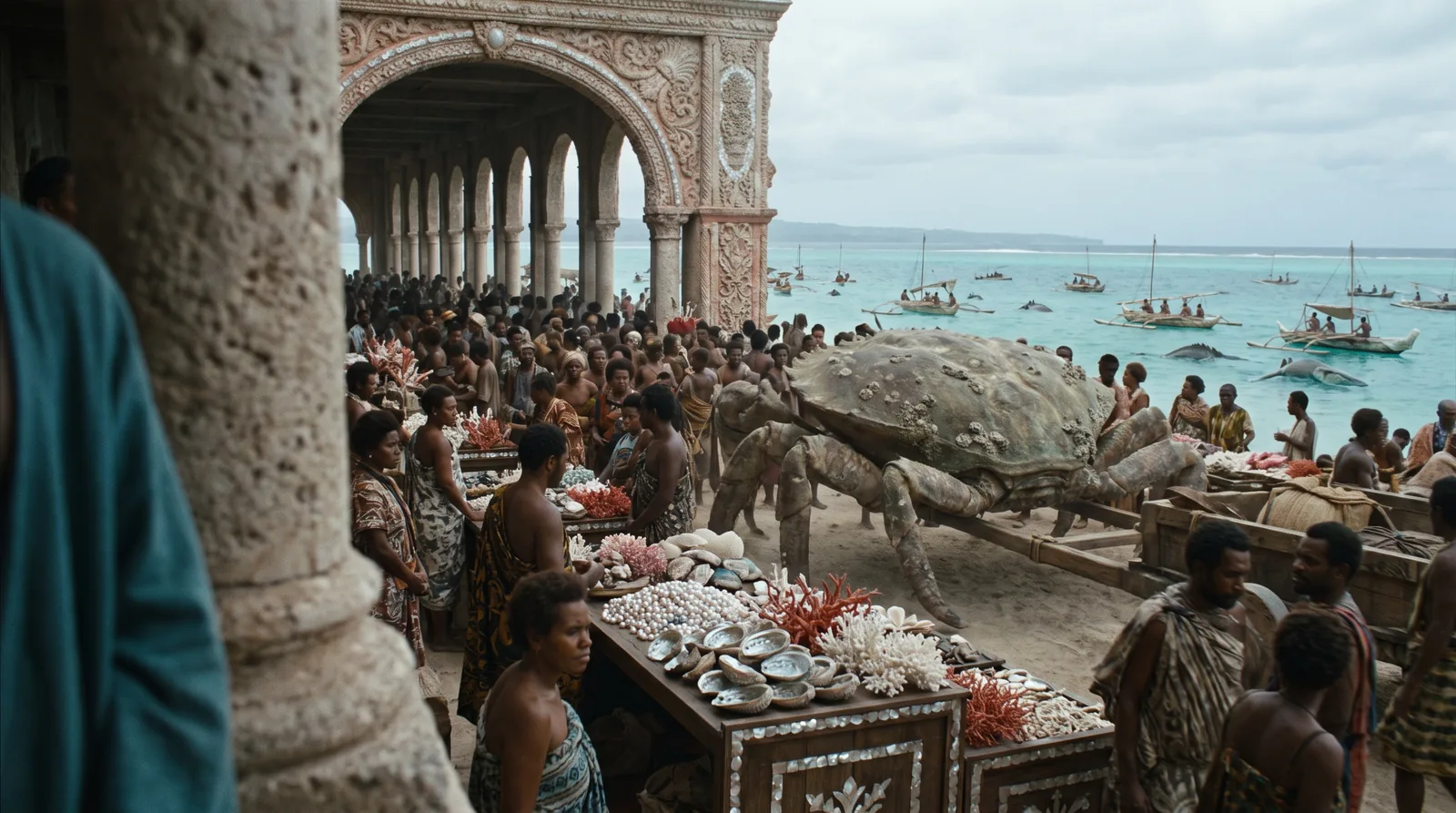
Girvane: materials brought from the waters
Diving, salvage and jewellery making put the city to work above and below the surface.
The treasure first had to be raised
Girvane is associated with pearls, marine reptile teeth, diving, jewellery making and salvage. Its mother-of-pearl markets connect work in the water with work in workshops. Precious material thus enters a chain: finding and bringing it back precede cutting, assembling and displaying it.
Nacre, coquilles et matières marines
Vue de détail.
Waters are separated within the city
Girvane shares the lagoon-terrace grammar: housing districts, workshops, theatres, markets and basins connected by ramps and service channels. Separating waters and waste is part of urban organisation. The diver’s trade returns to a city whose dry surfaces, passages and basins also require continuous maintenance.
Below the surface, the body matters
Underwater work uses trained breath-holding, breathing bladders, bells, towed chambers and removable ballast. Volonians learn currents and harnesses, but depth remains dangerous, brief and costly work. In a chain such as Girvane’s, a material’s value must also be understood through the effort required to bring it back.
Places and place names
Girvane’s pearl routes include several named places: Lit de Perles, Corail-Rouge, Récifane des Plongeurs, Bancvane des Huîtres, Capcorail, Quailune des Brumes and the Bancs Secs.
The divers and the bank right
In Girvane, nobody dives where they please. Each bank of nacre-shells is divided into plots, and each team of divers holds a bank right that reserves a plot for it for a season. These rights are granted by the houses and by the League, and the teams have grouped themselves into a divers’ cooperative that negotiates their price, keeps the list of teams and maintains the towers, the bells and the common boats.
A typical team works from a boat with a davit: a few divers, one person on the rope, a lookout and a light bell for catching one’s breath at the bottom. Descents are made on a held breath, weighted with a stone that is let go to come back up. The day is counted in descents, and each descent is noted in the team’s book. In the divers’ towers at the edge of the banks, the teams drop off their harvest, rest and dry their breathing bladders.
Sorting the pearls
A season’s harvest is very uneven. For every black pearl, the banks of Girvane yield about ten round pearls and some sixty baroque ones, not counting raw mother-of-pearl, shells and the pearl seed meant for the beds. Pearls are bought at the quay by trading houses, then sorted in a closed court where experts grade them by size, shape, colour and lustre.
Almost all of them then go on to Séloris, where Vornëa’s jewellers and the other luxury workshops set them in necklaces, ornaments and embroidery. The finest are kept for the great sales, notably during the Nights of Nacre. Mother-of-pearl also serves for seals, sebi tokens, furniture inlays and the navigators’ nacre charts, and the ink of the nacre-shells gives the dyers the blue of Volonia.
Teeth, shagreen and marine ivory
Girvane is also the great market for the hard materials of the sea. Blade sharks are skinned there, their sanded hide giving the shagreen that covers grips, scabbards and caskets; the teeth of marine reptiles are sorted there, sought after for harpoon points, tool inserts and quay trophies. The Traqueurs de Dents, hunting ships armed with harpoons, set out from Girvane to pursue the great wild reptiles, at the risk of meeting something bigger than themselves.
Craftsmen know the limits of these materials. A sea tooth is hard but brittle: it is made into points, short blades and set pieces, never into long blades of a single piece. The best teeth are drilled, polished and sold one by one; the splinters go into inlays, and the powder to the polishers.
Salvage and the routes of risk
The fogs west of Girvane hide shoals and reefs where many ships have been lost. Salvage is therefore one of the city’s trades: divers and crews of Récupérateurs d’Épaves bring up cargoes, bronze fittings, anchors and pieces of hull, in return for a share of their value fixed by custom. Whatever no one claims is sold at the quay.
Girvane’s insurers have made this danger a speciality. They cover the routes of risk towards Sand Port and the coasts of Arkhan, which others refuse or charge dearly for, and to that end they keep risk charts on which reefs, wrecks and pirate passages are marked. Bellcor keeps a counting house there. Sailors say Girvane lives twice off every shipwreck: once by insuring it, once by fishing it up.