
Places and landscapes
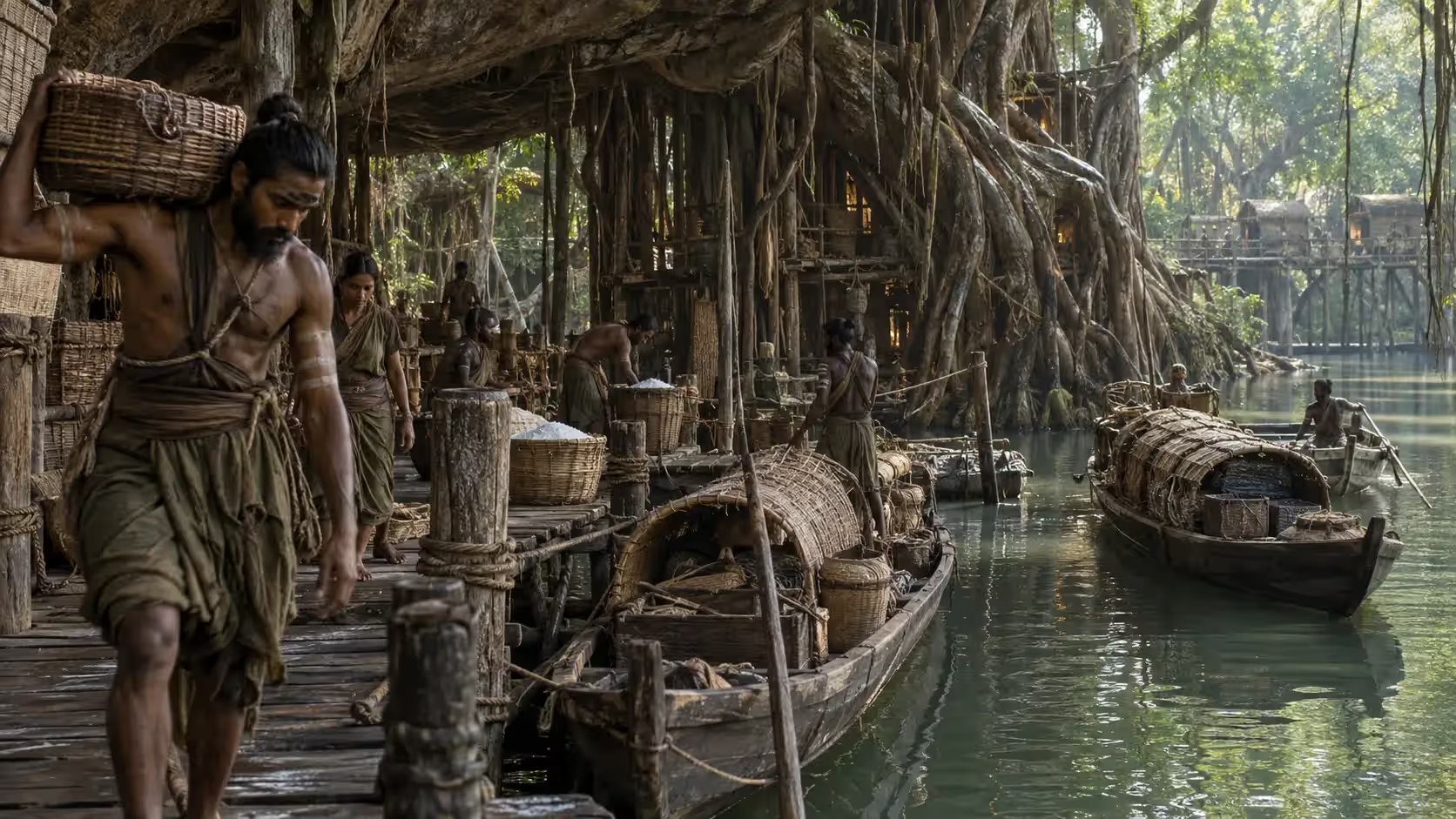
The Baie des Racines
The bay of hidden ports, master carriers, salt and venoms, where access depends on those who protect it.
Hidden ports and guarded access
The Baie des Racines shelters hidden ports, master carriers, flows of salt and venom, and contraband. Its accesses are not all visible, nor open to any traveller. Knowing that a port exists is not enough to enter it: relations with those who guard the access count as much as the ability to sail there.
The bay of the master carriers
The Ligue des Maîtres-Porteurs, which brings together transport, barges, hidden ports, guides and salt, has the bay as its territory. Its knowledge is part of what allows a cargo to arrive: on liquid, seasonal routes, direction is not enough; one must know when the passage stays usable and under whose protection.
The Pacte des Racines
The Pacte des Racines binds the master carriers, the hidden ports and the Black Milk Houses; its exact legal form remains uncertain. The route there is at once a place of trade, protection and power: a House protects the route it taxes and provides services the official power does not. This protection makes trade possible, but it gives local networks power over goods, travellers and those who live off their passage.
A bay made of roots
The Bay of Roots owes its name to its very shape. Where the giant mangroves meet the sea, their stilt roots form a labyrinth of passes, arches and corridors of brackish water stretching over leagues. At high tide everything seems open; at low tide half the passes dry out and the other half shrink to corridors a barge can barely pass. The hidden ports nestle beneath the largest arches, invisible from the open sea.
Some entrances are revealed only at low tide, others only at high tide, and a few only at the great seasonal tides. The bay also changes from year to year: a root collapses, a bank forms, a pass closes. Only the Master Carriers keep up-to-date knowledge of it, and they hand it down by word of mouth, from pilot to apprentice, without ever drawing it in full.
Entering a hidden port
A foreign ship never enters the bay alone. It announces itself offshore with an agreed signal — a flag, a smoke, a horn call — and waits for a pilot’s dugout to come out. The pilot, a member of the League of Master Carriers, asks for the private word of the day, which the shipowner must have obtained from a correspondent in the bay; without it the pilot leaves and the ship waits offshore, sometimes for days. The League’s largest quays are at Ngunya, where the House of Rith, one of its oldest lines, supplies most of the pilots.
Once admitted, the ship is led through the passes to an anchorage under the roots, where a quick inspection takes place: declaration of the water of origin, examination of the holds, counter-flasks for poisons. The Black Milk House that holds that arm of the bay then takes its share, in exchange for which it guarantees the ship, its cargo and its crew as long as they stay in its waters. A captain who tries to leave without a pilot can be sure of two things: he will strike bottom, and no one will come to help him.
The salt of the bay
Salt passes through the Bay of Roots more than it is born there. N’Goro makes little of it — a few marsh salt-works, such as the one at Ngunya, where brines are boiled in clay vats — and the greater part comes by sea from Volonia, landed in the hidden ports. The Master Carriers take it onto their barges and send it inland, where the freshwater marshes sorely lack it: without it neither fish nor several remedies can be preserved, and the markets of the middle world use it as small change.
Whoever holds the passage of salt holds part of all N’Goro’s table, and that is one of the reasons Muu-Shanga tolerates a Pact it does not control. The bay has other, less avowable trades. At Muyi-Nga, a hidden port facing the Quarantine of Vaesh and the Dents Noires, a prize court ransoms captives and resells cargoes seized at sea; in the hills of Gwanu, charcoal-burners and coopers supply charcoal for filters and watertight crates for laboratories.
A bay that defends itself
No fleet has ever taken the Bay of Roots, and it is not certain any has seriously tried. Large ships strike bottom there, the passes change with the tide, pilots vanish at the first sign of war, and the low waters shelter spinosaurids and great crocodilians that make no distinction between a fishing dugout and a landing boat. The hidden ports can be evacuated in a night, their quays dismantled, their stores flooded.
Volonia’s fleets, impressive on the high seas, poorly gauge this kind of obstacle, and their captains know it: they deal with the Pact rather than fight it. In times of crisis the bay serves above all as a refuge — for estuary barges, for the wounded, for goods one wishes to keep from an enemy or from the centre itself. The Master Carriers say that “a bay that cannot be drawn cannot be conquered”.