

Materials and resources
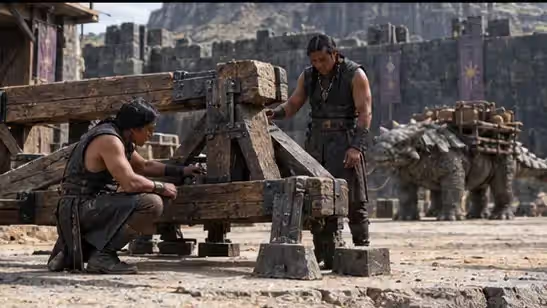
The Shared Recoil
A major innovation in recoil management, ancestor of the ballistics used against colossi and of the naval artillery Korath exports (Recul Partagé).
Mastering recoil
The Shared Recoil (Recul Partagé) is a major innovation in recoil management. It is the ancestor of ballistics against colossi and of exported naval artillery, and it explains why Korath became a world reference in artillery.
Mastering recoil contributes to the stability and repeatability of fire, but the result depends on the mount, its support and every part that transmits the load. Korath has no colossi of its own: its doctrine fights giants through ballistics, precision and synchronisation.
A technique the world buys
Korathised ballistae can be recognised by their agility, their recoil control, the rigidity of the bolt and the penetration rate. Some Arkhan batteries combine local tendon, Korathi recoil mechanisms and Volonian financing or transit.
In Volonia, several joints, iron parts, recoil mechanisms and safety pieces of the great hulls may be Korathi, and the Korathi recoil engineer adapts ballistae, tension and damping to the Great Hulls: an imported and very expensive technology. This dependence has its other side: in war, Korath can suspend licences, parts, engineers and certifications.
Sharing the recoil
A large ballista that fires takes a violent shock: all the energy that does not leave with the bolt comes back into the frame, the mount and the ground. Before the Shared Recoil, this shock dislocated joints, shifted the piece and forced the crew to re-lay it after every shot. The patent’s idea was not to absorb it in a single block but to spread it across several structures: the frame slides on a platform, stops of tendon and bronze cushion its travel, and the rock takes the rest through distributed supports.
The result comes down to two words gunners repeat: stability and repetition. A piece that barely moves can fire again without being re-aimed, and its lashings wear more slowly. The principle works at every scale, from the bridge crossbow to the buried batteries of the galleries, and that adaptability made it the ancestor of nearly all Korathi artillery.
On the great hulls
Outside the mountain, the Shared Recoil found its most expensive use: the decks of great ships. A deck ballista fires from a platform that rolls, pitches and gives, and without a mount able to spread the shock it would end up opening the joints of the hull. The distributed-recoil mounts Korath sells to Volonia’s shipyards pass part of the strain into the frame of the ship itself, through joints calculated to bend without breaking.
A great hull remains Volonian in its shape and Orlantian in its wood, but several of its joints, iron fittings and recoil mounts may be Korathi. The Korathi recoil engineers who install and adjust them are very highly paid, and Volonian shipyards say the shared naval recoil is, after the timber, the part that costs them most.
The korathised batteries
Korathi mechanisms do not only serve Korath’s allies. Some Arkhan batteries combine a local tendon, Korathi recoil mechanisms and Volonian money or transit, and the Empire’s gunners have learned to recognise the logic of the Shared Recoil among their enemies. Military memory links these korathised batteries to the great battle of the Three Waves, where the Arkhan scorpions refused a static duel against the imperial wall of artillery.
The paradox hardly troubles the Korathi. Their country sells licences and parts; it does not always choose who ends up using them, and it keeps the power to suspend its deliveries when war demands it. Urnok officers draw a bitter lesson from it: part of the artillery that hampered them came from the mountain that also sells them their hinges.
A licence the world pays for
The Shared Recoil mechanism is sold under licence throughout the known world, and its variants are among the country’s safest sources of income. The original principle returned to the Mountain long ago, but the successive improvements, lighter, sturdier, better suited to each use, remain protected, and those are what foreigners buy. Former foreign students can recognise the logic of the system; they do not possess its latest revisions.
Copies exist, and Korath is only half worried about them. A copy works, but it wears faster for want of the tolerances and alloys that make the difference, and its users often end up buying original parts. In war, the mountain can suspend licences, parts and certifications and leave entire batteries to fend for themselves.