
Materials and resources
The Returned Breath
Ventilation based on thermal differences and pressure, which lets the great dug-out cities breathe (Souffle Retourné).
Letting the mountain breathe
The Returned Breath (Souffle Retourné) is a ventilation system that exploits thermal differences and pressure. It lets the great dug-out cities breathe. With the Four Supports and the Warm Vein, it forms the trio of founding acts: structure, heat and air.
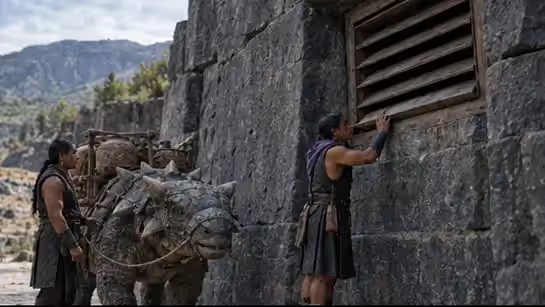
Like heat, air there is a maintained work, with its louvers, its galleries and its maintenance crews.
Redundant ventilation
In the warm layer of a great city, where the national forge or the arsenal stands, stone workbenches, crucibles, moulds and gauges sit beside slag drains and cooling. The Returned Breath provides redundant ventilation there.
Air also moves with the doors: airlocks, counterweights and reserves of air, water and heat can isolate a district, provided evacuation remains possible.
The principle of the draught
The Turned Breath rests on something every smith knows: hot air rises. The great vertical shafts of the cities, heated at their base by the Warm Vein and by the forges of the warm layer, draw the air of the galleries upwards and release it outside; fresh air comes in turn through low mouths opened in the façade and crosses the districts to replace the air that leaves. The city breathes like a drawing furnace.
The genius of the patent lies in how this movement is regulated. Bronze dampers placed at each landing open or close the branches of the network and make it possible to steer air towards a district or away from it. The name comes from the system’s most spectacular use: when winter chills the shafts or a fire threatens, the direction of the draught can be reversed in part of the city, letting in from above the air that is normally expelled.
Before the Breath
Before the Turned Breath, the great halls made possible by the Four Supports remained half uninhabitable. Air stagnated there, the smoke of lamps and hearths built up under the vaults, and the deep districts had to be abandoned as soon as their population grew. Part of the forgotten levels dates from that time: halls closed for lack of air far more than for lack of room.
The patent changed the scale of the city. With it, and with the Warm Vein that heated its shafts, large-scale underground urbanisation became possible, and the cities could sink several layers deeper. Korathi like to quote it as the example of an invention nobody sees: people admire a hall, they do not notice the air that lets them stay in it.
A common principle, licensed parts
The principle of the Turned Breath returned to the Mountain long ago: any workshop may build a draught shaft. But the system has been corrected so many times over the generations that most of the parts that make it work today fall under more recent patents. Counterweighted dampers, fine-adjustment shutters, grilles that stop flashbacks each carry their own plaque, revision and licence.
This layering makes the Breath one of the most disputed patents in the Great Chamber. Every district wants the latest improvements, every family of the Side of Breath defends its licences, and priority lawsuits over a damper detail fill the gazettes. Residents find it amusing, but they pay those licences in their rent, and the quarrel concerns them more than it seems.
The Breath at war
Ventilation is also a weapon. An enemy who has taken a city’s façade finds himself in halls whose air the defenders control from inside. By closing some dampers and opening others, Breath crews can cut off the fresh air of a lost district, push forge smoke into it, or let the steam and irritant gases of the geothermal networks rise there.
These manoeuvres are dangerous for those who order them. A badly closed damper can send smoke back towards a refuge hall, a gas can follow a forgotten conduit, and several accident stones recall defenders killed by their own weapon. That is why, in wartime, the order to turn the breath belongs to the command alone, and is only given after checking that the neighbouring districts can still be evacuated.
The Breath beyond the mountain
Korathi draught ventilation has crossed the passes with contract engineers. The Empire’s deep mines, the galleries of some quarries and the holds of Volonia’s great hulls use simplified versions of the Turned Breath, installed and adjusted by specialists from the mountain. These installations carry Korathi plaques and fall under licences that Korath can suspend in wartime.
Former foreign students can recognise the logic of the system and sometimes draw copies of it. But ventilation needs constant adjustment, maintained dampers and crews who can read the air, and copies that are poorly looked after often end up suffocating the people they were meant to let breathe. Korathi draw a conclusion from this they like to repeat: a patent can be sold, a Breath crew cannot.