

Institutions
Transmission of technical knowledge in Korath
In Korath, technical knowledge becomes transmissible when it can be shown, reproduced, corrected and signed. This circulation links school, workshop and exchanges with partners who use a part.
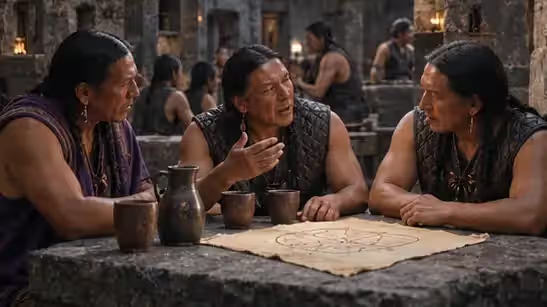
A method must work in front of other people
A process becomes shareable when it is observed, reproduced and subjected to objection. This principle allows a workshop to transmit useful gestures and limits to partners without pretending a recipe can replace experience.
Correction retains an origin
A correction can modify a part’s use without erasing the people who designed, tested or identified its limit. Signature makes an object’s evolution legible for those who must maintain or adapt it. It is a condition of trust in a long technical chain.
Transmission does not mean surrendering all responsibility
Knowledge shared between workshops or territories must remain tied to its material, load and maintenance context. Transmission passes through observation, trial and the experience of the people who work with these processes.
From the workbench to the school
Transmission begins in the workshop. The youth schools each workshop maintains take children early and first teach them to look: describe a part, measure it, say where it wears. Then come copying a plan, reproducing a simple part, and finally repairing a broken one. Childhood patents and the Trial of the Crack mark out this path: no one passes for learned until they have shown they can restore what someone else built.
Plans travel on humble materials. People draw in chalk on slate to discuss, engrave in stone or bronze what must last, and copy onto tanned hide the files they take away. A journeyman who changes workshops does not leave empty-handed: what he knows belongs to him, but his former workshop’s plans stay behind, and poaching suits often turn on that border between the knowledge of a hand and the files of a house.
The press as an open workshop
No nation reads as much as Korath. Reading standards, signals, procedures and plans is a matter of urban survival there, and the press has taken over from the workshop in spreading methods. The scientific press publishes protocols, demonstrations, limits and counterproofs for a readership far beyond the universities; each discipline has several journals, and even general sheets reproduce diagrams.
This publicity has a precise function: a published method can be reproduced and attacked by others, which is the very condition of Korathian trust. A process passed on by word of mouth remains a recipe; published with its limits, it becomes knowledge. Workshop critics, who comment on patents, transfers and counterproofs, act as go-betweens: they translate a technical report into public debate, and it is often through them that a discovery reaches the taverns.
Students from abroad
Before the war, foreign families and states spend fortunes to have their engineers, architects, officers and builders trained in Korath. Studies are often paid for in kind, grain, timber, resins, oils, medicines, fish, animals or ores, because every student consumes a share of what the mountain produces poorly. A foreign rector supervises these pupils and decides what they may access.
Foreigners learn mathematics, open patents and civil standards. They never freely enter the Forges, the registers of black patents or the central traps of the passes. Yet they leave with something precious: the ability to recognise the logic of a Korathian system. That is also why insurers, armies and foreign houses often require a Korath graduate or a Korath validation before installing a large intermediate mechanism.
What never leaves the mountain
Not all Korathian knowledge circulates. The Seal of Requisition lets the regime impose secrecy on a patent, and black patents show only their number, author, date and status. Engineers sent abroad, like the recoil engineer who fits a ballista to a great Volonian hull, work under contract: they install, adjust and maintain, but their complete files stay in the mountain.
This reserve is a weapon. In peacetime, Korath sells its parts, its licences and its graduates; in war, it can suspend licences, withdraw its engineers, refuse spare parts and cancel certifications. The countries that use its mechanisms then discover that they bought a dependence as much as an object. For Korath, passing on knowledge always means opening a relationship it keeps the power to cut.
With the League of the Stone Gates
The League of the Stone Gates, Korath’s ally, maintains a particular exchange of knowledge with the mountain. Its society lives by water, sheltered passages and hydraulic skill: piloting through stone, maintaining a sluice, reading a pressure. Korath brings it mechanisms and materials, the League its mastery of water levels. The two powers share the same respect for a well-kept work and for the person who knows how to regulate it, without the League giving up its independence.