
Culture
Growing up in a cohort
Educators and enduring bonds surround children before their First Weighing.
A Bronze childhood for everyone
All Ishtir children are Bronze until adulthood. The First Weighing at eighteen can maintain that rank or open a passage to Silver or Gold. This entry into adult life gives learning a shared milestone. A child’s rank does not come from a dynasty, and public identity carries no family surname.
Several adults, a shared memory
Children live in stable cohorts with several educators. Bonds between children and adults are real without becoming parental ownership or a means of passing on office. A cohort forms a social family: years of learning and memories are shared with people whom adult life may later place in different responsibilities.
Knowledge is shown through action
Exams, practical tests, service and the ability to pass on knowledge form the certification system. Learning therefore means more than recitation: a citizen must perform a task and demonstrate mastery. Certification establishes eligibility for a specific responsibility; it does not by itself guarantee promotion at a Weighing.
Dreamed-of medals
Children make copies of decorations they hope to earn. These objects extend dreams of trade, service or command into play. In adulthood, standardised signs of rank, order and certification make a person’s path visible. Prestige therefore attaches to a biography of achievements that people can learn to recognise.
The Houses of the First Morning
Births fall under the Houses of the First Morning. Cohorts are the true families there; couples who choose each other have no rights over the children.
From the Houses of the First Morning to the courtyard
A child of Ishtir is born in a House of the First Morning, in the hands of the Mains Blanches midwives. The first years are spent there with the season’s other infants, surrounded by carers who take turns day and night. Children born in the same year in the same quarter gradually form a cohort: twenty to forty depending on the place, who will not be parted again before the First Weighing.
At around three, the cohort leaves the House of the First Morning for a cohort house, where it receives a name. The guardians choose it and pronounce it at the first noon after the arrival; it stays carved above a door, on the chests, and later on a niche in the ossuary. Children who grow up together recognise each other by this name all their lives, and some still carry it beside their own long after eighteen.
A day in a cohort
A cohort house looks like a small theatre: low stone tiers surround a central floor, and their thickness holds the lodgings, kitchens and study rooms. Bunks fold into the walls, and the chests carry assignment notches that are scraped and recut at every change. Several radial passages allow the children to be evacuated without crossing the lane kept for the animals.
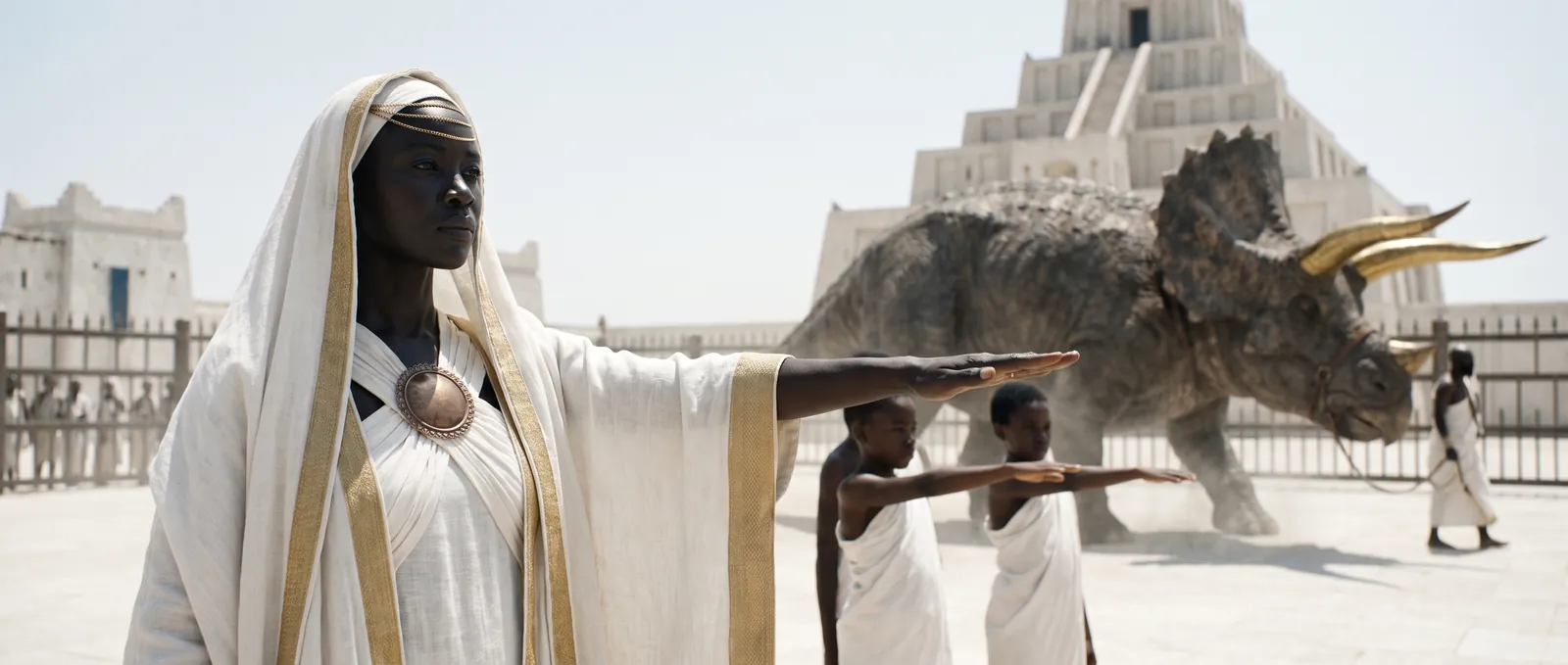
The day begins with care of the courtyard animals and the young ceratopsians’ dust bath. Then come arithmetic, spiral reading, care, handwork. At noon, low tables slide out of the walls and receive their function marks. On a workshop wall, a board of clay pegs shows the day’s rights: two hours of the fine punch, half a day of waxed thread, three passes of the trough along the outer lane. At night a guardian sleeps fully dressed in the night room, an alarm cord at her wrist, linked by reed tubes to the rooms of children who breathe badly when the air turns cold.
The cohort braid
On arriving at the cohort house, each child receives a fibre braid in colours chosen by the cohort, tied at the wrist as a bracelet. It is remade as the wrist grows, with the same strands, and many adults still wear it, worn to the thread, beside their rank marks. It says nothing about rank or trade: it says only where one comes from.
Children also make their own decorations, terracotta discs hung on a rush string, which they slap with the flat of the hand to make them ring like metal. They “certify” wishes: the Horns, the roads, the wings. The guardians let them be, and only remind them that they certify nothing before eighteen.
Eight weeks of watched freedom
During their eight weeks of Respiration, children change regime. Ordinary teaching stops; moral control loosens; they shout, get dirty, go to bed late, invent stupid games and bathe ten times a day. Cohorts often leave together for the Îles, the Côtes or the Plaines, supervised by their guardians and by volunteers from the quarters.
Safety, on the other hand, never disappears. Guardians count the children at every departure, every pool, every meal, and the exhausted educators of the Gardens are famous for a cry every Ishtiri has heard at least once: “DON’T JUMP IN THE CANAL!”, usually followed by a loud splash. Children become unruly; they are never abandoned.