
Creatures
Qer-Ma, Orûn’s Triceratops
The heavy Triceratops of Orûn, a ceratopsian general of Ishtir: a sacred line pair that waits for the ground before the priest.
The patience of weight
Qer-Ma is a heavy Triceratops with horn scars, bearing the same name as its rider’s cohort: Orûn, a ceratopsian general of Ishtir. They form a sacred line pair. Qer-Ma waits for the ground before the priest; from it, Orûn learns the patience of weight.
A heavy-line Triceratops
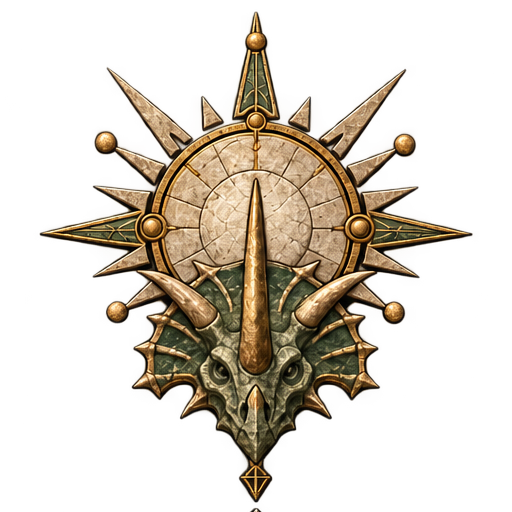
Qer-Ma belongs to the charge lines of the Silver Horns, the heavy Triceratops placed at the centre of the solar wedge, where the shock is hardest. He is an enormous animal, more massive than the procession Triceratops, thick-necked and short-legged, whose three matt-gold-sheathed horns carry the solar plate on days of battle. Like every animal of his line he was born on the Plaines des Brontes, trained for years before his first charge, and will never leave Ishtir.
His temperament is that of the great line animals: slow to stir, slow to stop, hard to turn once launched. Officers of the Horns reckon with him as one reckons with a mass, and the carers treat him with the respect owed to an animal that could overturn a team with a toss of the head.
The horn scars
The scars on Qer-Ma’s frill and brow tell of a long life of service. Some come from shock drills, others from nesting seasons, when the males of the Brontes clash at the edge of the pens, others again from battles. The carers have treated every one and noted it in the animal’s register; none has been covered with gold or paint.
It is a custom of the Silver Horns: the wounds of a line animal are not hidden, nor are they turned into ornament. The soldiers nonetheless know them one by one, and young riders learn to read a Triceratops’s history on its frill as they will later read a biography on a sleeve.
A cohort’s name
Qer-Ma has the same name as the cohort in which Orûn grew up. The custom is rare, but it exists: on the Plaines des Brontes, children’s cohorts visiting the pens in the year they are formed sometimes sponsor one of the season’s hatchings, and the animal then receives the cohort’s name. Such animals are called “of the same year”. They have no tie to the children who named them: the children go to their postings, the animals to their stables, and most never meet again.
Qer-Ma and Orûn are the exception the Horns like to tell of, since the allotment of mounts eventually brought together the ceratopsian general and the animal bearing the name of his childhood courtyard. Some see it as a chance of the register, others as a wink from the stables; the soldiers, for their part, have taken to calling them together “the Qer-Ma”, as if they belonged to the same cohort.
The patience of weight
Qer-Ma and Orûn form a sacred line pair: in the solar wedge they hold the place where the charge begins and where it is decided. Doctrine has the signal to charge come from the priest and the officer; Qer-Ma waits for the ground. Before launching himself he leans on his forelegs, tests the earth and goes only when he feels it can carry his momentum. Soldiers say the priest listens to the sky and Qer-Ma listens to the earth.
From him Orûn has learned the patience of weight. The ceratopsian general knows that a charge launched too soon on soft ground breaks the animals’ legs before it breaks the enemy line, and that a mass stopped in time is better than a mass lost. His officers have picked up his habit of looking at Qer-Ma’s feet before listening to the orders.
Growing old in the line
A heavy line animal serves a long time, but not always in the charge. When a Triceratops of the Horns becomes too slow for the solar wedge, it is not culled: it moves to the riding schools, where young riders learn on its back what a moving mass is, then to the processions of the Brontes, where less speed and more dignity are asked of it. Old line animals end their lives on the rotation pastures of the Plaines, among the herds, and many soldiers come to see them there during their Respiration.
A charge animal of the Horns does not leave Ishtir, even when old: the ceratopsians hired out abroad are culled working animals, never line animals. When it dies, its register is closed, its solar plate goes back to the workshops to serve another animal, and its body goes to the tanneries of Qer-Domar. Yet the Horns keep something of each: the animal’s name is read once before the soldiers who served with it, as one reads the name of a comrade.
Part of this article covers events of season 1. Turn spoilers on in the menu to read it.