
Materials and resources
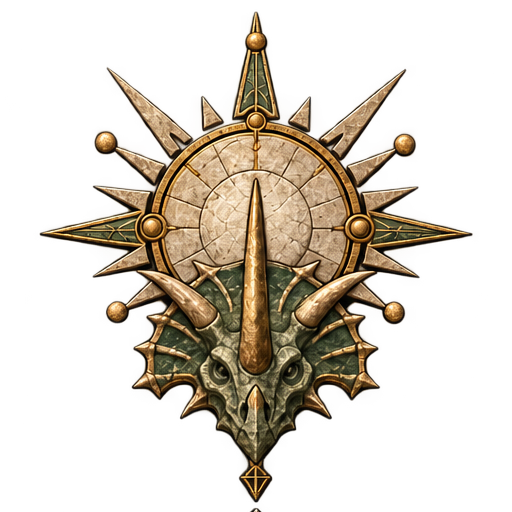
The ceratopsian solar plate
A frontal caparison giving ritual and material form to a charge.
Protecting and directing
The solar plate combines horn elements, leather and ornamental surfaces. It is designed for a ceratopsian and the space required by its horns, so its design cannot be transposed as enlarged human armour. It makes a relationship among care, harnessing and manoeuvre visible.
Equipment charged with meaning
The object links the image of the sun to a charge that must remain directed. Its reach is ritual as much as military: prestige comes from the whole formed by animal, people who equip it and the place where it appears.
Sacred charge and gate defence
The solar plate is a heavy frontal caparison made of horn and a reinforced brow, matt gold, hide and a solar mirror. It serves for the sacred charge and the defence of a gate, worn by Triceratops driven forward in a solar wedge. Its motto: “War must have a straight direction.”
Making a plate
A solar plate is the work of several workshops that do not know one another. The partitioned workshops of the Horns, at Qer-Domar and elsewhere, each make a single piece of the charge harness without knowing where the others are, so that no captured or betrayed workshop can give away the secret of a complete set. The horn and the reinforced plates come from the tanneries of Qer-Domar, which receive dead ceratopsians and draw from them signed leather, frills, sheaths and sinews without wasting anything.
The gold is matt gold, cold-beaten into leaf and laid on the horn, never polished to a shine. The mirror is a disc of polished bronze, set in the centre of the plate and covered with a leather lid outside combat. The plate is fitted to the frill and brow of one particular animal: harness-makers take its measurements with the cord, as one surveys a building, and a plate made for one animal serves another only after a fresh fitting.
Fitting the plate
A ceratopsian does not accept a heavy frontal caparison straight away. Young animals of the Silver Horns grow used to it over weeks with a wooden practice plate of the same shape and increasing weight, put on in the morning and taken off before the heat. The real plate comes only afterwards, and it is worn only for the charge, processions and drill: never at pasture, never on ordinary marches.
Fitting it takes a team of harness-makers. The plate is presented to the animal head-on, so that it sees it coming, fastened to the frill straps, every fastening checked twice, then the animal is walked a few steps to make sure it carries straight. An animal that shakes its head or turns sideways is unharnessed at once: nobody charges with a badly fitted plate. Harness-makers say a charge is won the night before, by lamplight, at the workbench, and in the morning, by hand, on the animal’s brow.
The mirror
The mirror is not an ornament. At the moment of the charge the leaders remove the lids, and the plates throw the sun into the eyes of the opposing line: across a front of several dozen animals, the glare blinds archers, unsettles mounts and tells the whole Ishtiri army that the horns are away. Officers of the Horns calculate the hour and angle of a charge as one calculates a shot, so that the sun is behind the animals and in front of the enemy.
The mirror has its limits, and Ishtir knows them. It is worthless under cloud, worthless at night, worthless when the sun is at the enemy’s back. That is one reason why Ishtir’s armies prefer to give battle in broad daylight, and why their enemies learn to attack them at dawn, facing the sunrise, or in the rain.
Who owns a plate
A solar plate belongs neither to the rider nor to the animal. It is entered in the register of the Silver Horns under a number, with the list of the animals that have worn it and the campaigns it has seen. After each campaign it goes back to the workshops to be repaired, its gold redone, its mirror repolished. A plate can thus serve several generations of animals, and the oldest, covered in repairs, are prized above new ones.
When a plate is retired, it is taken apart. The gold is recovered, weighed and returned, exactly like the rank thread at the Unstitching; the horn and leather go back to the workshops; the mirror is melted down. Only a few famous plates escape this rule and remain on display in the temples of the Brontes, where the cohorts come to see them. Soldiers of the Horns greet them in passing with a nod, as one greets an elder.