

Places and landscapes
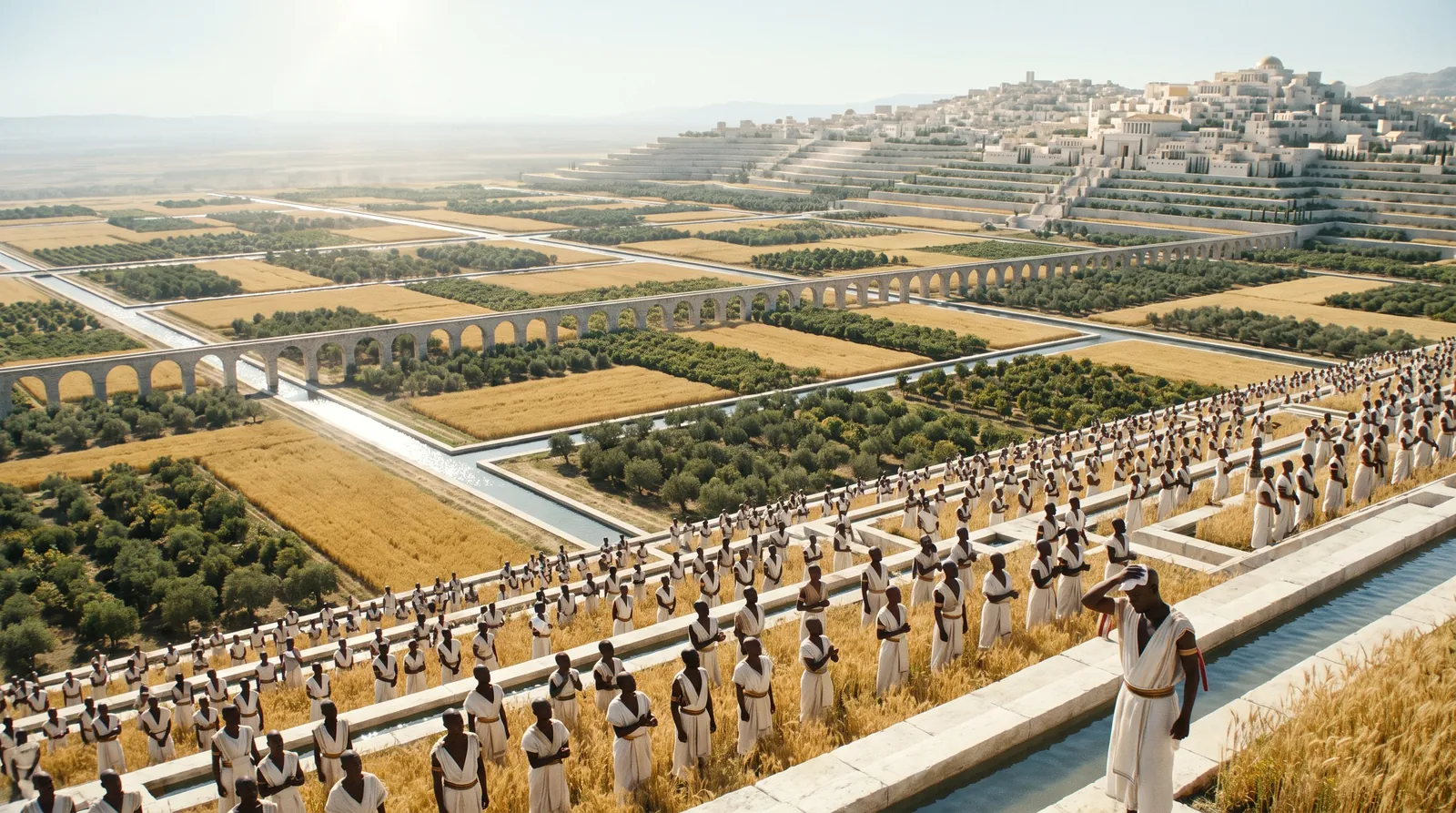
The Jardin du Levant
The region of Qer-Aton, Ishtir’s capital: an irrigated territory of terraces, crops and promenades that feeds the city all year and becomes, during the Great Respiration, the heart of the great flower carnival.
The region of the capital
The Jardin du Levant is the first of Ishtir’s nine regions, the region of the capital, Qer-Aton: a sacred city where, as in the cities of Gold, the country’s public summit sits — the elected supreme leader and the Ten Golden Wings. The Garden feeds it all year round. On the national map it surrounds the country’s solar heart.
What “Garden” means
The name is not ornamental. For Ishtir, a Garden is a territory that people have made useful, fertile, beautiful, habitable, pleasant to cross and worth spending one’s Respiration in, all at once. The Jardin du Levant carries that idea at the scale of a region: a truly civilised land must feed, serve and be pleasant to live in.
Beauty there is a public good. Terraces, canals, orchards, public pools, shade, dancing squares and promenades are civic facilities, which the Ordre des Jardins maintains as a religious office. Ishtiris do not seek wild nature: they sculpt the landscape with canals, terraces and aqueducts to obtain an ordered and beautiful nature.
Terraces, canals and orchards
The Jardin du Levant is an irrigated territory of terraces, crops and promenades. Its canals serve to produce, to distribute water, to tend the orchards and to make movement bearable in the heat. With the neighbouring Terrasses d’Auréon, it links crops, canals, orchards and housing. Drinking water, troughs, washing and waste follow separate circuits there, maintained by the Canaux Clairs.
It is a civic and ceremonial centre as much as a major garden, with large ceremonial spaces.
The Gardens of Dawn
Around Qer-Aton, the Jardin du Levant is first of all a land of wet meadows, open woods and grassland, around a lake. The Gardens of Dawn occupy the best land: solar grain, rice, date palms, lotus basins, orchards, simples. They are so called because work there is done mostly from dawn to mid-morning, before the heat, and because their rows face the rising sun.
The Garden of the Thousand Rays, at the heart of the capital, carries these crops into the city: its walks of orchards and basins feed part of the refectories, and its lawns serve as an evening promenade.
Héliodrum and the oasis of the three lakes
The region holds a second great town, Héliodrum, the temple-city of the Thousand Rays. It rises in drier country, between a steppe, a forest and three lakes that form an oasis. Part of the summit is trained there, the exact shadow is measured there, and its workshops polish the bronze mirrors used by the temples and the signal relays. It is the goal of the pilgrimage every Ishtiri hopes to make once in a lifetime.
Around the oasis, the ferns and cycads of the steppe feed the animals, and the forests yield sacred wood and charcoal for the workshops. Pilgrims arriving from every region find caravanserais there kept by the Golden Ray.
The parks of the Garden
The Jardin du Levant holds several of the great parks of the Breathing, grounds of several square kilometres woven into the crops. There are the Great Falls, where aqueduct water rushes down fast channels and slides of polished stone into pools full of shrieking children; solar wheels, great wheels with gondolas driven by counterweights and water, from which the whole Garden can be seen; plant labyrinths of several hectares, in which adults get lost for six hours; and performance houses for concerts, theatre and satire.
These parks are free, since the country has no internal money. Entry is by reservation, by rotation and according to one’s rights of use, and by draw when too many people ask for the same day.
The Order of the Gardens at work
The flowers of the Great Breathing do not grow by themselves. Months ahead, the gardeners of the Order of the Gardens sow whole flower fields, timed to bloom in the week of the festival; others weave the plant crowns, prepare the dyes for the ribbons and prune the trees of the promenades. For the rest of the year the order keeps up canals, shade, public basins and dancing squares as one keeps up a temple.
The Order’s work is also measured by what does not show: a canal that does not overflow, a walk that stays shaded at noon, a bench repaired before anyone complains. The ritual gardeners, who gather the sheaves and flowers of the offerings at the prescribed hour, are only the most visible part of an office that mobilises thousands of people.