

Places and landscapes
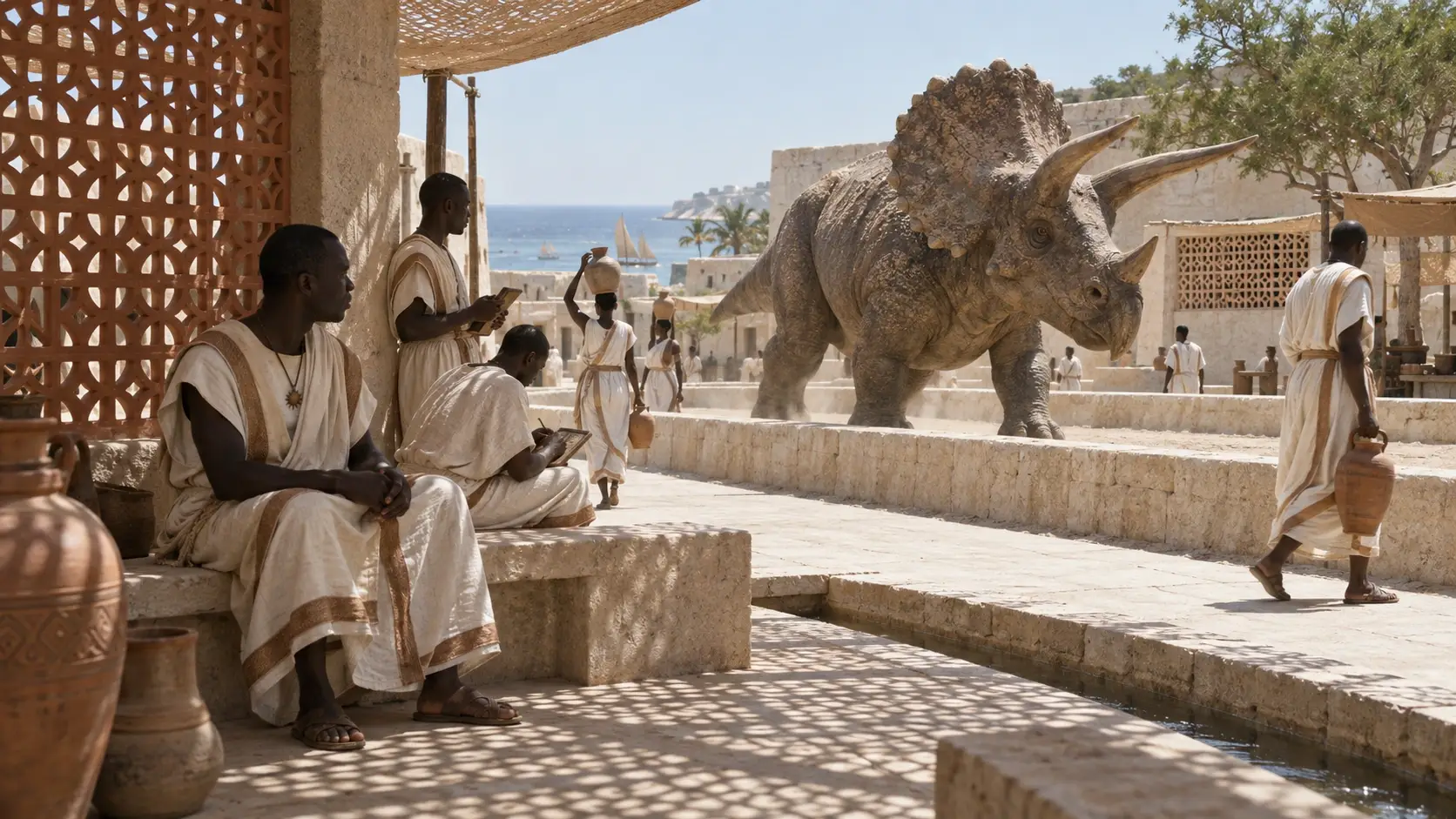
Porticoes, gates and halls of Ishtir
In Ishtir, porticoes link temples, Weighing centres, districts and enclosures; the gates of great cities open wide to the herds; halls distribute without money. Circulation there makes rights and functions visible.
Porticoes that link rights
Procession porticoes link temples, Weighing centres, districts, enclosures and public buildings; they are found from the capital to the small town. Benches, water, troughs, banner stands, instruments, allocation tablets and rest areas accompany them. Their lanes are separated by size and function, with wide crossings and quiet bypasses.
Circulation shows right and function: processions, service lanes, examination courts, animal access and bypasses can be told apart at a glance. Marks of rank do not prevent movement; they make responsibilities and temporary permissions visible.
Gates that do not trap
Ishtir thinks of itself as a garden-fortress, protected by ramparts, bottlenecks and bridges. The outer wall, the gate of a great city or the square that absorbs a march, as in the Brontes plains, use demountable barriers, rounded bollards, passage gauges, troughs and racks. Wide turning radii, side exits and buffer pens are essential there: an enclosure closed like a corolla would be a trap for the herds.
Halls for distribution
Ishtir has no internal currency: inside the country, the fair becomes distribution, an exchange of services and the allocation of rights, while the money market stays at the frontier. Distribution halls also serve as refectories, communal kitchens and granaries. Low silos, jars, baskets, hearths, stone tables, allocation registers and washing areas equip them. Cold is obtained by pit, evaporation, fermentation, smoking and salt; light enters through clerestories, mica or membrane.
Building a portico
An Ishtiri portico is a covered gallery, open on one side or both, carried by columns of golden stone cut in the quarries of the Terrasses d’Auréon. The columns are spaced widely enough for a harnessed ceratops to pass between them without touching them with its horns, and the architraves, of stone or hardwood, carry a roof of tiles or plastered reeds. The floor is paved and slightly cambered so that rainwater runs off into the side gutters.
At crossings, a bronze disc set into the paving marks the point where two ways meet; engraved on it are the names of the places they lead to. The porticoes of the great towns are limewashed every year before the Zenith festival, and the unbroken shade they offer lets one cross a town at noon without ever leaving shelter.
The portico on a procession day
On feast days the porticoes change their use without changing their form. The central way, the widest, is given over to the consecrated animals and the processions; the side ways are reserved for the faithful, who stand there in lines; the quiet bypasses are then used by healers, water carriers and those who must go on working. The banner holders receive the orders’ vertical standards, and the benches are taken away to make room.
During the Ascent of the Rays or the Great Breathing, thousands of people thus pass under the same columns within a few hours, without crushing, because everyone knows which way is theirs. The next day the benches come back and the central way returns to the carts.
A day in a hall
The distribution hall wakes before the sun. The refectory ovens bring out the first loaves, the cooks prepare the midday meal, and the clerks open the allocation registers, in which every inhabitant of the quarter has a line. In the morning people come to collect grain, oil, fruit, linen or an allotted tool; at noon the refectory serves the common meal; in the afternoon the hall receives deliveries from the countryside and the workshops; in the evening the teams wash the stone tables and the floors.
Cohort children do their kitchen service there in turn, and many adults keep a precise memory of their first week of washing up. A hall clerk knows every face in the quarter, and it is said that he knows before anyone else who is ill, who is expecting a child and who is about to change rank.
The great town gates
The gates of the great towns combine ceremony and safety. Their main arch, high and wide, lets herds, convoys and processions through; two smaller gates, one on either side, serve pedestrians. Behind the arch, a round absorption square lets animals slow down, drink and turn before entering the streets; buffer pens there wait for herds that are too large.
The Gate Wardens hold these squares. Their post overlooks the arch, with a signal mirror and a water reserve, and a line of pikes always stands ready along the wall, waiting to be planted. A well-kept gate can be recognised by how little is heard there: no shouting, no crushing, only the tread of the animals and the voices of those who count.