
Creatures
Aru-Keryth
The field Pentaceratops of Ishara, commander in the Marche de Keryth, who thinks with the ground rather than the liturgy.
Seeking the oblique slopes
Aru-Keryth is a field Pentaceratops with a green and white frill: the local command mount of Ishara, commander in the Marche de Keryth. It seeks out oblique slopes. Ishara thinks with the ground rather than with the central liturgy.
A slope ceratopsian
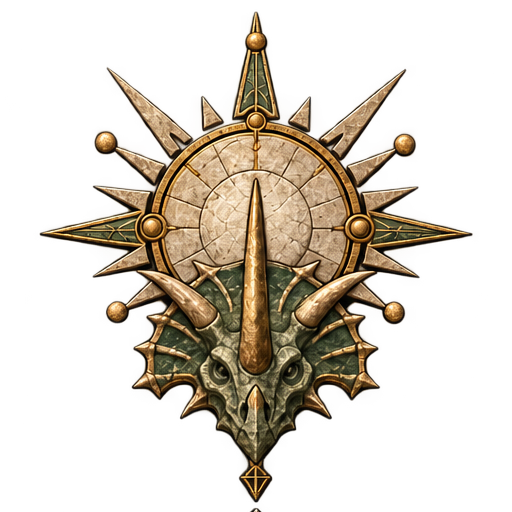
The field Pentaceratops is a line of the Marche de Keryth, bred for ground where the great Triceratops of the Brontes struggle: dunes, scree, rubble, the banks of dry ravines. It is lighter than a Sha-Qerim and carries five horns, two long ones above the eyes, a short one on the snout and two cheek spikes, beneath a very tall frill that makes it look bigger than it is. Its gait is cautious: before putting its weight on a slope it tests the ground with one foot, then the other, and commits only once sure of its footing.
People of the Marche value this apparent slowness. A column of Pentaceratops moves more slowly than a column of Triceratops on a straight road, but much faster across broken country, and it arrives whole. Animals of this line live in the forts of the Marche and rarely leave their region; it is said they know the dunes better than the maps do.
The green and white frill
Aru-Keryth’s frill does not owe its colours to birth. In the Marche de Keryth, command mounts are painted in the green of the oases and the white of the boundary stones, the two things the Marche exists to guard. The paint, made of ground green earth and lime, is renewed every season by the fort’s carers, and the animal submits to it with a patience it does not show for bathing.
These colours have a purpose. In the dust of a march or an engagement, a green and white frill can be seen from afar, and the soldiers know where to look to follow their commander; the arm and pennant signals start from there. The other regions of Ishtir rarely paint their animals, and the officers of the Brontes find these colours a little loud. The people of the Marche answer that a mount nobody can see in the sand is no command mount.
A mount that stays
Aru-Keryth is a local command mount: he belongs to the stables of the Marche, not to a person. Commanders come and go with the rhythm of Weighings and postings; the animal stays and knows the country, and it is often the animal that teaches the Marche to a newcomer. His register name says as much: the sacred prefix Aru-, followed by the name of the Marche, the way animals devoted to a charge rather than to a rider are named.
Ishara, commander of the Marche de Keryth, chose to keep Aru-Keryth rather than ask for a more prestigious mount. Her soldiers see in this a portrait of their commander, who thinks with the ground rather than the central liturgy. She is often seen dismounting to look at the ground from the animal’s height, then climbing back without a word when Aru-Keryth has already chosen his way.
An animal that seeks the oblique
Aru-Keryth seeks out oblique slopes, and this taste raises a delicate question in Ishtir. The faith of the Zenith holds what is oblique and lurking to be impure, and the capital’s doctrines prefer straight lines and frontal charges. The Marche de Keryth has learned something else: in dune country the straight line is rarely the shortest, and the slope taken at an angle is often the only one that can be held.
The priests of the Marche have found their answer. They say an animal that skirts a scree slope is not hiding, it is looking for its footing, and that the straight direction of a war is judged by its aim, not by each of its steps. The soldiers put it more simply: “Aru-Keryth doesn’t pray, he looks at the ground.”
Life at the fort
Aru-Keryth lives, like the Marche’s other command animals, in a fort built around a cistern. His day follows the heat. Outings are made at dawn and late in the afternoon; in the middle of the day, when the sand burns the feet, the animals stay under the courtyard awnings, and the whole fort keeps the silence of exact noon. Water is counted for animals as for people: a ceratopsian drinks a great deal, and every jar poured into the troughs is noted on the fort’s tablet.
Fodder comes mostly from the Plaines des Brontes, by convoy, and is supplemented by what the Marche can give, oasis palm fronds, ravine grasses, the leftovers of the date harvest. The carers add a sand bath every evening, which the Pentaceratops take with obvious pleasure, and check each animal’s feet after every outing, for a mount that goes lame in the Marche is a mount lost for the season.
Part of this article covers events of season 1. Turn spoilers on in the menu to read it.