

Culture
Ishtir : jardins, pâturages et discipline
Repas, fourrage et soin animal relient les jardins à une organisation religieuse et militaire.
Produire un lieu habitable
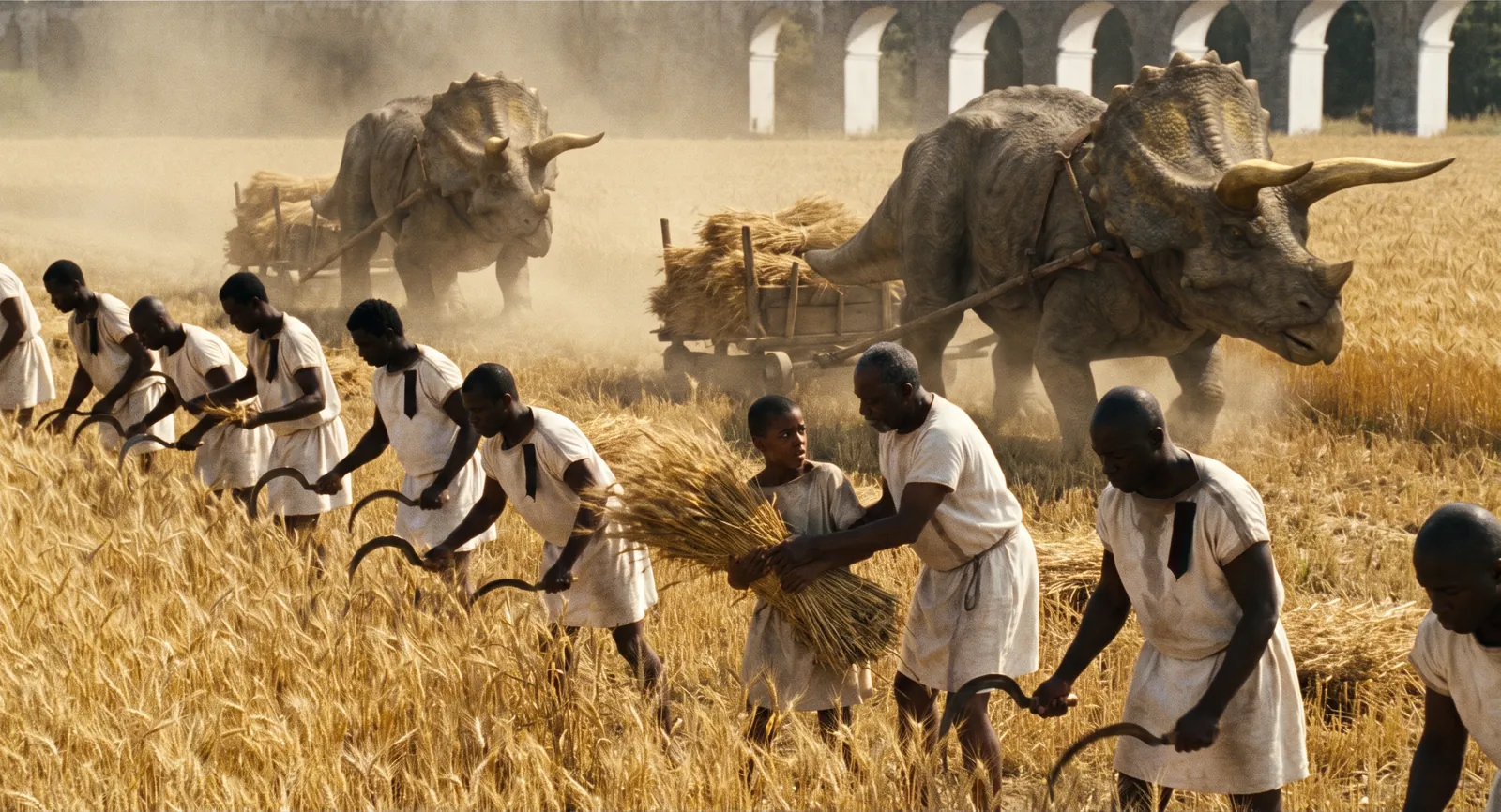
Céréales, fruits, produits rituels et viande codifiée font partie de l’alimentation. Jardins, terrasses, vergers et pâturages organisent un cadre de vie, des saisons de travail et des règles de soin, sans imposer un régime identique à tous.
Le pâturage rejoint la manœuvre
Le fourrage conditionne soin, monte et capacité de déplacement des herbivores. La nourriture est donc une responsabilité technique avant d’être un signe religieux ; elle ne garantit ni rang ni promotion.
Une règle alimentaire a des conséquences sociales
Repas, troupeau et service rituel peuvent être soumis à des règles d’usage qui concernent aussi celles et ceux qui les préparent.
What the nine regions provide
Ishtir’s table is fed by the whole country. The Terrasses d’Auréon and the Plaines des Brontes grow most of the solar grain, fine-grained cereals milled into porridge and flatbreads, along with beans and tubers. The Marais Lumineux give rice, lotus and its roots; the oases of the Marche de Keryth, above all those of Sothir, give dates; the Verger des Halcyons gives fruit, honey and wine. The Îles du Soleil Levant and the Côtes des Alizés send fish, fresh, dried or salted, and the salt of their pans. The quarters’ poultry yards supply table eggs, the food of every day, and bitter herbs grow in every garden.
The capital eats more than it produces, and the regions send each other their surpluses by road and barge. A flood year in the Marais or a drought in the Brontes is felt all the way to the refectories of Qer-Aton, where the clerks read it in their registers before people find it in their bowls.
Codified meat
Ishtir eats little meat, and never just any meat. Codified meat comes from herbivores raised in broad daylight on the Order’s farms: psittacosaurs fattened for the butcher, culled qerik that can no longer pull the plough. Nobody ever eats a carnivore, an animal found dead or an animal of the sacred lines. A line ceratopsian that dies goes to the tanneries of Qer-Domar for its hide, horn and sinews; its flesh returns to the compost pits of the Gardens.
Slaughtering is a certified trade. It is done in the morning, before noon, the animal turned towards the sunrise, with a single blow struck straight; an oblique cut would make the meat impure. The blood is collected and poured onto the Gardens’ compost. Meat does not appear on tables every day: it is served at festivals, for heavy labour, to armies on campaign and to convalescents, on the carers’ advice.
What never reaches the table
Ishtir’s food purity follows the same line as its faith. Nothing venomous, scavenging or nocturnal is eaten. Fish caught at night by lantern light, as the Volonians do, does not enter the refectories; the fishers of the Îles go out at dawn and come back before noon. Eggs of the sacred lines are not eaten on any pretext, and only table eggs, laid in surplus by small poultry-yard animals, serve as food. The rule applies only to humans: animals eat whatever feeds them.
A tiny fault is enough to set off a crisis. Should a jar of night-caught fish slip into a kitchen, the whole meal is thrown away; the cooks are heard, their certifications reviewed, and a quarter priest blesses the hearths again before the fires are relit. If the fault comes from a storehouse, the whole stock is declared misaligned and withdrawn, and the entire region talks of it for a season. Ishtiris do not laugh about it: an impure table is a table where the Sun no longer sits.
Eating at war
An Ishtiri army carries its own table. Field kitchens follow the columns with their solar grain, dates, salted table eggs, dried fish, salt and jars of water drawn from the drinking circuits. The soldier keeps the day’s ration in his pocket, a grain flatbread and a few dates, which he eats when the order to halt is given.
Ishtir’s armies do not eat plunder. Food taken from the enemy is neither tasted nor shared out: it is left to the captives, returned to the villages or burned. Priests see it as a matter of purity, officers as a matter of prudence, since an enemy granary may be poisoned, and either reason is enough. The other side of the rule is well known to foreign strategists: an army of Ishtir depends on its convoys more than any other, and cutting its roads starves it faster than one might think.