

Places and landscapes
Brontes: plains and functions
A territorial name associated with Ishtir’s productive work and circulation.
Living stock in production
The Brontes Plains are associated with farming, breeding, circulation and large living stocks. This combination gives a working landscape: crops and animals require routes, reserves and teams able to maintain them. The plain becomes productive through activities that depend on one another.
Opening the enclosure to large bodies
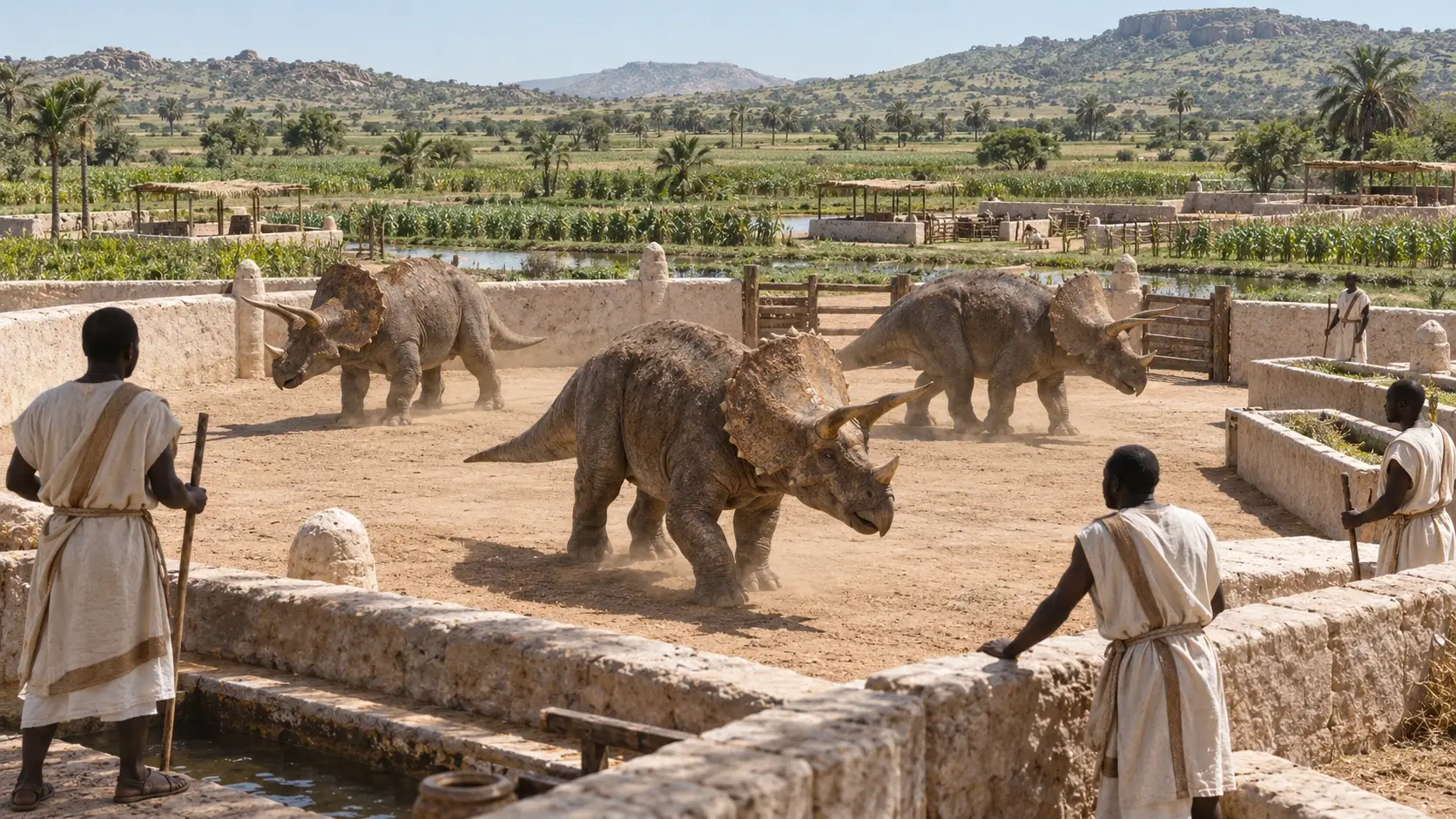
For a march such as Brontes, ceratopsian architecture provides gates and crowd or herd holding spaces with generous turning radii. Removable barriers, rounded markers, gauges and troughs accompany buffer enclosures. A transverse exit can release blocked movement; the enclosure gains its value from what it lets circulate safely.
A place name within an identity
Brontes can identify a place, march, cohort or assignment. The name connects a person with part of civic life rather than a hereditary house. In a society where certifications form a visible biography, a territorial affiliation indicates a context of work, training or responsibility.
Feeding towns and herds
The Plaines des Brontes are great plains of pasture, breeding, fodder crops and herd movement. They tie the feeding of towns directly to the care of ceratopsians. They do not only produce the animals seen in processions or in the land forces: the region organises pasture, fodder, water, shelters, equipment yards and herd watch. Every working animal there involves farmers, stock keepers, carers and traffic teams.
Gathering grounds
It is the region of ceratopsian gathering grounds and great garrisons, and the country’s great farming complex: working ceratopsians, breeding, stocks and Bronze production. The plain thus carries the beasts of labour as well as those of the land forces.
Giant open-air festivals
During the Respiration, the Plaines des Brontes host giant open-air festivals: races, sports, ceratopsian parades and camps of tens of thousands of people.
Places and place names
The plains count two named places: Qer-Brontes des Cornes Sacrées, whose name follows the Qer- system of Qer-Aton and Qer-Sana, and the Garnison du Rempart Solaire.
Qer-Brontes, Qer-Domar and Qatren
The Plaines des Brontes have three centres. Qer-Brontes, the town of the Sacred Horns, surrounds the Gathering Field of the Rising Sun, with its stud farms, ceratops hatcheries, granaries and great garrisons. Qer-Domar, the horned city, holds the Garrison of the Solar Rampart and the Gathering Field of the Scarlet Dawn; its tanneries receive dead ceratops and work them without wasting anything, hide, horn, frill and tendons. Qatren, the Sentinel, guards the wooded hills and the coast of the Corridor of Winds from the Temple-fortress of Sol-Varak and its watchtowers.
In the partitioned workshops of Qer-Domar, each workshop makes only one piece of the charge harness: one workshop the straps, another the plates, another the horn sheaths. A faulty piece can thus always be traced back to its workshop, and the workshop answers for it.
What a herd eats
An adult triceratops eats about two hundred and fifty kilos of fodder a day, and the Plains feed the largest herd of great ceratops in the country. Fodder is therefore a crop in its own right: bale-fern mown and stacked, sun-fern, cycad fronds, ginkgo leaves. Cycad cones, poisonous when raw, are steeped for several days in running water before going into the horn ration, and this preparation requires a certification of its own.
The Plains mow more than they consume and send the surplus to the capital, the Marche de Keryth, the Couronne and the coasts. In dry years the reserves of sacred hay are opened in a fixed order: lineage animals first, working animals next.
The Solar Rampart
The Solar Rampart is a long earth bank faced with white stone, which closes part of the plains on the coastal side. It does not form a continuous wall: it alternates stretches of bank, ditches, watchtowers and great herd gates, with their absorption squares and buffer pens. The elders date its building to the aftermath of the Excursion of the Solar Horns, when the herds and hatcheries had to be protected from raids coming from the sea.
Today the Rampart serves peace as much as war. Herds cross it through its gates with the rhythm of the grazing seasons, and its garrisons, largely made up of Bronze from the plains, learn the trade of the gates there before being assigned elsewhere.
The Enclosure of the Golden Lines
Near Qer-Brontes lies the Enclosure of the Golden Lines, the sacred reserve of Ishtir’s ceratopsians. The lineage animals that live there, gold-horned Sha-Qerim and procession lines, never leave the country; their matings, layings and hatchings are entered in the register, and their eggs leave under seal for the Temples of the Solar Nest. The Enclosure answers to the Golden Ray, and no one enters without written authorisation.
Trafficking in these animals, their eggs or their fertile breeders is punishable by death. The breeders of the Enclosure know it, and it is said that they count their animals three times a day, at sunrise, at noon and at sunset, as others recite a prayer.
Part of this article covers events of season 1. Turn spoilers on in the menu to read it.