
Culture
The Garden Games
Large play complexes set within the Gardens: water games, great wheels, collective swings, mazes, races and shows, open without tickets during the Respiration.
Parks within the Gardens
The Garden Games are complexes of several square kilometres set within the Gardens. They are free, since Ishtir has no internal currency: people get in by booking, rotation, capacity and right of use, and by drawing lots when the crowd exceeds what the place can hold. They keep the Ishtiri look: white, flowers, pools, terraces and light.
What one finds there
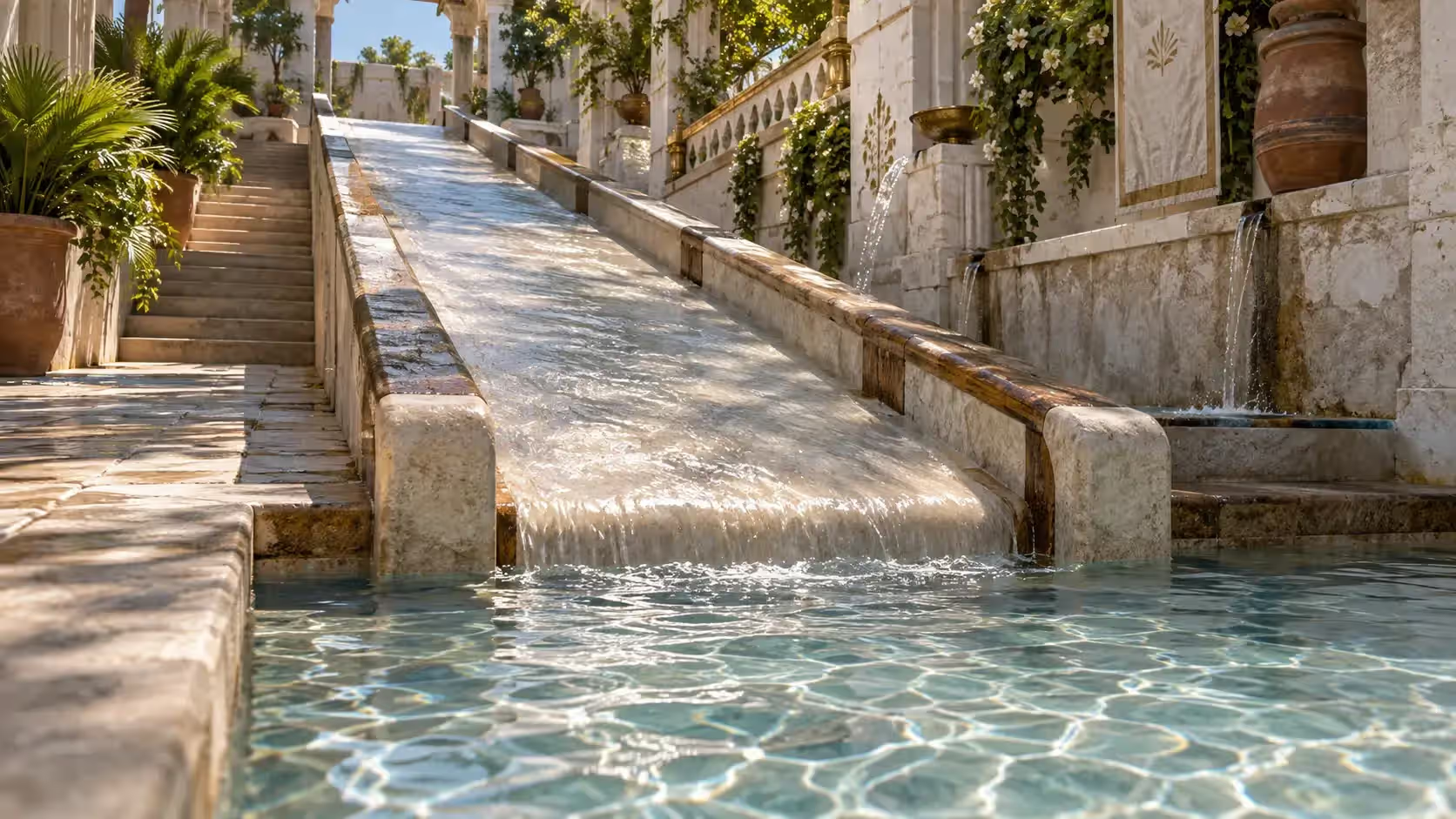
The aqueducts’ fast channels become water games there, with boats, chutes of polished stone or oiled wood, and pools. Great wheels with cabins, driven by counterweight, traction or water power, offer a view over the Garden. In windy regions, collective swings carry ten to twenty people at once.
Hedge mazes cover several hectares of hedges, pools, footbridges, statues and challenges; adults spend six hours in them. Great show houses host concerts, drumming, choirs, dance, theatre, satire, animal acts and acrobatics.
Betting without money
Races of small domesticated runners draw bets. With no money, people bet forfeits: who will cook tomorrow, who will swim fully dressed, who will sing in front of the group. The game thus stays within the relationship, reputation and humour of the cohort.
The great games and their names
The prototype of these complexes is the Grand Garden of Games of Qez-Auréon. There the Great Falls send aqueduct water racing down fast channels, between chutes and pools; the Solar Wheels carry their cabins above the Garden. In windy regions the Wind Pendulums swing ten to twenty people at once. The priest in charge of a Pendulum judges: “That is high enough.” Fifteen teenagers answer: “NO.”
A day at the Games
A day at the Games starts early. Groups arrive at dawn with their booking tablet, which shows the hours allotted for the great attractions; the rest is free. Morning belongs to the water games, while the stone of the slides is still cool. At exact noon, even here, everything stops for a moment; then comes the meal, from the baskets the refectories prepare for outings, and a nap in the shade of the orchards. The afternoon is spent in the mazes and on the wheels, and the evening in the show houses, where performances follow one another late into the night during the Respiration.
People come as a cohort, as a household, as workmates or in gangs of adolescents. Children’s cohorts, with their guardians, have hours reserved in the morning. The adolescents, for their part, always manage to get the evenings.
The people who keep the Games running
The Games need a great many people. Canaux Clairs workers regulate the flow of the Great Falls and empty the pools every night; certified carpenters maintain the solar wheels, whose cabins are taken down and checked before each season; ropemakers replace the ropes of the Wind Pendulums long before they wear; gardeners trim the maze hedges to the line. Each great attraction is entrusted to one person, often a priest of the Order of the Gardens, who alone decides to stop it or reopen it.
These staff work mostly during other people’s Respiration. During the Great Respiration, watch teams keep the Games running, and their week is given back to them afterwards. Many take their own Respiration out of season at the same Games, empty and silent, and swear it is the best time to ride the Great Falls without queuing.
The little runners
The Garden races are run with small domesticated runners, scaly-skinned bipedal ornithopods barely taller than a child, fast, nervous and stubborn. They are bred on the Gardens’ farms, where they also serve to chase small scavengers out of the orchards. Each animal has its name, its quirks and its supporters, and the best runners are known across a whole region.
Races are held on sand tracks lined with low hedges, in short heats, with light young riders or no rider at all depending on the place. Juries of the Order of the Gardens check that the animals are fit to run and stop a race as soon as one goes lame. With no money, bets are made in forfeits, and a lost forfeit is paid that same evening, in front of everyone.
Other games, other places
The Garden Games are not the country’s only playgrounds. In the Marche de Keryth the Respiration games are martial: archery and throwing contests, races, wrestling, controlled hunting. The Côtes des Alizés fly giant kites and hold sailing races along the beaches. The Plaines des Brontes stage great races and ceratopsian parades, while the Marais Lumineux prefer boat jousts and lantern outings.
All year round, finally, the cohort courtyards have their own games: playing at the Weighing, playing the Ten Wings on a low wall, leading a decorated qerik up a ramp, chalking far too large animals on the flagstones. Guardians say the Garden Games only make room for what children already invent in a courtyard twenty paces wide.