

Creatures
Ishtir: learning ceratopsian care
Care expertise opens a precise responsibility within the animal chain.
Care comes before command
Ishtir organises a progression of ceratopsian certifications: care, herd behaviour, riding, manoeuvres, fodder logistics, strategy and command. Each certification establishes eligibility for a responsibility; it does not guarantee promotion. Care therefore has its own value before military glory and rank insignia.
A place to care for a body
Buildings provide lateral animal courts, drinking troughs, fodder racks, sanded floors and horn clearance. Large turning radii and buffer enclosures prevent an enclosure becoming a trap. Care takes place where routes accommodate the animal’s body and humans also have exits and refuges.
A separate logistical skill
Fodder is one of the certifications, alongside behaviour and manoeuvres. Herbivores feed on grazing, grain and dry fodder. This chain therefore combines observing the animal with resource availability. It does not reduce care to ceremony, and no medical treatment suits every case.
Preparing the body, place and rations
Ceratopsian care is visible in feeding, behaviour and horn clearance. Fodder racks and drinking troughs belong in a yard where the animal can turn and a keeper can withdraw. Pastures, grain and dry forage make up the diet of Ishtir’s herbivores.
Certifications distinguish care, riding, manoeuvring and fodder logistics. Beautiful ornaments replace none of these skills.
A season of apprenticeship
Ceratopsian care is first learned beside someone. Ishtir’s children approach the animals during their rotations, but real apprenticeship begins after the First Weighing: for a whole season the apprentice follows a certified carer in the care yard of a stable or fort, and under that eye does everything a carer does, from cleaning the troughs to inspecting the feet.
The test takes place before a jury and a living animal, never a model. The candidate must approach the animal, examine it, say what he sees and what he would do, then prove he knows how to stop: an Ishtiri jury is readier to refuse certification to someone who persists with an uneasy animal than to someone who hesitates. Many carers remember that first certificate all their lives, the first plaque engraved on their sleeve.
The carer’s gestures
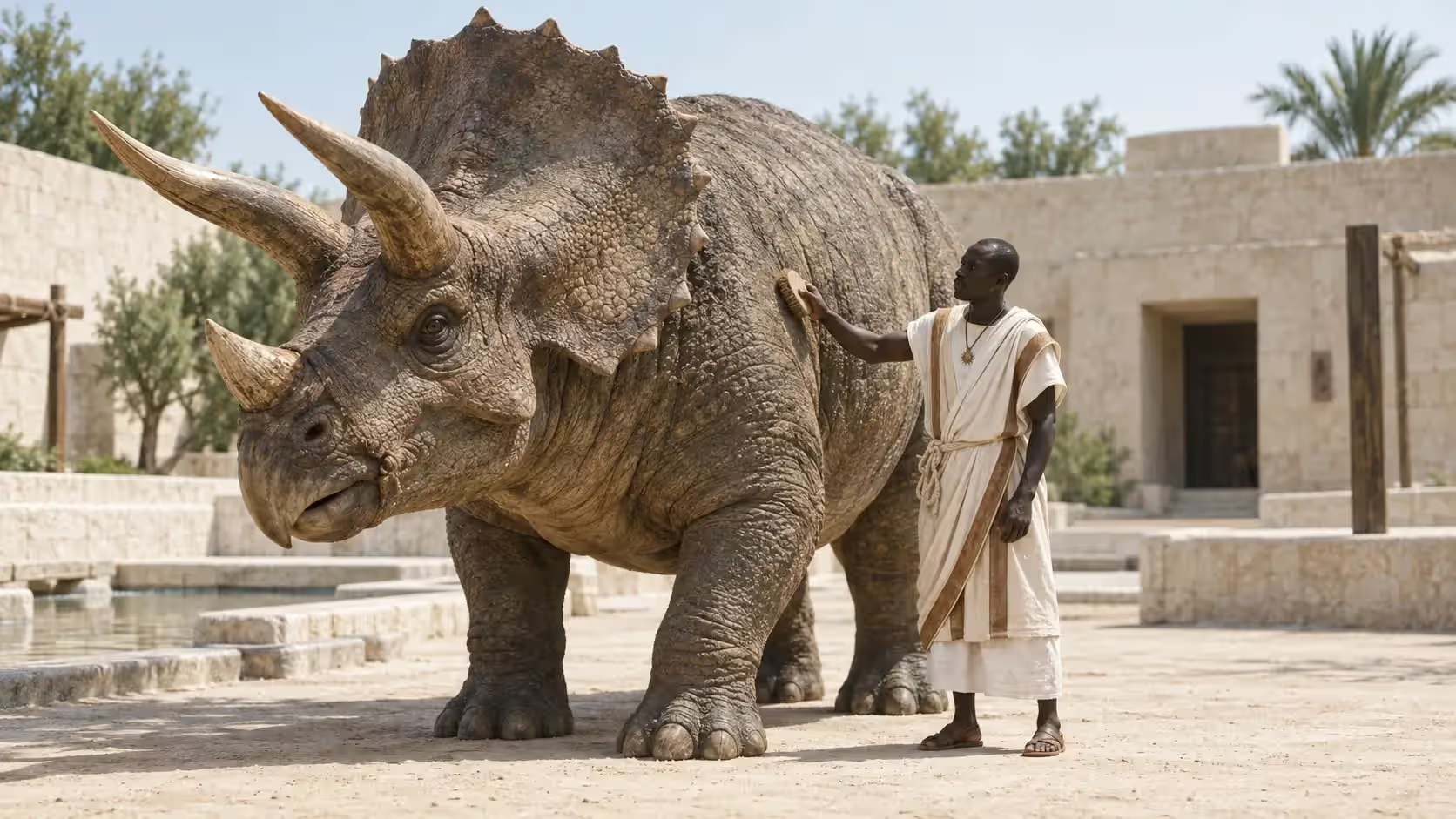
The work goes from the ground up to the head. The carer begins with the feet, which he scrapes clean with a bronze scraper, watching the thick nails that wear badly on soft ground; he then moves on to the body, brushed with palm fibre, and searches the folds of skin, under the frill and where the legs join, for the giant ticks that lodge there. Then comes the frill, washed with warm water, and the horns, whose casing and base are checked.
The beak needs a gesture of its own. It grows all its life and, if the ration is too soft, lengthens until it hampers the animal: it is then filed down with a stone, a little at a time. The carer ends with what cannot be seen: the dung, which he looks at every morning, the water drunk, the way the animal lies down. The old hands say you care for a ceratops with your hands and read it with your eyes.
Ordinary ailments
Carers know the ailments that keep coming back. Horn rot sets in under poorly kept sheaths and on animals that dig; it is treated by uncovering the horn, scraping away the softened part and drying it in the sun. Fodder colic follows too rich a ration or badly steeped cones; the animal lies down, swells and refuses water, and has to be walked, slowly, for hours. Lameness comes from wet ground and hidden stones; heatstroke, from exercises held too long in the midday sun.
There is also shedding: a ceratops renews its skin in patches, and a shed that goes badly leaves shreds that become infected. The remedies are simple, rest, shade, a changed ration, poultices of cold mud, abscesses opened and washed, and each one is applied to one animal, not to all.
Caring in war
In war, carers follow the Silver Horns a few hundred paces behind the line. Their care posts, set up at every halt, hold ropes, wooden chocks, buckets, balms and strap knives, used to free an animal caught in its harness in an instant. After a charge it is they who go out to fetch the wounded from the field, animals and riders together.
When an animal cannot be saved, it is a certified carer who ends its life, quickly and with a single stroke, never its rider. Custom then has its name read before those who served it. Soldiers of the Horns say the last person an animal sees should be the one who cared for it.