
Religion and rites
The Ascent of the Rays
An Ishtiri procession of sacred triceratops and relay pteranodons, from the Garden of the Levant to the solar terraces.
The horns climb the ramps
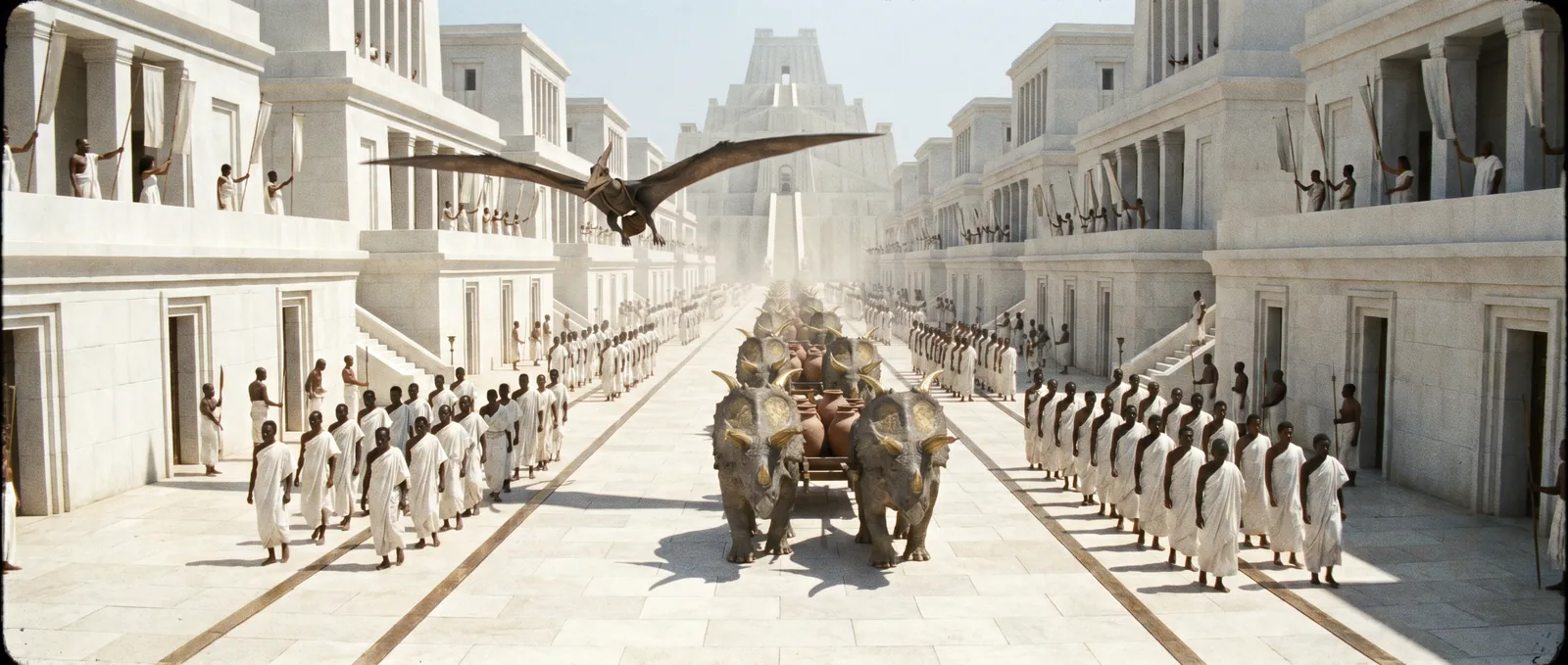
The Ascent of the Rays (Montée des Rayons) leads the sacred triceratops, known as the “Sacred Horns”, in procession from the Garden of the Levant up to the solar terraces. The gilded horns climb the ramps at a walk; above the procession, pteranodons released in relays trace arcs in the sky. The drivers sing of verticality and its three heights: the ground, the horn, the sky.
The procession
The setting is one of stepped terraces, sacred aqueducts and the white stone of the Garden of the Levant. The Order of Guardians, responsible for the ceratopsian camps, escorts the animals; pilgrims come from the country’s nine regions and children carry solar discs. Consecrated ceratopsians have theological and military value: Ishtir forbids the export of their eggs and fertile breeders.
Climbing before the Zenith
The Ascent of the Rays opens the Zenith season. A few days before the solstice, the Sacred Horns leave the courts and pens of the Jardin du Levant to reach the solar terraces where the great festival of the highest noon will be held. The procession takes several days to make the journey, at the animals’ pace, and stops each evening at a place fixed by custom, where people come to watch the horns go by.
The route follows the Sacred Causeway and the processional ways, lined with porticoes and aqueducts. The ramps were built for these animals: gentle slopes, wide resting landings, troughs, and rounded bollards that guide the horns without hurting them.
The Sacred Horns
The animals of the Ascent belong to the most prestigious lines in the country: Hel-Qerim with immense gilded frills, reserved for high processions and the great rites of the Jardin du Levant, and Sha-Qerim, the sacred triceratops with gilded horns. Their matte gold sheaths are polished again, their frills painted with solar discs, their white harnesses renewed; for weeks the technicians of the Horns make sure they will endure the crowd, the noise and the ramps.
Each animal is accompanied by its leader, on foot at its head, and by two healers. An animal that refuses to climb is never forced: it is taken back to its pen, and the procession goes on without it. People see a sign in it; the technicians speak only of fatigue or heat.
The song of the three heights
The drivers sing throughout the climb. Their song follows the three heights of the Ištâr language: a verse for the ground, taken up by the growers and carriers massed along the ramps; a verse for the horn, sung by the leaders themselves; a verse for the sky, struck up only by the priests when the relay pteranodons pass over the procession.
The pteranodons are released from tower to tower and trace arcs above the procession at every stage. Children carry solar discs of bronze or painted wood on the end of a pole, and the smallest, perched on adults’ shoulders, follow the wings with their eyes to the horizon.
The Wardens’ escort
The Order of the Wardens, which keeps the ceratops camps and the gates, escorts the procession. Its pikemen walk on either side of the animals, at a set distance, and hold a safety lane no one may enter; its chiefs set the pace, the halts and the order of the animals, and push the crowd back when a horn turns too close. Healers of the Silver Horns follow with water jars and ointments.
Pilgrims come from the nine regions to watch the Sacred Horns go by. Places along the most famous ramps are allotted by draw, like the parks of the Breathing, and the quarters along the route welcome visitors in their refectories for as long as the procession lasts.
The small Ascents
Not every region sees the Sacred Horns go by. Each therefore celebrates its own, more modest Ascent, towards the terrace of its main temple: monoclonius on the Terrasses d’Auréon, parade chasmosaurs in the towns of the Garden, styracosaurs in the Marche de Keryth, and in the Marais Lumineux, for want of ramps, a procession of boats that goes up the channels.
In the cohort courtyards children have their own version: they lead flower-decked qerik to the top of a school ramp, singing the three verses at the top of their voices. Educators see in it a first lesson in handling an animal in public, and the children the best day of the year before the Breathing.