

Institutions
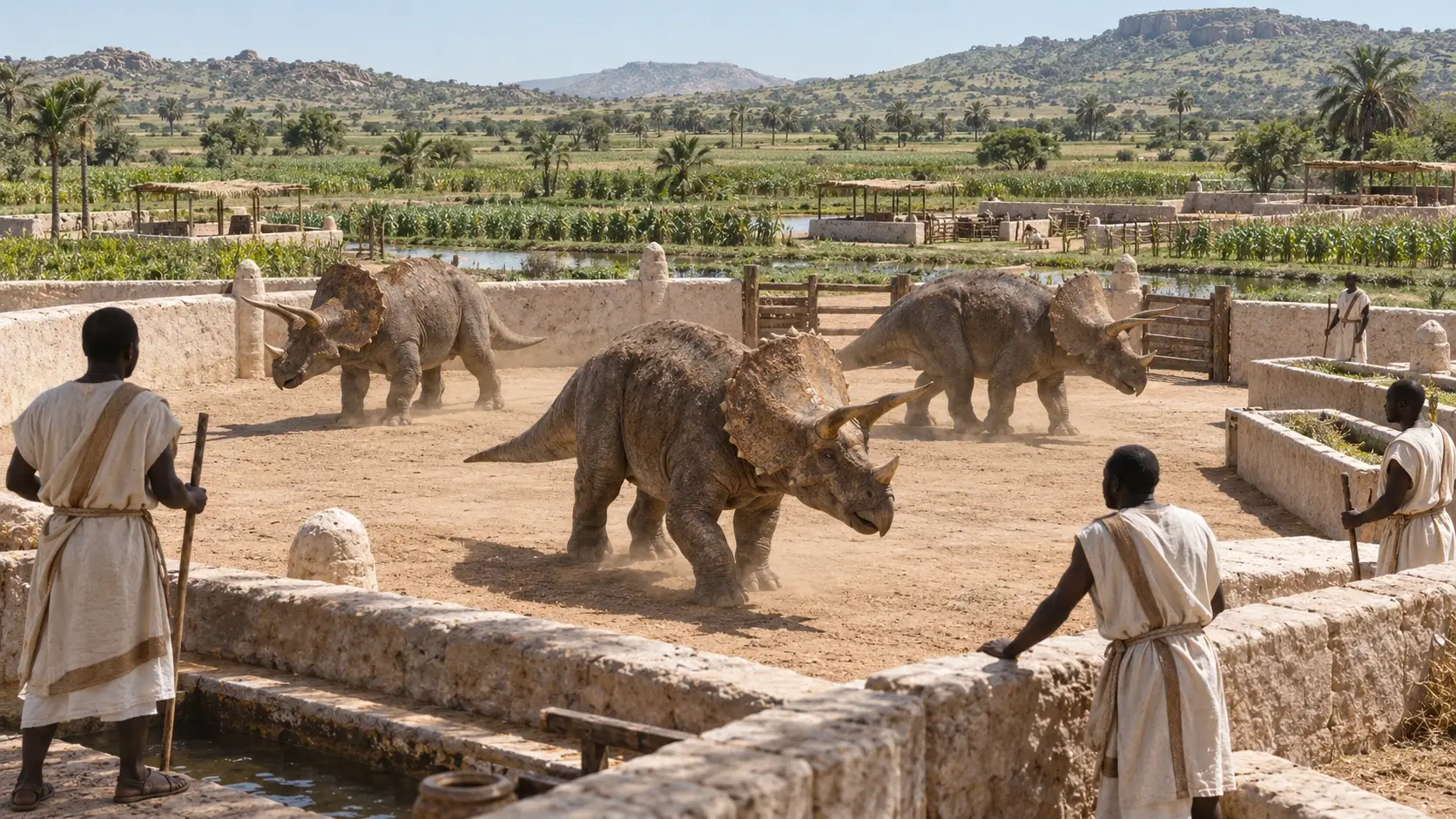
The Plaines Brontes
A Bronze-rank order in charge of the farming, herding, movement and great living stocks that feed Ishtir.
Feeding the country
The Plaines Brontes hold Ishtir’s food base: crops, herding, the movement of harvests and the great living stocks on which the cities depend. The order belongs to the Bronze rank, alongside the Canaux Clairs and the Mains Blanches. Its work carries one of the fundamental rights of Ishtiri society: food is guaranteed to everyone, with no condition of performance.
It should not be confused with the region of the Plaines des Brontes, a great plain of pasture and fodder crops.
The work of the herd
Ishtiri herding is first of all the raising of ceratopsians. Herds need pasture, fodder crops, clean water, shelter, rotation routes and watching; a working animal needs rest, space, food and care. This work links growers, stock keepers, carers and movement teams. Enclosures open wide, with broad turning radii, removable barriers and troughs, to let horns turn.
The herd’s year
The work of the Plaines Brontes follows the ceratopsians’ year. In laying season the females dig their nests in pens of loose sand, and the order’s teams watch them day and night, keep predators away and record every clutch for the Greffiers du Nid. Then come the hatchings, when a good herd chief can go a whole season without losing a hatchling, which ends up engraved on their sleeve. The young then join the herd on the rotation pastures.
The rest of the year belongs to fodder: cutting, drying, stacking, supplementary crops for the dry season. Flood years overturn everything. The irrigation basins overflow, the pens are moved, and the order’s people work alongside those of the Canaux Clairs, each in their own water, until the plain dries out.
The trades of the Plains
The order brings together trades that are not to be confused. Cultivators keep the fodder fields and the solar grain crops; herd chiefs lead the animals and answer for their health; stock keepers watch over the reserves of grain, fodder and table eggs; circulation teams drive the harvest convoys to the towns and distribution halls. Herd carers, finally, make the first sorting of the sick before handing them to specialised care.
Each of these trades has its certifications, its grades and its elders. A certified herd chief can answer for a hundred animals and several dozen people without ever leaving Bronze, and many have no wish to.
The great living stocks
The phrase means what a town will eat tomorrow without knowing it. The great living stocks are the reserve herds kept beyond the year’s needs, the laying pens for table eggs, the standing fodder fields cut only in case of need, and the yards of small saurians that provide the codified meat. Together with the town granaries they form the reserve that lets Ishtir get through a bad year or a siege.
Their management follows the country’s rules: nobody owns a stock, everyone answers for it. A stock keeper who lets a reserve waste away has lost nothing of their own; they have failed a responsibility, and that shows at the Weighing.
The Plains at war
The Plains of the Brontes are also the region of the ceratopsian mustering fields and the great garrisons, and the order carries that weight in wartime. Its teams raise the young Triceratops the Silver Horns will train, its fields feed the line animals, its convoys follow the columns with fodder. When a campaign begins, herd chiefs receive requisition lists, and the best animals leave with their carers.
The order’s Bronze also supply their share of the mass infantry and the quarter defences. On the Plains they say an Ishtiri army marches on its horns but eats from the hands of the Bronze.
Plain councils
Like the whole Bronze rank, the Plaines Brontes have no national grand master. The order governs itself through plain councils, on which sit herd chiefs, stock keepers, cultivators and convoy drivers chosen for one Weighing cycle. These councils allocate the rotation pastures, set the cutting dates, settle quarrels over fences and watering points, and tell the towns what the plain will be able to supply in the year.
Their decisions are engraved on tablets posted in the halls, where anyone can read and contest them. A complaint against a council is read at its members’ Weighing like any other, and every cycle one sees herd chiefs answering in public for a badly placed fence.
Qer-Brontes and Qer-Domar
Two places on the Plains of the Brontes speak for the order’s work. At Qer-Brontes of the Sacred Horns, the Enclosure of the Gold Lineages keeps, under the authority of the Rayon d’Or, the sacred reserve of great ceratopsians, animals that never leave Ishtir; it is the people of the Plaines Brontes who feed, clean and watch them. At Qer-Domar, the tanneries receive dead ceratops and work them without wasting anything: signed leather, frills, sheaths, tendons.
On the Bronze farms, finally, small ploughing ceratopsians, the qerik, pull the light ploughs, while the centrosaurs of the Brontes take on the heavy ploughing.
Part of this article covers events of season 1. Turn spoilers on in the menu to read it.