
Trades
Entretenir l’air, l’eau et la chaleur à Korath
Volets, drains, aqueducs et ventilation rendent les quartiers creusés et les cultures de montagne habitables.
Les fonctions du Côté du Souffle
Le Côté du Souffle réunit ventilation, hydraulique, chaleur, pression, serres, irrigation, conservation et filtration. Ses métiers travaillent sur les échanges qui rendent un espace utilisable, plutôt que sur sa seule enveloppe. Dans une ville creusée, un mur ou une porte ne suffisent pas à faire une habitation. L’air, l’eau et la chaleur doivent continuer à circuler dans des conditions qui permettent aux personnes de vivre et aux ateliers de travailler.
Canal de pierre, roue et conduit de ventilation
Vue de détail.
Évacuer ce que produit le travail chaud
La couche chaude d’une cité peut accueillir forge nationale ou arsenal. Établis de pierre, creusets, moules, pinces et jauges voisinent avec drains à scories et moyens de refroidissement. La ventilation redondante du Souffle Retourné accompagne ces espaces. L’entretien porte donc aussi sur les conséquences de la fabrication : un objet métallique achevé laisse derrière lui chaleur et résidus, dont les passages doivent rester distincts des lieux où travaillent et circulent les personnes.
Maintenir une vallée productive
Les cultures de montagne reposent sur terrasses, serres, sols importés, miroirs, aqueducs, vergers et vignobles chauffés. La production d’un fruit local dépend de ces aménagements. Entretenir l’eau, la lumière et la chaleur revient donc à maintenir un milieu de culture, et pas seulement un bâtiment. Ces récoltes complètent un approvisionnement encore dépendant des importations alimentaires. Un réseau technique peut rendre une vallée productive sans effacer les limites du relief et des ressources disponibles.
Des réserves pour les espaces isolables
Les districts dotés de doubles portes et de sas possèdent des réserves d’air, d’eau et de chaleur, ainsi qu’une fermeture manuelle de secours. Un quartier isolable doit pouvoir être évacué. L’entretien de ces moyens participe donc à la sécurité du passage autant qu’au confort quotidien. La séparation des espaces protège certains lieux, mais peut aussi priver les habitants d’un accès ; les métiers du Souffle restent liés à cette question de continuité, de réserve et de sortie.
A crew’s round
A Breath crew sets out on its round with a precise route: a sequence of shafts, shutters, drains and conduits to check in order, written on a tablet the crew chief signs at each stop. Everyone carries a caged gallery lamp, whose sheltered flame goes out before the air becomes deadly, and a leather mask with a filter of sulphured chitin and charcoal for smoky passages.
At each stop the crew reads the pressure gauges on the Warm Vein conduits, checks the play of the bronze shutters, clears the grilles and notes the colour of the flame. An abnormal reading brings the crew back the next day, or triggers an immediate repair if the gauge exceeds its engraved limit. Round tablets are filed by district, and the engineers of the Side of Breath read the city’s health in them the way a carer reads a beast’s.
Pumps, cisterns and flooded galleries
Hydraulics is the other half of the trade. Mines and deep levels fill with water as soon as people stop emptying them, and bronze piston drainage pumps run without pause in the low galleries, worked by crews who take turns day and night. The same pumps, famous throughout the known world, are sold to Volonian shipowners to empty the holds of their vessels.
The cisterns of the deep core need a different care. Their level, clarity and taste are checked, the sand and charcoal filter basins cleaned, the joints of the pipes repaired. A water warden who finds cloudy water in a cistern has the right to close the district’s valves himself, even against the residents’ wishes, until the water has been tested.
The trades of the Side of Breath
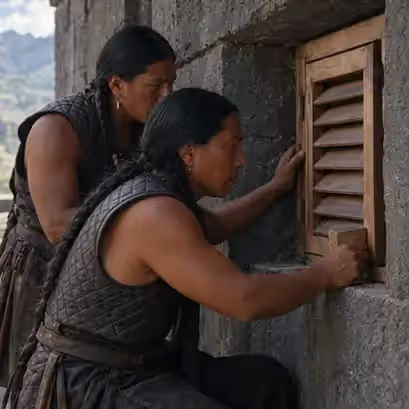
The Side of Breath brings together a multitude of trades. Shutter-setters manage the draught of the shafts, conduit sweeps scrape away soot and mineral deposits, conduit stokers watch over the Warm Vein, water wardens the water of the cisterns, filterers the sand and charcoal basins, greenhouse keepers the heat and humidity of crops under thermal glass. Each trade has its tools, its journeymen and its youth schools.
The family that holds this Side has a motto every Korathi knows: “The other Sides build Korath. We let it breathe.” Breath workers repeat it with pride, and a little irony when their work goes unnoticed. That is the paradox of their trade: when it is done well nobody notices it, and they are only talked about on the days when the air runs short.
A dangerous trade
The Breath kills more workers than most of the city’s trades. Sweeps breathe soot, stokers are scalded by steam leaks, water wardens go down shafts where the air thins without warning, and gas pockets from the rifts can rise through a badly closed conduit. Crews always work at least in pairs, roped together when they go down, and the second stays where the air is safe.
Breath accidents have their own memorial stones, like those of the mines, and the names of their dead are read out during closing drills. In return the trade is well paid and protected: Breath crews are among the first served in times of rationing, and their families are housed near the great shafts, where the air is the safest in the city.