
Trades
The insect-breeder
In N’Goro, insects are infrastructure: the insect-breeder draws cleaning, light, fibre, gas detection and, in war, swarms from them.
Insects at work
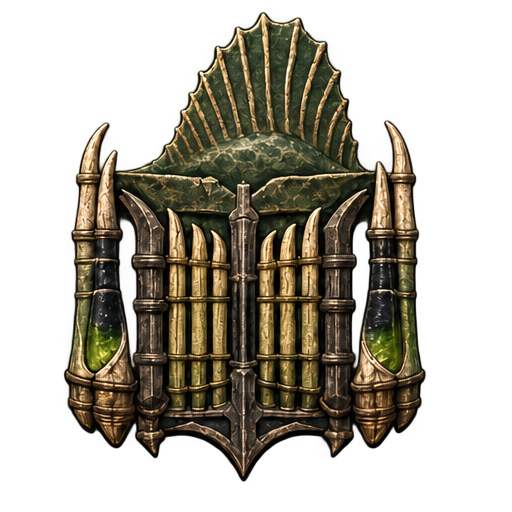
The insect-breeder manages cleaning, light, fibre, gas and insect warfare. In N’Goro, domesticated insects are infrastructure: cleaner beetles, fireflies, fibre caterpillars, termites, pollinators, gas detectors and water indicators. The Moult-Villages count insectariums among their modules.
The fifth threshold
In war, the insect orders form the fifth of the seven thresholds of defence: they release, move or draw colonies onto targets. The insect-breeders are also one of N’Goro’s great blocs; under Sûma’s centralised power, they mount a clandestine resistance alongside the Houses of Black Milk.
The insectary
A N’Goro insectary is a living building. It is set up in a chamber of living wood, under chitin trellises, or on a separate barge in a Shedding Village, and closed with fine mats that let the air through without letting the creatures escape. Every species has its place. Fat larvae grow there in trays of mash made of overripe fruit, duckweed and compost, before being eaten or dried into black flour; fibre caterpillars spin their cocoons; fireflies are fed on nectar before lighting the streets; cleaner beetles wait to be sent into the latrines and refuse pits.
Other insects have subtler functions. Bred termites break down dead wood and prepare compost; the pollinators of the giant hives give honey and wax and spend the dry season under shelter; certain insects, placed in cellars, holds and near waters, are detectors: they flee or die when the air fills with gas or the water goes bad, and their silence warns the humans. A large insectary employs some ten breeders, a few herbalists to treat stings, and sometimes guards.
“Small mouth, great kingdom”
The trade is handed down in families and clans that have made it their pride. The country’s largest insectaries are at Yamwa, in the heart of the deep marshes of the Silver Reeds, where a clan of breeders raises arthropleurids for chitin, caterpillars for silk and larvae to feed the beasts, and also produces wax, black flour and light venoms. Its motto, “Small mouth, great kingdom”, sums up the insect-breeders’ whole philosophy: each insect is tiny, but their numbers keep a country alive.
The apprenticeship is hard. One starts by feeding and cleaning, learns to recognise a sick colony by its sound and a tired queen by her smell, and gets stung far more often than one would like; swarm serum, against multiple stings, is in every breeder’s kit. The great Broods, where insects are raised on the scale of whole regions, feed N’Goro, but they employ children for the finest tasks, and it is said of them that they bury more children than anywhere else. That is the dark side of the trade, which its own members acknowledge.
A force the centre does not hold
The insect-breeding orders are among N’Goro’s great blocs, and they hold a place apart in political life. Under Sûma’s centralised power, they form with the Black Milk Houses a clandestine opposition. The reason lies in the trade itself. Whoever knows how to raise a colony also knows how to move it, starve it or release it, and swarms are the only great force in the country that goes neither through the Sap-Keepers, nor the trainers, nor the ports. The Synod’s protocols, which govern the transport of colonies from one basin to another, are felt by many breeders as dispossession.
This opposition stays muted. The insect-breeders do not contest the quarantines, which they need as much as anyone; above all they refuse to have their swarms registered as goods of the centre. They answer the Circle’s calls when the enemy is at their gates, but on their own terms, and every war is negotiated with them. The people of the Long Boughs respect them and fear them a little: you do not fall out with those who light your streets and clean your latrines.
The war swarms
At the fifth threshold of the defence, the insect-breeders release, move or lure colonies onto objectives, and they do it with precise equipment. The best-known weapon is the dart-cage: a silk-strung cage holding a war swarm, carried by two men or by a barge, opened only over a marked objective, a camp, a depot or a column committed to a channel. Krath wasps, from which a light venom is also drawn, guard the border passes; watch dragonflies, raised by orders such as the War Hives of Ruche-Noire, signal movements.
Swarms make no distinction between sides. Before opening its hives, N’Goro gives swarm serum to its allies and its own fighters, and the breeders mark out the corridors where they release the colonies so that the defenders keep away. Swarms are also hired out, with their keepers, cages and serums, to whoever can pay for the service. The breeders say their weapon has one flaw and one virtue: it cannot be recalled, but it does not betray.