
Trades
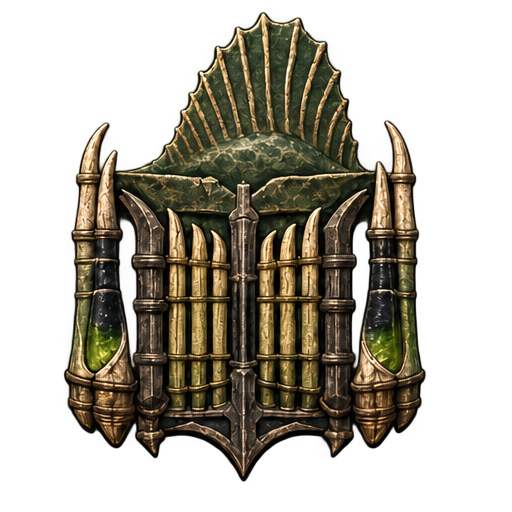
The Living Mirror
Mapping changing waters and seasonal routes.
A map for a changing environment
The Living Mirror is an order mapping changing waters, seasonal routes and biological signs. Its working subject changes with environmental conditions. In N’Goro, routes move or become unusable; knowledge of a passage must therefore account for its state. Reading a route requires more than finding its outline again.
A journey has several heights
The living continent includes low waters, mangroves, roots and canopy. Maps must be read within this vertical world, where human movement meets maintained vine networks. A destination has an environment of access as well as a location. The Living Mirror’s seasonal routes belong among these levels, subject to water and biological rhythms.
Passage is read in living signs
Biological signs belong to the Living Mirror’s cartography. Water health, seasons and relationships among living forms are part of a journey’s conditions. The Synod can close a route, while the Knotters maintain canopy networks. Cartographers, health authorities and messengers therefore work on complementary aspects of movement.
The order and its motto
The order of the Living Mirror has the motto “Our maps change with the tides”, and it has made it a working rule. Its members, the cartographers of the Living Mirror, produce wet and temporary maps, made for a navigation that is never fixed, and keep the reading posts set up at the crossroads of the liquid routes. They have their schools and registers at the Sacred Lakes, in the heart of the region that gave the order its name, but their posts extend far beyond, wherever a waterway must be read again.
Many come from a single lineage, the House of Naem, an old family of cartographers known as the readers of coded waters, allied by marriage to the threshold houses. But the order also recruits outside the great families, among the children of boatmen and fishers who have the eye and the patience. It seeks neither power nor wealth; yet its cartographers have considerable influence, for nearly all of the Circle of Balances’ arbitrations rest, at one point or another, on one of their readings.
Making a liquid map
A liquid map is not drawn once and for all. The cartographer layers sheets of damp silk, on which he lays reactive pigments that change colour with humidity and heat, fibres soaked in scents that signal dangerous waters, and sometimes tiny indicator organisms lodged in wax cells. He works with ink, medicinal spores, insect wax, silver-reed fibres and Silver Reeds acid to fix certain pigments.
Such a map must be fed: its pigments refreshed, its scented fibres replaced and its organisms nourished, usually every month, or it stops telling the truth. A map no longer fed becomes a dead map. It keeps its colours for a while, then its scents fade and its organisms die, and it then gives a picture of the past that can be mistaken for the present. Cartographers destroy dead maps themselves, or mark them with a black stroke so that no one relies on them again.
Selling a reading
The order lives on its readings. A master carrier, a Shedding Village pilot, a merchant or a pass captain may commission from it the mapping of a waterway for a season: the cartographers survey the route, draw up a liquid map of it and undertake to keep it up for the whole period. The client receives the map or, more often, the right to consult it at a post. Passing travellers simply buy the day’s reading at a Mirror post, for a few shells or a service rendered.
The order’s strictest rule concerns the age of readings. Every map and every reading carries the date of its last survey, and presenting an old reading as a recent one is a grave fault, comparable to a guide’s lie. A cartographer who sells a dead map as a living one loses his post and his name in the registers. Clients know they can demand to see the date before paying, and the most careful have it checked by a second post.
What foreigners misunderstand
The cartographers of other nations have often tried to copy the maps of the Living Mirror, and nearly all have failed. Urnok’s surveyors, used to maps fixed in the register and valid for generations, brought back from N’Goro precise surveys that were wrong by the next season. The Volonians, whose portolans are sacred objects, admire the Ngoro’s science but cannot abide the idea that a map can die. A stolen liquid map is worthless far from its cartographers: unfed, it stops telling the truth within a few weeks.
The cartographers of the Mirror are both amused and worried by this. They know their strength lies in the fact that their knowledge does not travel, but also that a foreigner with a dead map can lead people to their deaths while believing they are well guided. They have a saying for it, which they readily address to overly curious merchants: “Stealing a map from the Mirror is like stealing a fish: it rots before it gets there.”