

Institutions
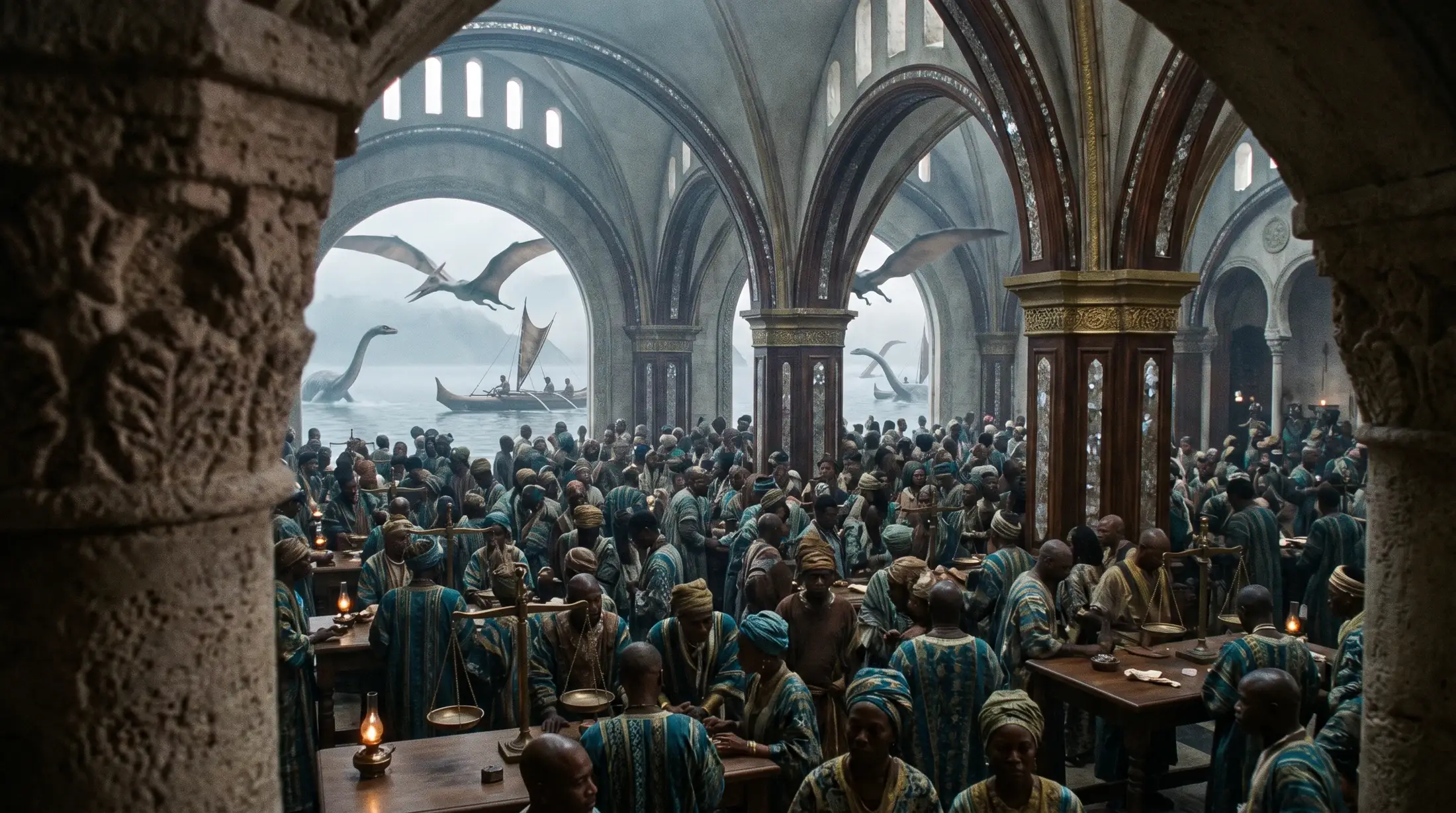
The agents of Vaesh
Collectors, econometricians and quarantine officers: through the agents of Vaesh, the register becomes a border and the republic is read as a system.
An order under public charter
Vaesh is a private order under public charter, non-hereditary and highly selective. Its functions go beyond quarantine: tax, customs, beneficial owners, national statistics, econometrics and reserves. Its agents give these functions a face.
The register becomes a border
The collector of Vaesh carries out taxation, customs, quarantine, the tracking of beneficial owners and seizure: in his hands, the register becomes a border. Petty fraud brings fines, seizures or bans; grand fraud — a hidden beneficiary, a double register, corrupting the collectors, untaxed political money — is constitutional treason, which can lead to a public execution in a maritime theatre.
Reading the country as a system
The econometrician of Flows tracks prices, tonnage, stocks, debt and contagion, and forecasts their course: through him, Vaesh reads the republic as a system. The quarantine officer of Vaesh authorises or blocks the movement and mobilisation of the very large.
Joining Vaesh
Vaesh is not inherited. The order recruits on merit, in subjects rarely combined in one person: economics, statistics, taxation, law, marine biology, navigation and strategy. Candidates come from every station, salters’ sons as well as daughters of great houses, and it is said that an illustrious name helps less there than elsewhere, because the written examinations are marked without the examiner knowing who wrote them.
The tests combine pen and quay. The candidate is asked to find a double register hidden in a house’s accounts, to estimate a hull’s tonnage by eye, to read a tide table and to describe the condition of an animal in a basin. The best are taken young and trained for a long time; the others leave with a reputation that often suffices to open a counting house to them, for a house knows what someone Vaesh nearly took is worth.
A collector’s day
The collector starts the day at his district counting house, where the previous day’s declarations await him. He compares declared income with the movements other registers reveal: stakes posted on the Great Board, entries in the Register of Hulls and Routes, sales at the Exchange of Great Catches. Then he goes out. He visits a trading house, attends an unloading, checks a cage at the harbour bar, affixes or refuses a seal.
His seal carries the white of Vaesh, the colour of the order and of its emblem, the White Mosasaur. The quays fear and respect him at once; people do not always greet him, but they open their holds to him. A collector who looks away for a coin commits the gravest fault of his trade: the corruption of collectors is among the great frauds that amount to constitutional treason, alongside the hidden beneficiary and the double register.
The republic’s figures
The economists of the Flows keep the nation’s accounts: prices, tonnage, stocks, migrations, debts, crisis indicators. They forecast the course of markets and of contagion, in the sanitary as well as the financial sense. Their debates are reputed to be serious and endless: how far to let the spontaneous order of markets run, when a house becomes a monopoly, what reserves to keep, how to stop any one player from buying the wrist of the invisible hand.
Every season a bulletin of the Flows is posted at the Great Counting House, next to the price boards. Shipowners read it to decide on their sailings, insurers to adjust their premiums, unions to discuss wages. The economists do not govern; but when they announce that a route is running out of breath or that a debt is spreading, the houses listen to them more closely than to many orators of the Palace.
The quarantine officer
The quarantine officer is the best-known face of Vaesh in the ports. He decides when a human, an animal or a cargo may rejoin ordinary activity, and he authorises or blocks the movement of the very great. The work demands biology as much as firmness: he must know how to read an animal, but also how to hold a closure against a shipowner who loses money with every tide.
Within the order they say a good quarantine officer is one nobody remembers, because nothing happened. The trade has no glory. Its mistakes, on the other hand, stay in everyone’s memory: an admission granted too quickly is paid for in lost live tanks, an abusive closure in ruined houses, and in both cases it is his name that is read at the foot of the decision.