

Culture
Fashion circulating reputation
Drapery, nacre and Séloris workshops turn materials into public visibility.
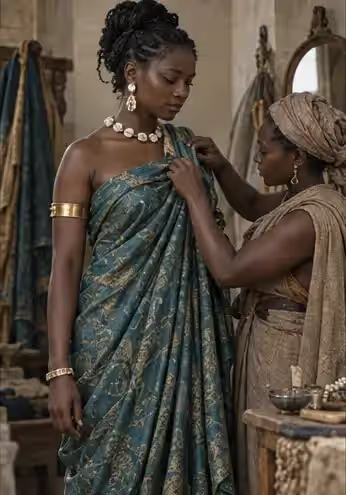
Fabrics worn as drapery
Dress uses silk or brocade drapery, with gold and nacre among signs of wealth. Pearls, headdresses and quay fabrics belong to different social uses. The same port gathers clothing stiffened by work at sea and materials worked for prestige. Drapery and ornament make this difference visible on bodies.
Workshops, perfumes and prestige routes
Séloris concentrates silk, spices, fashion, perfumes, artists and workshops. A parade therefore brings together several trades before displaying dress. Fabric, jewellery and scent participate in circulating styles; they allow a place or house to become recognisable beyond its quays. Reputation follows objects and their wearers.
Luxury produces a presence
Vornëa works with nacre, pearls, jewellery, fashion, tourism, spectacles and artists. Its influence rests on image, desire, diplomacy and coalitions. Dress seen in the right setting can therefore participate in a social relationship as well as a pursuit of beauty. Luxury objects become ways of making a house present in other people’s imagination.
Colours and materials
Two colours are considered Volonia’s own: nacrier blue, a night blue with pearly glints drawn from the ink sacs of ammonites, and crab-shield purple, extracted from the shells and reserved for parades and house seals. The dyers’ guild of Séloris keeps the recipes. To these colours are added the gold of stigmas brought back from the Souths, which dyes parade fabrics, and a whole range of faded turquoises seen on the quayside scarves.
Materials are no less sought after. Nacre-moiré silk, lustred with shell powder, changes colour under the lanterns; the sea silk of Girvane, a golden thread the great pen shells secrete to anchor themselves to the bottom and which only the women divers know how to spin, is used for the gloves and bridal veils of the houses. Ceremonial headdresses are made of nacre strips and baroque pearls, and parade gowns receive thousands of tiny pearls sorted through a sieve, sewn on one by one by the workshops. A gown of this kind takes several months of work by a dozen seamstresses.
From the quay to the salon
On the quays, people dress for work and for the heat: tarred canvas trousers rolled to the knee, rope belts, light shirts, bare feet on the planks. The turquoise scarf knotted at the neck or the wrist is almost a sign of belonging. Hairstyles say more: tight braids, locks adorned with baroque pearls, copper rings or small shells, worn as much for style as to keep the hair out of the water. A careful hairstyle is redone once a season, and the quayside braiders have their faithful clients.
Jewellery is also savings. A pearl necklace is worn, lent, pawned and resold; many terrace families keep their fortune around their necks rather than at the counting house. A whole trade lives on this: jewellery renters lend for a night necklaces, headdresses and gowns their customers could never buy, against a deposit and a small insurance. For a feast or a wedding, a modest family can thus appear adorned like a house.
Parades on the water
The great parades are held on the water, notably during the Festival of Music. The models walk along floating gangways between two rows of boats laden with spectators, and the outfits are designed to be seen from afar, under lanterns or at sunset. A parade gown from House Vornëa is worn only once; it then goes to a client, to a salon or to the house’s stores, which hold hundreds of them.
A parade is a business. It brings orders from foreign courts, from the nobility of Urnok in particular, draws visitors to the inns of Séloris and gives the house that stages it allies on the Great Board. The copy workshops of Port Volon reproduce the designs within a few days in cheaper materials, and that is how fashion comes down from the barges to the terraces. Even the contract companies take care of their appearance: their armour of sea leather and shell plates, struck with a house emblem, serves as advertisement as much as protection.