

Economy
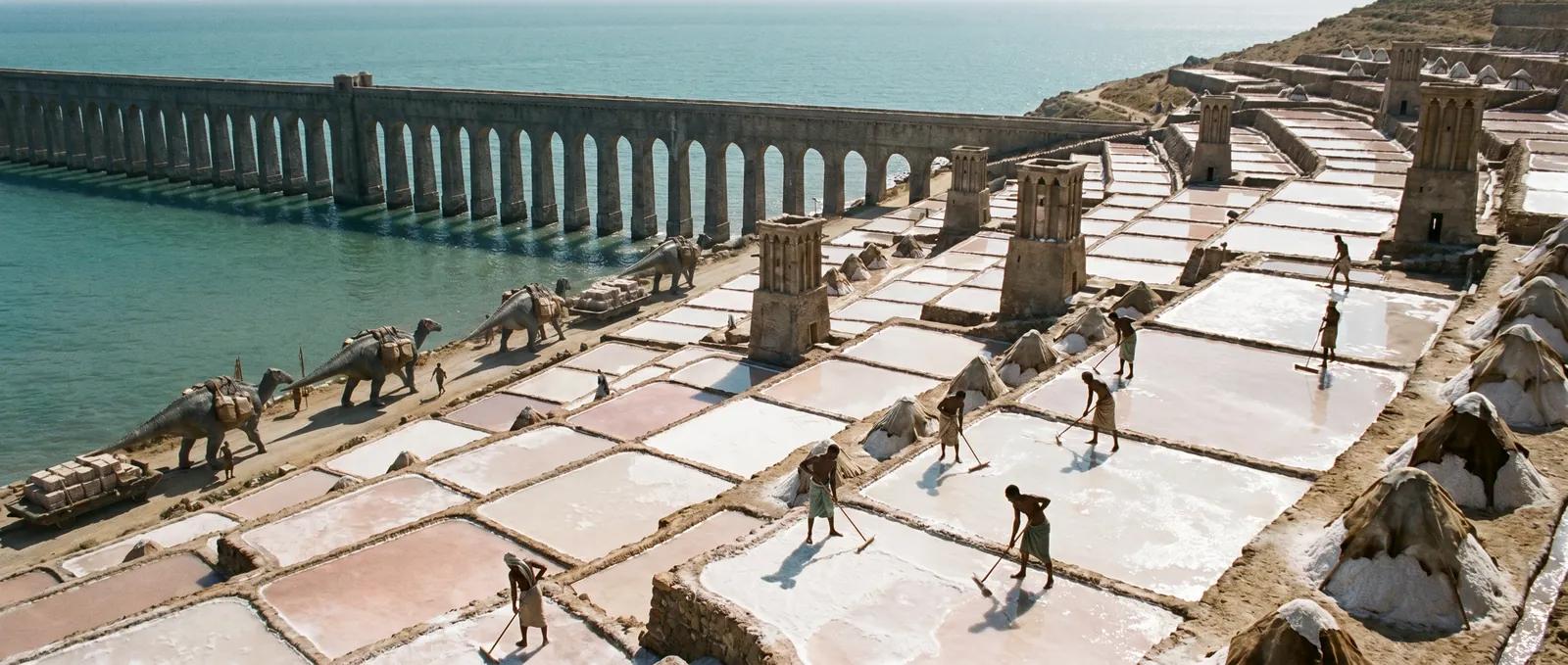
The saltworks and its wearing parts
Tides, gravity, rakes and stores form a small coastal production chain.
Water enters a workplace
Salt Aqueducts organise the work of a small salt town or coastal district. Shallow basins receive water through tides and gravity, then the chain reaches crystallisation beds. The arrangement has a specific productive function; its form does not become the compulsory plan of every Volonian town.
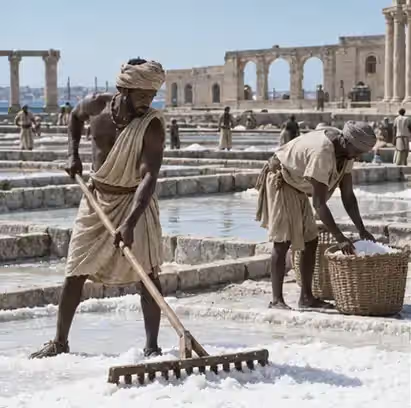
Gathering, weighing and keeping
Raised paths, rakes, baskets, jars, scales, salinity floats and ventilated stores are the chain’s objects. They connect basin work with storage and measurement. Becoming salt does not free the material from infrastructure: it still passes between containers, work surfaces and reserve buildings.
A resource that attacks its tools
Salt corrodes: sacrificial coatings and replacement parts require labour and supplies. The product also supports chains of brining, salting and holding ponds. Production and preservation meet through this material while the works handling it must remain maintained. Preservation needs and wear on the works thus accompany the work of gathering.
The salt season
Salt is harvested during the dry season. Seawater enters the great basins at high tide, passes from basin to basin as it evaporates and reaches the crystallising pans, where the salt settles. The salt-workers rake it with wooden rakes, drain it on the causeways and heap it into great mounds under thatched roofs. In the evening, when the wind drops, they skim a fine crust from the surface of the pans, the fleur de sel, which goes to the tables of the palaces.
The largest salt works are those of the salt marshes of Vaesh, which supply most of the country’s salt; others, smaller, line the bays of Marévant and the meadows of Malvia-la-Blanche. A single rain at the wrong moment can ruin a week of work, and salt-workers watch the sky as pilots watch the swell. The trade is hard: sun, salt in cuts, eyes burned by the glare, backs worn by the rake.
Volonia’s salts
Grey salt, the most common, salts fish, leathers and rations. Fleur de sel is the table salt of the rich. Black salt, smoked over charcoal and seaweed, preserves fish for six weeks in the hold; its preparation is the secret of a company of Vaesh, which draws from it the mastery of all long preservation. Blocks of salt are also moulded and given to the animals to lick, and brines are drawn off to prepare salted tendons, which do not rot at sea, and to tan sea leathers.
The marshes yield other products. The plants of the salt marshes, burned, provide an ash rich in soda, the material of Volonian soap; the nearby chalk platforms give a sea chalk used for renders and for improving garden soil. The salt workshops are thus surrounded by other workshops, and a salt district lives off a whole chain of trades.
Salt and interest
Salt has left its trace in the language of money. The League’s debt titles pay their interest in salt at each equinoctial tide, and the custom is old enough that interest is called, in the credit houses, “salt”. A lender who asks for heavy salt asks for a high interest rate, and a ruined borrower “has lost his salt”. The salt-workers, who never see the colour of these titles, laugh about it readily: to hear them, it is they who pay the interest of the whole republic.
Salt and war
Salt is also a matter of war. Without black salt, no fleet can stay long on the Great Ocean or hold a distant blockade; without grey salt, harness tendons and leathers rot. The League keeps reserves in ventilated stores, and the salt marshes are among the best guarded places in the country, even though they look poor and defenceless. An enemy wishing to weaken Volonia without facing its fleets might strike at its salt works; Volonians know it and never leave a salt store unguarded.
In peacetime, these guards are there mostly against thieves: a sack of fleur de sel is worth more than a docker’s day of work and is easily resold in the wreck-cities. The salt-workers themselves live in villages built on the causeways between the basins, where nothing is grown and fresh water arrives by boat, and every year they celebrate the first salt raked in the season by carrying a basket to the nearest chapel.