

Places and landscapes
The wreck-cities
On the edges of Volonian ports, salvaged homes cling to hulls, reefs, stilts and walkways. The wreck-cities shelter the poorest, as close to danger as can be.
Living in salvage
The wreck-cities are salvaged homes set on hulls, reefs and walkways, in extreme exposure and close crowding. They are found in poor districts, scavengers’ villages, cold quays or illegal settlements on the edges of ports. Volonia’s poor thus live on tiny islets, ship carcasses, stilts and walkways exposed to storms.
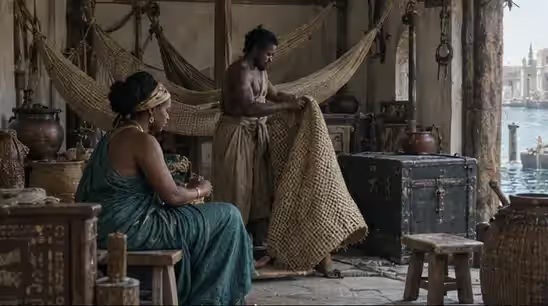
The weight rests on the reef, the rock or the stilts: a rotten hull cannot hold up a stone building, and wrecks mostly supply house parts and furniture. Hammocks, tarred chests, lockers, hooks, salvaged furniture and walkways fill cramped spaces. Every storm puts these walkways to the test, and the strength of a lashing decides a family’s safety.
Freedom and abandonment
Volonia is the freest of the powers in movement, morals, trade and association, and one of the least protective towards those who cannot turn their abilities into income. Palaces, hotels and theatres stand beside the wreck districts and exposed walkways; the same city may hold children dead for lack of care, maimed dockers and undersea hotels of unimaginable luxury. In Volonia, the rich own a second exit, the poor a better rope.
What the wreck-cities live on
The inhabitants of the wreck-cities live off what the ports throw away or do not hire enough of. Some are salvagers: they strip stranded hulls, resell bronze and copper fittings, and unpick old ropes to make new cordage. Others catch the cast-off fish that the fish ponds refuse, gather kelp, mend nets or work as day labourers on the cold quays. Children dive to collect whatever falls from ships at anchor.
Part of these districts belongs, in fact if not in law, to salvage houses that buy wrecks and then let out their holds as lodgings. A berth in a hull is rented by the tide, and one can be thrown out at the next. The work of these houses also feeds the small markets of the outskirts, where ship parts of every origin can be found.
When the storm comes
The wreck-cities have no high refuge. When the port signals announce a storm, each family lashes down what it can, doubles the moorings of its hull and takes the children to the most solid part of the reef or to the stone piles. Common ropes, stretched between the walkways, make it possible to move about when the wind makes standing impossible.
After the storm, people count. Torn-away walkways are rebuilt with whatever floats, capsized hulls are righted or broken up, and the missing are reported to the district’s minor priests, who carry their names to the nearest chapel. No insurance covers these losses. Families who have lost everything often move on to another wreck-city, unable to pay rent in the terraces.
Tolerated districts
Most wreck-cities have no status at all. They are tolerated as long as they obstruct neither a channel nor a quay, and the houses let them grow because they find cheap labour there. Collectors rarely go there, for lack of income to tax; port guards only when a theft or a brawl has reached the neighbouring quays.
Vaesh, on the other hand, comes as soon as a disease appears. A wreck-city struck by fever can be isolated, its passages cut and, in the gravest cases, its hulls burned. Its inhabitants nonetheless have their place in political life: by pooling their small stakes by district, they can weigh on a vote in the Chambers, and some dockers’ and divers’ unions recruit most of their members there.
Growing up on a wreck
Children of the wreck-cities swim before they can walk straight. They dive under hulls to recover what has fallen, guide boats between the walkways and learn early to recognize a lashing that is about to give. Many become divers, haulers or salvagers; the most skilful are spotted by Girvane teams or by captains looking for ship’s boys.
Care is what they lack. An infected wound, a fever or a diving accident can kill where a terrace child would be treated. A few minor priests, volunteer nurses and neighbourhood associations try to make up for it, with means out of all proportion to the need.