

Institutions
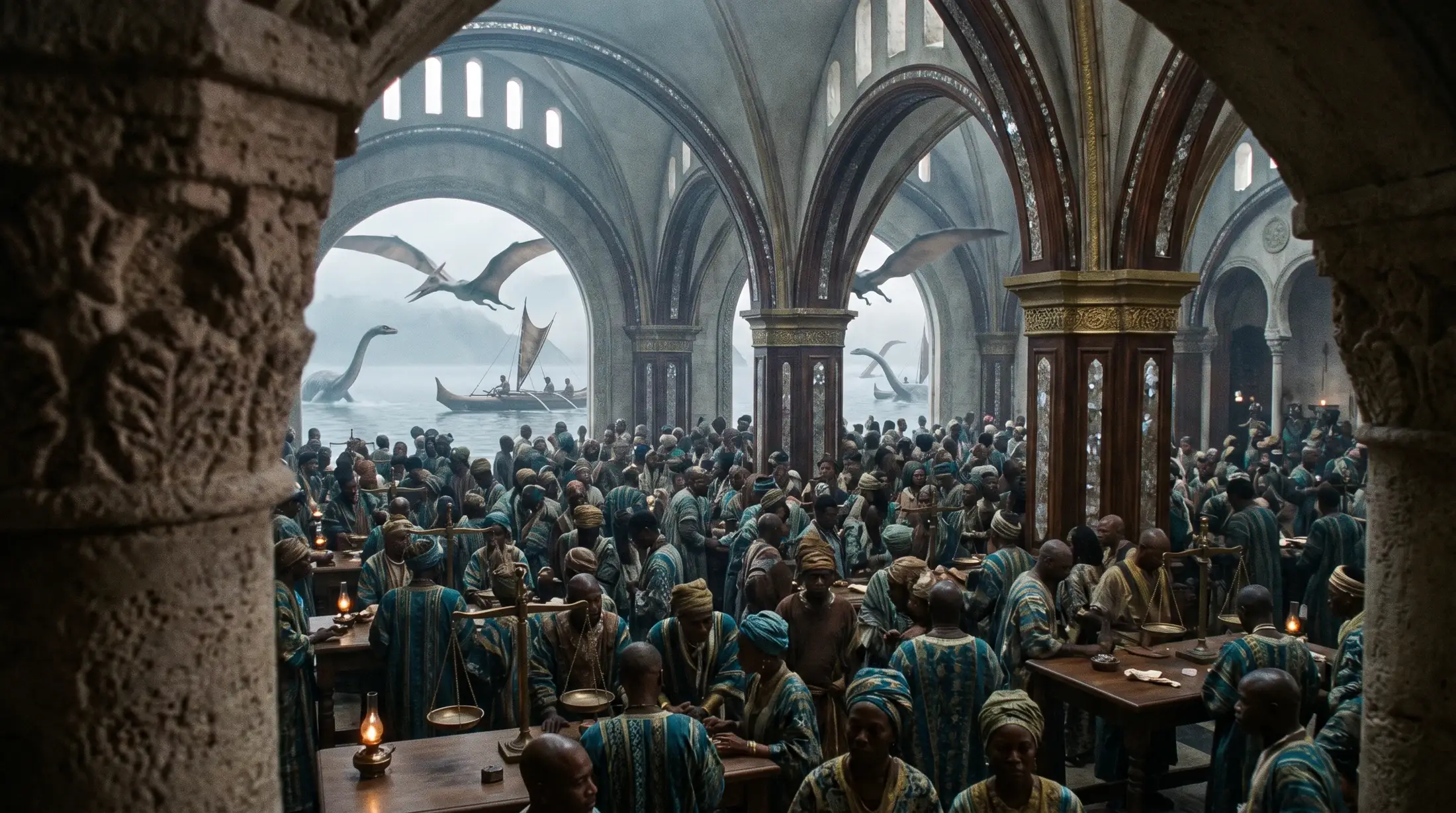
The Exchange of Great Catches
The market where fishing catches and materials brought up from the deep are valued.
Putting a price on the catch
The Exchange of Great Catches organises the valuation of fishing catches and of materials gathered in the deep. It turns a capture — an exceptional shoal, an oil, a rare material from the open sea — into a displayed price that can be negotiated and insured.
What the open sea brings back
Great Ocean campaigns bring back fish, oils, bones, pearls, shells and other biological materials. Some go to specialised workshops: waterproof leathers and harness hides, sea teeth for harpoon points and inserts, nacre and pearls for jewellery, seals and certain tokens. The Exchange stands between the catch and these workshops.
Finance built on flows
Volonian finance rests on these material flows: it advances funds, spreads risk and allows long-distance transactions to be settled. The Exchange extends the work of the Institute of Deep Fisheries: one locates and studies resources, the other gives value to what has been brought back.
The auction of the depths
The Exchange holds its sessions in a hall in Port Volon, with annex rooms wherever the Great Ocean Fishers put in. Lots are not shown whole: sealed samples are displayed, a jar of oil, a cut of sea tooth, a handful of pearls, a piece of waterproof leather, together with the ship’s catch book. Buyers examine, smell and weigh, then bid aloud under the eye of the clerks who carry the prices over to the board.
Sales follow the rhythm of returning campaigns. When a distant fishing fleet comes home, the hall fills with workshops, jewellers, harness makers, oil merchants and foreign agents. The best materials are gone within hours; ordinary lots wait several tides. A season’s opening price is the talk of the taverns, and crew families often learn through the Exchange what their sailor’s share will be worth.
Grading before selling
Nothing is sold at the Exchange without first being graded. Gaugers rank materials by rarity, fineness, preparation and the risk of carrying them: an oil is judged by its clarity and smell, a sea tooth by its size, its soundness and the direction of its grain, a pearl by its lustre and shape. The same catch can thus yield lots of very different quality, and careful preparation is often worth more than a more abundant shoal.
Materials from ultra-deep fishing form a class of their own. Volonia alone brings them back regularly, and the Exchange protects that near-monopoly: the rarest lots leave the country only under contract, with their origin recorded. Foreign buyers, from Urnok, Arkhan or Korath, must go through Volonian agents and pay for that passage.
Campaign shares and bets
A distant fishing campaign is financed before it sails. Its shares are bought by houses, captains, craftsmen and ordinary savers, who then draw their portion of the returns. It is the Exchange that gives those returns their value: the price of the lots sold sets what each share brings in. The campaign estimator separates the cost of the expedition, the prize shares, the insurance and the bets, so that everyone knows what they have won or lost.
Around the hall, predictive bets cover the size of the catch, the date of return or the opening price of a material. They remain separate from the shares, and their winnings pay the Fifteenth like any others. A successful campaign can enrich a shareholder and ruin a gambler who bet against it; the Exchange settles both, each at its own counter.
The workshops downstream
The Exchange’s ordinary buyers are workshops: tanners of waterproof leather and harness hides, makers of sea-tooth harpoon points and inserts, pearl-workers, makers of seals and tokens. Some have had their reserved place in the hall for generations, and pass it on with the workshop.
A workshop that loses its place often loses its access to the best materials, and must buy second-hand, at a higher price, from merchants who resell the lots. Small craft houses therefore band together to bid jointly, share a rare lot and then divide the pieces according to their needs. The Exchange tolerates these joint purchases, provided they are declared.