

Places and landscapes
Undersea palaces and dry galleries
In Volonia, going down beneath the sea means rising in society. The richest live in dry residences between five and fifty metres deep, at the permanent cost of pumps, air, exits and servants.
The top of society goes beneath the sea
Volonia’s social geography is vertical and inverted. The ultra-rich go down beneath the water: dry domes, coral gardens, silent galleries, rum cellars, private museums and hundreds of servants. Their dry residences lie between five and fifty metres deep; the same city also counts undersea hotels of unimaginable luxury.
Going beneath the water means rising socially, not because technique abolishes the sea, but because one can buy pumps, air, exits, maintenance and servants. Safety under water is a permanent expense.
What a dry room costs
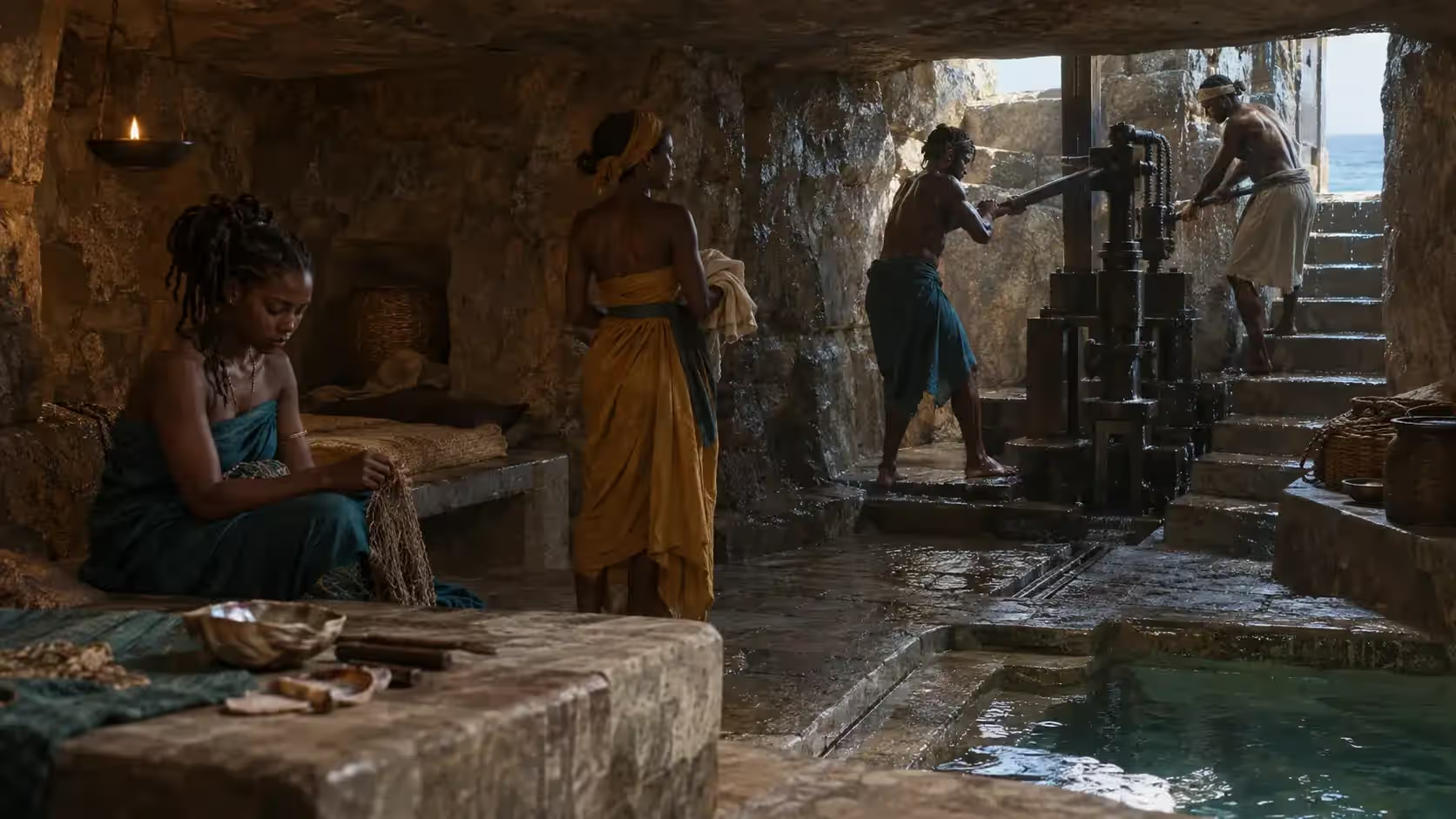
These spaces remain small, costly, watched and redundant. They are dry galleries cut into the rock, shallow caissons, caves and villa annexes. A dry tunnel, compartments, drains, pumps, escape shafts, masonry or fixed furniture, air bladders, stoppers, alarm bells and very small protected openings make them habitable. No panoramic glazing opens onto the sea, and no transparent city exists at great depth.
Volonians are excellent swimmers and divers, but they have no gills: no underwater journey is free. Trained breath-holding, breathing bladders, diving bells, towed caissons, half-flooded nacelles, masks, removable ballast and a few N’Goro products against irritation and pressure allow them to go down. Deep journeys remain dangerous, short and costly.
Beyond fifty metres
Further down, beyond fifty metres, there are only small stations, bells, strongboxes, observatories and installations for animals. Volonia has no generalised undersea city.
The pump people
A dry residence lives to the rhythm of its pumps. Teams of pumpers take turns day and night to empty the water seeping through the rock and the joints; others carry the air skins, maintain the escape shafts and check the stoppers, drains and alarm bells every morning. A dwelling of a few rooms may require several dozen servants, the largest hundreds.
These servants nearly all live on the surface and go down for their service. Their work is hard and dangerous: a pump that breaks at night, a blocked shaft or a gallery that floods can trap them with their masters. They are better paid than most dockers, but their contracts bind them to discretion about what they see, and most keep to it, because their next hiring depends on it.
The luxury of silence and coolness
What one buys by going down is above all calm. Above, the surface of the poor is noisy and exposed; below, the depth of the rich is cool, silent and sheltered from storms. Dinners are given there in galleries where no cry from the quays can reach, cellars of century-old rum are kept at a constant temperature, and private collections of mother-of-pearl, sea trophies and objects from all over the known world are displayed.
Light is scarce and precious. The small protected openings let through a bluish daylight; the rest comes from a few oil lamps, for every flame consumes the air the servants have brought down. Guests quickly learn the customs: one does not run, one does not close a watertight door without warning, and one goes up at the first stroke of the bell, whatever one is doing. The coral gardens, tended by divers, are visited from half-flooded passages where one wades waist-deep in the water.
Insuring a dry room
A dry residence is one of the hardest properties to insure in Volonia. Before covering it, insurers send inspectors down to check the pumps, the escape shafts, the redundancy of the exits and the number of servants in each team. The premium depends on depth, the age of the galleries and the distance to the nearest port; beyond a few dozen metres, few houses agree to cover a dwelling.
Losses are rare but terrible: a gallery giving way, a pump stopping during a storm, a shaft blocked at the moment of the alarm. The Merchants’ Court judges each case, and the inquiry almost always turns on maintenance. This is one of the reasons the very rich maintain their dry rooms with obsessive care: what they risk there is not only their fortune, but their breath.