
Pirates du Nord — les Trois Noirs
Des pavillons noirs frappés d’un crâne saurien, des équipages du Nord et trois Mosasaurus noirs. Du conseil des capitaines à l’abordage, cinq scènes suivent cette force maritime autonome.
Sous le pavillon saurien
Les Trois Noirs appartiennent aux Pirates du Nord, une force distincte de Volonia. Les équipages vêtus de noir se réunissent sur les ponts et progressent dans les embruns.
Observe gestures and materials · 3 images
Le Double Cercle
Côtes du Nord · Doctrine maritime.
La mer devient noire
Côtes du Nord · Attaque depuis les profondeurs.
Les maîtres de la crique
Côtes du Nord · Haute société pirate.
The captain in the rain
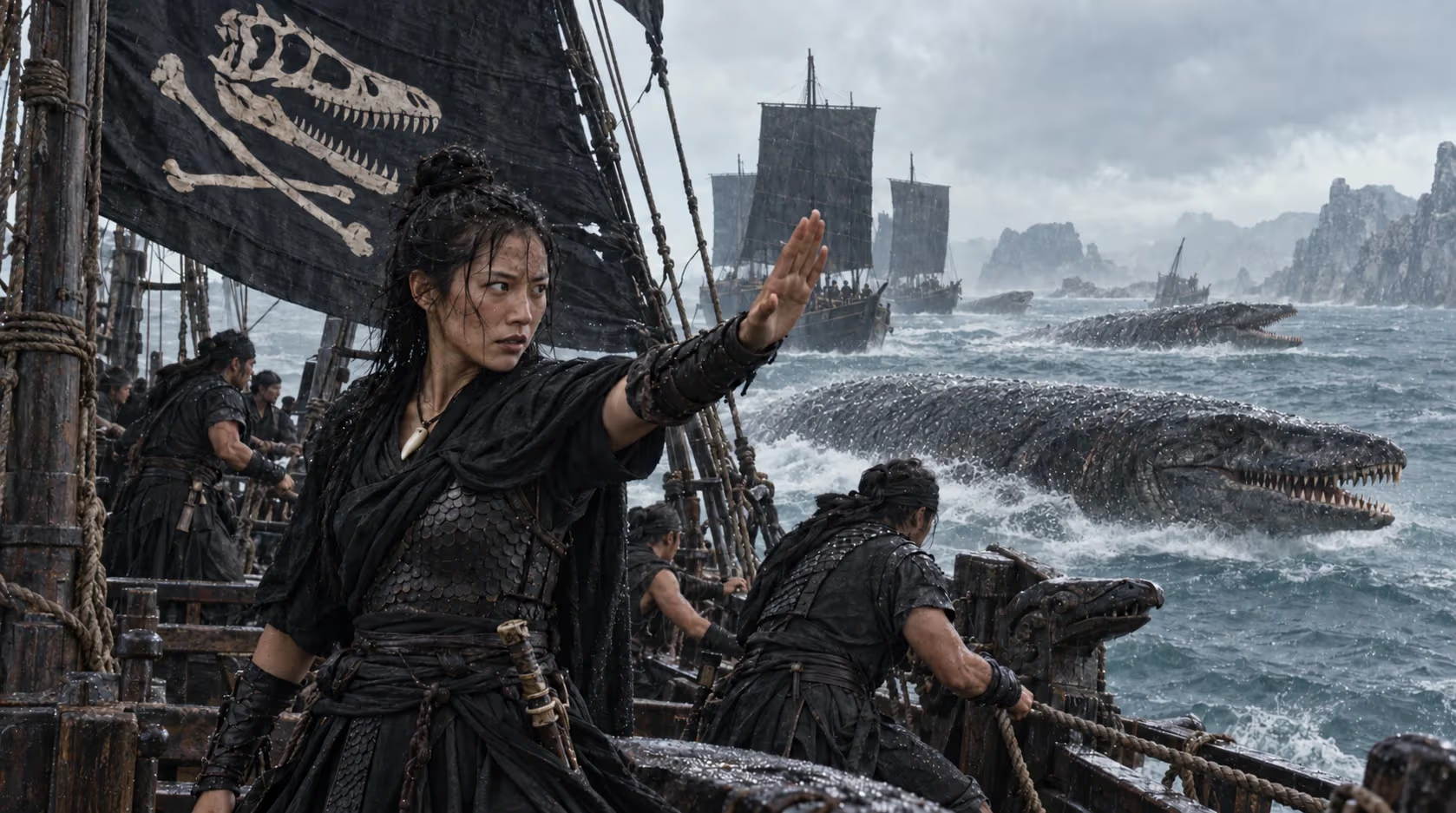
The first scene is a portrait of command. A captain stands at the stern of a dark wooden ship in cold rain, the black flag cracking above him; a few lengths off, two black backs break the surface, and a third, further away, barely rises behind another ship. All three Mosasaurus are there, but they are never seen whole: a back, a snout, a mass that changes the colour of the water.
This is how the Pirates du Nord like to be shown. A captain does not pose before a palace or a treasure, but before the Blacks, as if to say under whose protection he sails. The image respects a detail northern sailors know well: a mosasaur has no dorsal fin, its smooth back breaks the water without standing proud of it, which is why it is seen so late. Northern sailors say you never see a Black coming, only leaving.
The black boarding
The second scene shows the hand-to-hand fight. The pirates climb aboard an enemy ship over the side, dressed in black from head to foot, with not a single animal in the frame: boarding is a matter for men. Their weapons are biological blades — marine teeth, carved bone, fangs mounted on hafts — lighter than metal and proof against rust in the spray; scale breastplates and laced leather arm-guards leave their movements free.
Boarding is the last phase of a Pirates du Nord attack, never the first. By the time their men climb aboard, the enemy crew has already seen the surface close around it and felt the hull shudder under a blow from below. Many surrender at that moment. Those who resist face fighters trained to fight on slippery decks in a heavy sea, one hand on a rope.
The Double Circle seen from the mast
The third scene is taken from high up, from the mast of a ship under attack. Around the hull, small marine mounts trace a ring of foam, their riders carrying fire-pots; closer in, under the surface, a black mass moves, barely distorted by refraction. This is the doctrine of the Pirates du Nord, the Double Circle, as seen by the lookout who is about to die.
The first circle closes the surface: the fast riders set fire to the boats, the sails and the oil spread on the water, and stop anyone from jumping overboard or lowering a boat. The second closes the depths: a Black strikes under the hull, where no archer can aim. Caught between the two, a ship has no way out, up or down. The image shows at a glance why a maritime civilisation far smaller than Volonia can stand up to it.
The sea turns black
The fourth scene is under water. It shows a black head, powerful flippers and wet, pebbled skin as the animal rises towards a keel. The view is partial on purpose: no one aboard a ship ever sees a Black whole. First a shadow darkens the water, then the hull takes the blow.
The blackness of the three animals is natural. They come from a local melanistic line, extremely rare and kept up for a long time: back almost uniformly black, anthracite flanks, very dark grey belly. Their scars show only when they surface, and their harness is cut to the bare minimum, with no decoration at all. To Volonian crews, used to the republic’s marked and harnessed mosasaurs, that plainness is more unsettling than any ornament.
The masters of the cove
The fifth scene leaves the sea for a low hall on the edge of a cove: the captains’ council. A dozen men and women sit around a table of rough timber, each in a different black outfit — cuts, knots, sashes and ornaments mark out ranks and crews. In the middle of the table lie three black tokens. The flag with the saurian skull hangs behind them.
The three tokens stand for the three Blacks. No decision that commits the animals — a distant expedition, open war with a Volonian house, a truce — is taken without them: the captains in charge of a Black raise its token to approve, or leave it on the table to refuse. The rite is a reminder that the power of the Pirates du Nord belongs to no captain in particular. It belongs to the whole coast, which entrusts it to its best sailors.