

Places and landscapes
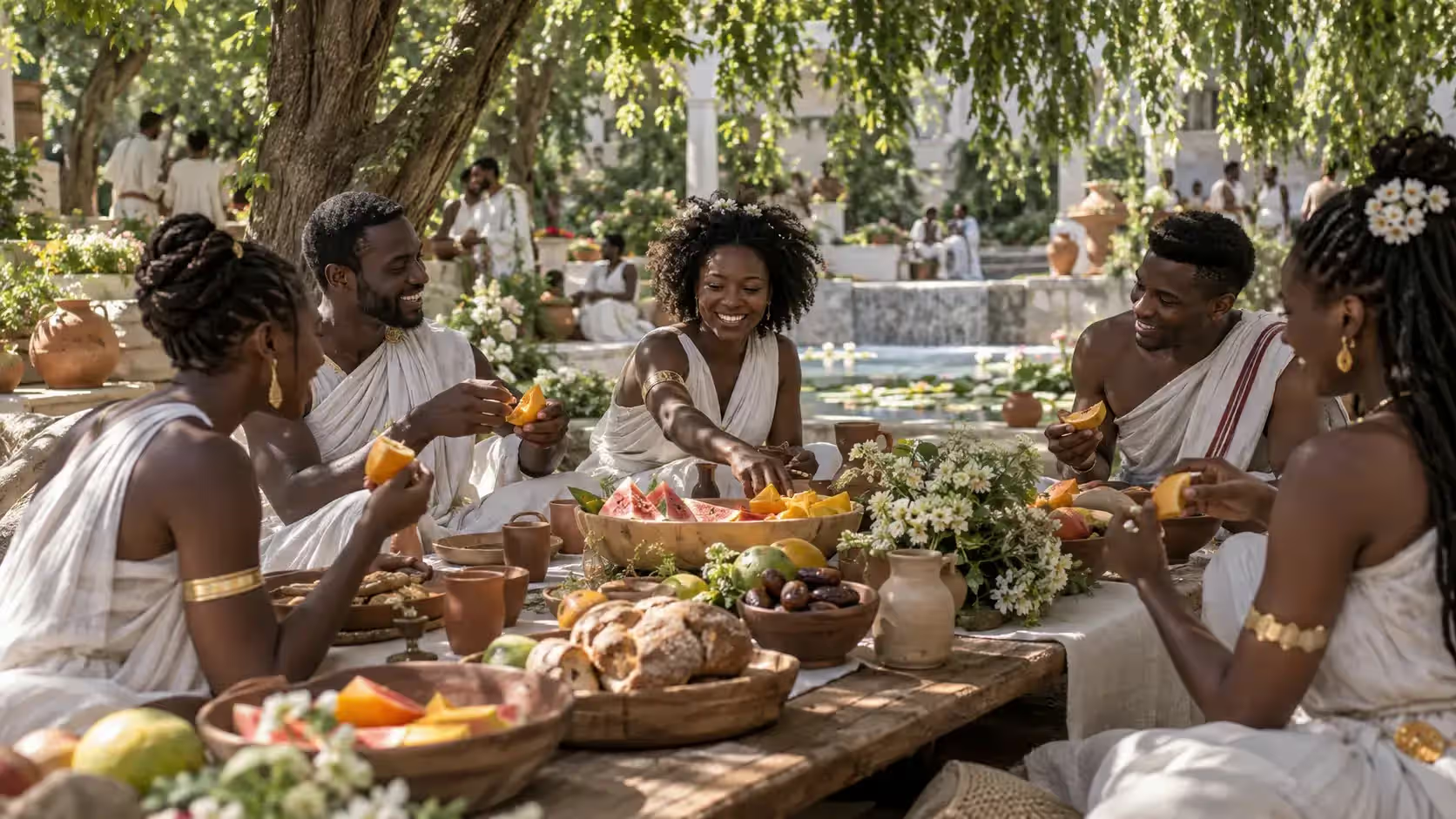
The Verger des Halcyons
A region of fruit, harvests, communal tables and seasonal festivals: Ishtir’s gastronomic region.
Soil, water and shade
The Verger des Halcyons is a region of fruit, harvests, communal tables and seasonal festivals. The quality of soil, water and shade matters there as much as yield.
Border sanctuaries and ritual orchards stand there, alongside specialised crops, plants, religious institutions and suitable livestock.
When the harvest becomes hospitality
The region shows another side of farm work: the harvest becomes hospitality, a communal meal and a seasonal festival. That beauty rests on precise tasks — irrigation, pruning, shading, terrace repair, distribution and cleaning — which keep the orchard from being a mere picture of prosperity.
Cereals, dates and fruit belong to Ishtir’s food repertoire, and purity rules govern how meals are prepared and shared. Refectories, communal kitchens and distribution halls make food available without an internal market.
The gastronomic region
During the Respiration, the Verger des Halcyons is the country’s gastronomic region: fruit, banquets and harvest festivals. People eat there, it is said, until they can no longer move.
Places and place names
The Vergers Rituels du Serment are among the region’s named places.
Marshes, clearings and slopes
The Verger des Halcyons is nothing like a plain of tidy orchards. Around the town of Halcyons, which gave the region its name, stretch marshes and damp forests; fruit trees occupy the clearings and the high ground, won from the water by earth levees and drainage canals. Further on, the wooded hills of Hel-Vaara shelter vineyards in their clearings: this is where the Ritual Orchards of the Oath lie. The coast is short, but the Port of Halcyons receives boats and coasting vessels there.
It is one of the least populated regions of Ishtir, and one of the most carefully tended. An orchard plot needs more hands than a grain field: pruning, grafting, propping, picking from ladders, shading young plants, repairing the levees after every flood. Grain comes from elsewhere: the region receives it from the Plaines des Brontes and the Côtes des Alizés.
The solar wine of Hel-Vaara
The vineyards of Hel-Vaara make three wines. Ordinary wine goes with refectory meals, cut with water. Solar wine, stronger, aged in wax-sealed jars, travels all over Ishtir and abroad, in amphorae, through the regulated ports: it is one of the few Ishtiri goods that Volonian merchants ask for. Sacred wine, finally, never leaves the temples; a Keeper of the Sacred Wine holds its register, jar by jar.
Whole trades live around the presses: potters of jars and amphorae, coopers, makers of fruit preserves, herbalists who draw simple remedies from marc and bark. During the Breathing these same cellars open their courts to the banquets; the year’s wine is tasted under the trellises, and fruit fermentations are a local pride.
The Temples of the Solar Nest
The Orchard is also Ishtir’s nest. The Temples of the Solar Nest receive the hatching of the sacred eggs of the ceratopsian lines; the shells never leave and are kept at the temple. The eggs incubate in sand pits warmed by fermenting leaves and grape marc, which the brooders turn and feel by hand several times a day. Small horn-beaked dinosaurs, the temple oviraptors, sort and guard the eggs; they spot a cracked shell and let no one they do not know come near.
Beside the temples stands the House of Eggs and Lineages, both school and archive. There people study the formation of embryos, animal genealogies and frauds involving rare living things, and the titles of Nest Keeper, Lineage Scribe and Gauger of the Rare are granted. The certificates it prepares are then sealed by the Greffiers du Nid.
The groves of the Sacred Wood
The forests of Hel-Vaara supply Ishtir’s sacred wood, used for temple roof frames, wooden gnomons and the Greffiers’ chests. No tree is felled there without a rite: a gardener of the Order of the Gardens designates it, a priest speaks the formula in the sky register, and the felling is done in the morning. Every tree cut down is replaced by a sapling planted before a witness, and the grove’s register records the place of both.
Wood that is not sacred goes into barrels, beams and charcoal. The region’s woodcutters say they never cut a forest, only trees, and their groves are often cited as proof that a Garden can be worked without being exhausted.
Guarded sanctuaries
The national map makes the Orchard a land of frontier sanctuaries, and not by chance: sacred nests on a coast are a temptation. The temples are walled, their gates held by Wardens and guard styracosaurs, and relay pteranodons, the Watchers of Halcyons, circle over the quays to signal any unknown sail. The elders link these walls to the memory of the Excursion of the Solar Horns, when Arkhan raids targeted the eggs and the sanctuaries.
On feast days, however, the same sanctuaries open to pilgrims and guests. The harvest banquet is often held at the foot of their walls, on long tables in the orchards’ shade: flatbreads of solar grain, fruit roasted with honey, marsh fish, lotus rhizomes and wine cut with water.