

Institutions
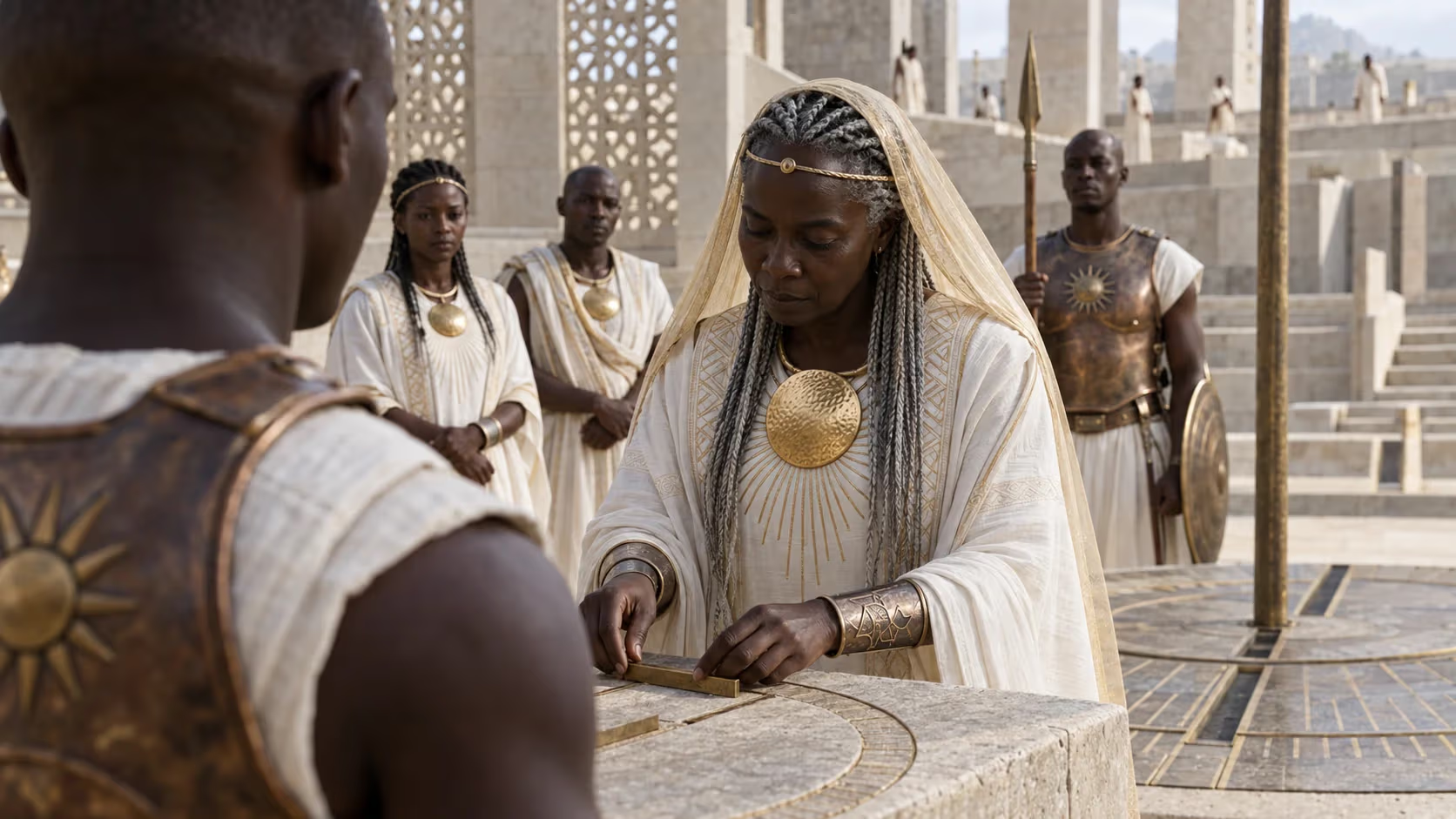
The First Weighing
At eighteen, every Ishtiri — Bronze by right since childhood — is weighed for the first time: the Weighing assigns an adult rank, an order and a posting.
Coming of age
Every child of Ishtir is Bronze by right, from birth to adulthood. Childhood is the same for everyone: cohorts mix children whose future Weighing nobody knows, and the rank of their biological parents — whom nobody knows either — plays no part.
The First Weighing takes place at eighteen. It keeps a person in Bronze or raises them to Silver or, more exceptionally, to Gold. Later Weighings come every seven years; the mobility they open remains zero-sum, and every change of rank requires a move.
What it decides
It is not a school examination. On the same day a person comes of age, enters civic contribution, receives a professional posting and a first adult rank, and begins to wear certifications and medals in public. Entering adulthood is at once civic, professional and religious.
The decision sets the responsibilities a person may take on, the trades they are authorised to practise, the orders they may join and their public standing. It rests on comparable proofs: examinations, practical work, service, exercises, games, duels, command, the ability to teach and certifications already earned. The great majority remain Bronze; some reach Silver, a tiny minority Gold.
The First Weighing does not judge a birth. It can recognise someone from a cohort with no particular prestige; it can also separate two people who grew up together. Childhood is shared and separation comes with adulthood: everyone keeps childhood friends on the other side of the wall.
The cohort bracelet
Those newly weighed wear on the left wrist a cohort bracelet braided from the strands of their childhood companions, which they keep for the rest of their lives. Since in Ishtir it is the cohort, not a family, that mourns the dead, the bracelet tells, at death, to whom the body should be returned.
The year before
The year before the First Weighing is like no other. Seventeen-year-olds gradually leave the chores of the great court for the trials: written examinations, practical work in the orders where they did their rotation, first drills and games under the eye of the trial masters. They assemble their file with their keepers and declare their preferences.
They can be seen rehearsing in front of their cohort how to stand before the Weighers, and the youngest of the house watch them the way one watches travellers about to leave. The keepers also teach them how to lose: they are told again and again that confirmation in Bronze is not a failure, and the cohort’s elders come back to tell of their own Weighing, the best and the worst hour of their lives, often on the same day.
The east side of the square
First Weighings are held on the same day as the quarter’s Weighing, on the same square, but on the east side, the side of the rising sun: that is where one stands when one begins. The cohorts line up there, knees trembling under new tunics, each of them holding their left wrist where the brand-new bracelet has not yet loosened. The Weighers call the names one by one; the whole cohort shouts the name of whoever leaves the table, and the square takes up the shout, even for a youngster nobody knows.
The Weigher’s gesture is the same as for adults: the hand opened towards the sun and then closed for a rise, laid flat for a confirmation in Bronze.
“Weighed at home”
The great majority of young people leave the First Weighing as Bronze, and most are glad of it. Confirmation in Bronze opens the order they asked for, a first posting, eight weeks of Respiration and life in quarters they know. A girl who leaves the table posted to the Canaux Clairs she wanted gets as many cheers from her cohort as a rise would.
Ishtir has a phrase for these young people happy with their lot: they are said to have been “weighed at home”. There is nothing condescending in it. It says that a just Weighing can also confirm someone where they wanted to be.
The rare eighteen-year-old Gold
A First Weighing that grants Gold is an event the quarter talks about for years. It is rare, since the ten thousand seats do not grow with every success and one can open only when a place falls free. The young person weighed Gold leaves the cohort for further away than the others: they join the halls of the Rayon d’Or to be trained for the summit, with a single week of Respiration a year from that day on.
The cohort congratulates them and mourns them a little at the same time. Cohort keepers say with a laugh that they prefer eighteen-year-old Silver: one sees them more often.
The first adult week
In the week after the First Weighing, every young person leaves the cohort house for their first adult lodging, allocated according to their order and posting. The cohort house chests are scraped and recut for the younger ones. The newly weighed take their belongings, their bracelet and their first engraved sleeve, still almost empty: a rank, an order, a few certifications.
It is that sleeve, read by everyone, that makes them an adult in others’ eyes. In the first days the newcomers can be spotted because they look at their own arm more often than at anyone else’s.
At the Weighing Hall
In the capital, First Weighings take place at the Weighing Hall of Qer-Aton, under the authority of the Tribunal of the Measure, which belongs to the Rayon d’Or. The Hall receives the young people of several quarters on the same day, and its tiers fill with whole cohorts come to shout the names.
The Tribunal does not weigh anyone itself. It checks that every table followed the rules, keeps the files under solar seals and hears appeals. In the regions, Weighings are held on the quarter squares, and the juries of the Bureau of Certifications travel from one square to the next as the season goes on.
Part of this article covers events of season 1. Turn spoilers on in the menu to read it.