
Places and landscapes
The Silver Reeds
Flooding, mud and fibres give material form to wet margins.
A region of overflows
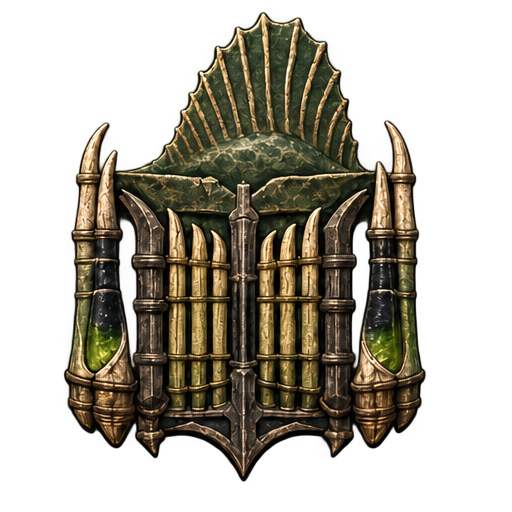
The Silver Reeds are associated with flooding, mud, reeds, acids, fibres and rare biological materials. The landscape supplies materials through its wet processes. Approaching a resource involves soil, water and the organisms producing it; the place of collection belongs to the value of what is brought back.
Les Roseaux d’Argent
Dans les roseaux inondés, des fibres coupées sèchent au-dessus de l’eau sur un petit camp de récolte.
Neighbouring waters can differ
In N’Goro, each basin has its own bacteria, parasites, minerals, acidity and cycles. Neighbouring water can endanger an unadapted body. In a region of flooding, this diversity makes crossing concrete: recognising useful material also requires recognising the water and conditions surrounding it.
Material leaves the place with its conditions
Fibres, spores, filters, living wood and medicine give N’Goro products high value despite low human density. Their transport retains an environmental dimension: season, dose, source basin and delay matter for circulating products. Silver Reeds materials participate in this connection between rare resources and local knowledge.
The College of Alchemists
The Roseaux d’Argent are the domain of the College of Alchemists, turned towards rare materials — reeds, muds and acids — and towards the trade in remedies.
Why “silver”
The name comes from the light. The region’s tall reeds have the undersides of their leaves covered with pale down, and when a wind lays them flat the whole flooded plain turns from green to silver-grey. The mineral-laden muds also shine in the low sun, and some pools left by overflows are covered with an iridescent film that harvesters know to be dangerous: that is often where the water turns acid.
The Silver Reeds stretch across vast low plains that floods cover and uncover through the year. There is almost no firm ground, few large trees and no lasting path: one travels by flat-bottomed dugout, on foot over mats of woven reeds, or not at all. Seen from afar, from a mangrove root at the edge, they look like a calm sea; seen up close, like a field of blades.
Cutters, diggers and acid-takers
Three trades live off the Silver Reeds. The reed cutters mow with billhooks the stems that will yield fibres, mats, roofing, floats and shafts; they work in teams, before high water, and bring back the bundles on rafts built on the spot from the harvest itself. The mud diggers extract rare silts: fine clays for remedy pottery, black muds for poultices, mineral deposits for dyes.
Finally, the acid-takers collect in resin-lined jars the acid waters of the iridescent pools and of certain peats, which go into anti-rot glue, the crystal filters of the Black Quarantine and the pigments of liquid maps, and also serve for tanning and etching bone. It is the most dangerous of the three trades: acid-takers wear oiled leather gloves up to the elbow, mud sheaths on their legs and a dose of Clear Breath in their kit, and they know that a drop in the wrong place costs an eye. An old acid-taker is recognised by hands speckled with small white scars.
Chitin, silk and rope: the House of Phael
The Silver Reeds are not only a plain for harvesting: they are the land of fibres, and the House of Phael holds first rank there. Its workshops at N’Gimu, the town of Argent, weave fibre-caterpillar silk, cloth and spore-cloth; its rope-makers twist ship’s cordage, chitin rope and mangrove-vine rope. The great insectaries of Yamwa, in the heart of the deep marshes, breed the arthropods that yield the chitin for armour, centipede saddles and the hauling collars of the Siirmuu.
Part of this chitin goes to the Control Basins, where it goes into glues and filters. In N’Gimu people say that “a Phael knot holds longer than an oath”, and the Knotters themselves buy their mission cords from its workshops.
The workshops of the College of Alchemists
The College of Alchemists, whose domain is the Silver Reeds, keeps its workshops on long stilt platforms planted at the edge of the plains, where the mangrove resumes. There the region’s materials are transformed: fibres into ropes and filter membranes, muds into ointments, acids into tannins and mordants, resins into glues and anti-rot. The work is done in clay jars and vats heated over peat fires, and in clay stills whose condensed vapours are collected.
The College trades its remedies and materials throughout N’Goro and beyond, but it does not work outside the law: every poison it prepares carries name, dose, signature, origin and antidote, and its counter-flasks are sent to the Control Basins. Its relations with the Sap-Keepers’ Synod are those of two houses of learning that watch each other: the Synod controls, the College invents, and each accuses the other, in low voices, of keeping its best recipes to itself.
A plain no one marches across
For an army, the Silver Reeds are a trap with no trap in it. Nothing there holds a foot soldier, nothing carries a heavy beast, and columns that venture in stretch out over leagues, sunk to the knees, without cover from missiles. Acid waters burn ill-protected feet, reeds cut hands, and the fevers of stagnant water do the rest. The defenders need only hold the edge and let the plain do its work.
The region also supplies part of N’Goro’s arsenal. The marsh stake-planters take from it the stems they harden in fire and tip with bone, points smeared with sticky resin, to impale the great beasts hurled against their lines; archers find their shafts here, and dosers some of their poisons. On the College’s platforms people say that “the Silver Reeds have armed more soldiers than they have killed”, and that this is already a great deal.