

Institutions
Volonia : contrat, risque et responsabilité
Dans les ports voloniens, la finance suit les coques, les équipages et les cargaisons. Le contrat organise qui supporte une perte et qui peut continuer à circuler.
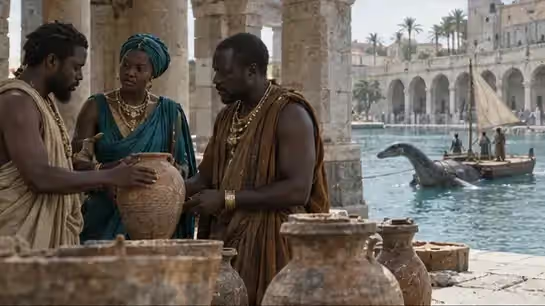
Le contrat suit une activité réelle
Pêche profonde, quais, coques et circulation maritime créent les risques que le crédit et l’assurance doivent ensuite organiser. Une garantie n’existe donc pas séparément de ce qu’elle couvre : un trajet, une cargaison, un chantier ou une personne qui assume une fonction. Cette relation laisse voir les métiers portuaires derrière les comptes.
Déclarer rend le pouvoir contestable
Les revenus et gains enregistrés sont soumis au Quinzième avant de peser dans la vie publique. Le principe est institutionnel : l’argent déclaré doit assumer une contribution avant de devenir pouvoir.
Protéger ne fait pas disparaître le danger
Bellcor / Clair-Sceau associe assurance, crédit, comptoirs et dette. Cette fonction permet de distribuer les conséquences d’un risque entre plusieurs engagements ; elle ne rend ni la mer, ni une traversée, ni le travail d’un équipage prévisibles. Les contrats répartissent le risque entre plusieurs engagements, sans rendre une traversée prévisible.
General average
Volonian maritime law has long settled a case every crew knows: cargo thrown overboard to save the ship. When a captain lightens his hull in a storm or in front of a predator, the loss is not borne by the owner of the sacrificed goods alone. It is shared among all those whose property was saved, and the ship itself, in proportion to their value. This rule is called general average.
Applying it keeps claims brokers and maritime-clause jurists busy. One must establish what was thrown, why, on whose order, and what was saved; the logbook, the witnesses and the hull book serve as evidence. Sailors see in it a simple kind of justice: on a ship in danger, everyone is in the same hold, money included.
The share of the dead
A Volonian contract does not stop at the death of those who carry it out. The commitments of an expedition set out what is owed to the families of the drowned and the missing: a share for widows, the buying back of a bell, a stele when the body has not been returned to the sea. Funeral insurance covers bringing home those who die far from the water. A house that neglects these obligations incurs a debt to the dead, which the opinion of the ports does not forgive.
These clauses carry practical weight. They decide whether a widow keeps her lodging on a lagoon terrace or moves down to the wrecks, whether a sailor’s child can enter an apprenticeship, whether a crew agrees to sail. The best captains have these clauses read aloud before departure, so that everyone knows what the sea will cost their own.
Claw clauses and living-cargo clauses
The trade in living animals has produced its own clauses. Claw clauses, in use in ports such as Sand Harbour, share out the risks of a dangerous animal: a handler bitten, a broken cage, an animal refusing water, a death in the hold, an escape at unloading. Each of these events has its designated party, its price and its procedure, drafted before the animal comes aboard.
Living-export clauses go further. For certain animals sold outside the republic, they require sterilisation, forbid eggs and have the animal accompanied by keepers. A birth abroad in breach of these clauses is a cause for war. Here the contract touches sovereignty: it protects the bloodlines that make a nation’s power.
Risk is shared unevenly
Contracts share out risk, but not equally. A house can insure its hull, its cargo and its captains; a docker injured under a load, a hauler caught by a harness team or a diver struck by pressure often have only the cover their employer chose to write in. Dockers’ unions demand minimum clauses, and win them in some places, through coalitions and stakes.
Volonia says it of itself with cruel frankness: the rich man has a second way out, the poor man a better rope. The contract does not make that difference disappear; it makes it legible. That is already a great deal for those who can read a clause, and little for the rest.