

Institutions
How a decision becomes imperial
An official act must pass through people, materials and institutions before it becomes imperial.
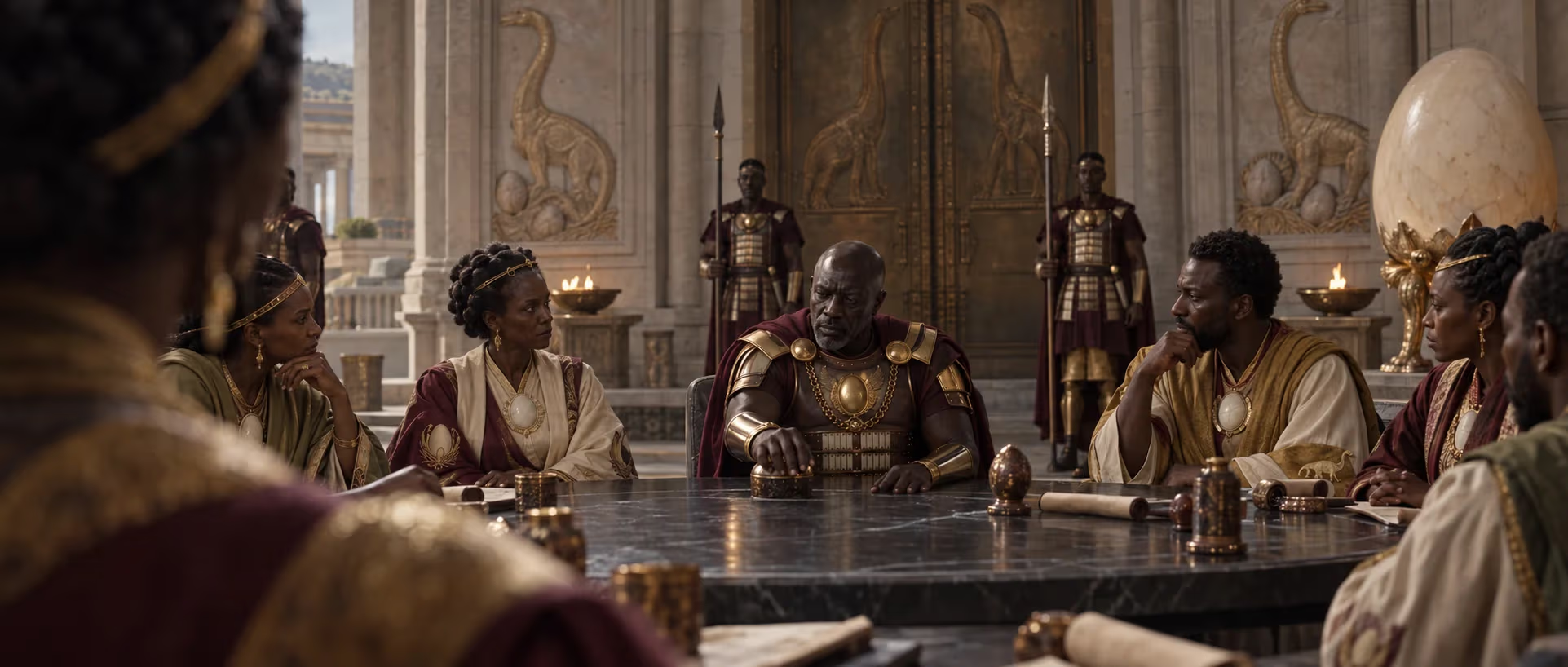
Declare, then feed
Imperial war belongs to the Crown and Grand College, but its execution meets the Bank, Sahina and the relevant dukes. Silos, roads, fodder and the Long-Pas are not campaign scenery: they determine duration, direction and sometimes the very possibility of the effort. This chain explains why an order for war may be legally clear while remaining materially impossible.
Repair without breaking continuity
Repairing a major way involves the High Chancellery, the company doing the work, the local duke and financing. Bridge, paving and watering place do not have the same function, but failure of any one can interrupt the whole chain. The decision must therefore arbitrate between immediate use, load compliance, team time and ability to pay. Infrastructure becomes political when it forces several authorities to acknowledge the same failure.
Certify without owning
The Diet and Bank may certify reserves while stocks remain distributed among duchies, Houses and trade Lines. Public certification therefore does not turn an institution into the owner of grain. It establishes contestable trust: a declaration can reassure markets and inhabitants, or provoke panic if promised reserves no longer appear verifiable.
Import a living being, import a trade
Importing foreign animals requires agreement among road services, the receiving duchy and trainers connected to the knowledge of origin. Financing and public health may also stop the project. This procedure recalls that an animal is not neutral cargo: its habits, care, risks and the people able to understand them travel with it.
Financing a secret project
The decision matrix gives a line to secret armour projects, the living armours prepared for the great animals away from any publicity. Three actors decide them: the Crown, the Living Armouries and the Bank. The assets involved are rare: the black stone of Velmor, unique parts forged in Korath, military secrets. Those who can block are therefore those who supply the material or who might learn of it: Velmor, Korath, and the Grand College if the matter leaks.
This line explains why such a project is politically dangerous. It depends on an archduchy that keeps a right of private war and on a foreign power that forges what the Empire cannot make. Secrecy protects the project against the enemy, but it puts it at the mercy of its suppliers.
Raising a war surtax
To raise a war surtax, the Emperor, the Bank and the Grand College are needed. The decision affects the dukes, the great industrial dynasties and, when contracts have been made abroad, Volonia itself. The rate imposed on tolerated houses may then rise beyond its ordinary thirty per cent, which creates a latent conflict with families such as Karûm-Brakh, indispensable and therefore able to slow their deliveries.
The surtax illustrates a constant rule of the matrix: whoever pays can brake. A great house does not refuse the tax; it discovers delays on its building sites, dearer advances, convoys leaving later. The administration knows this, and it negotiates the surtax with the houses before putting it to the vote.
Training those who will decide
The training of imperial officials also appears in the matrix. The Synod of Living Measures decides officially, through its examinations, its trials and its selection. Dukes through their patronage, rich families through the years of study they can pay for, can bend the result. The stakes go beyond the university: the scribes, stewards and rationers who will leave the Synod will draft, count and carry out every other decision in this matrix. An imperial decision is thus prepared years in advance, at the moment one chooses who will be able to calculate it. The dukes know it: placing a protégé at the Synod means placing a scribe in an office ten years later, and a steward in an army twenty years later.
The path of an act
An imperial decision travels. It is drafted by the chancery of letters, sealed with the seals it commits, the Crown’s and, where money is concerned, the Bank’s, then registered before leaving: an act not recorded binds no one. Relay couriers then carry it, at forty to sixty leagues a day in the best conditions. It takes ten to fifteen days to reach the margins of the Empire.
On arrival, the duchy’s chancery acknowledges receipt with a dated seal, which fixes the moment from which the order is deemed known. This delay is part of the law: a duke does not answer for an order he has not yet received, but he answers for every day that passes after the seal of receipt. The capital’s jokes about orders “that arrive older than they left” are about this rule.
Blocking is not disobeying
The matrix distinguishes those who decide from those who can block, and the latter have no veto. They hold back a means: a credit, a delivery of stone, a ration, a permit to pass. Blocking is lawful, but it commits whoever opposes it. It must be written, reasoned and dated, and its author then answers for what the delay has cost.
This rule gives Urnokian decisions their particular rhythm. People rarely block in silence: a banker, a duke or a builder who holds back his means knows that his name will appear in the register if the campaign fails or the bridge collapses. In Urnok, responsibility follows a refusal as surely as it follows an order.