

Places and landscapes
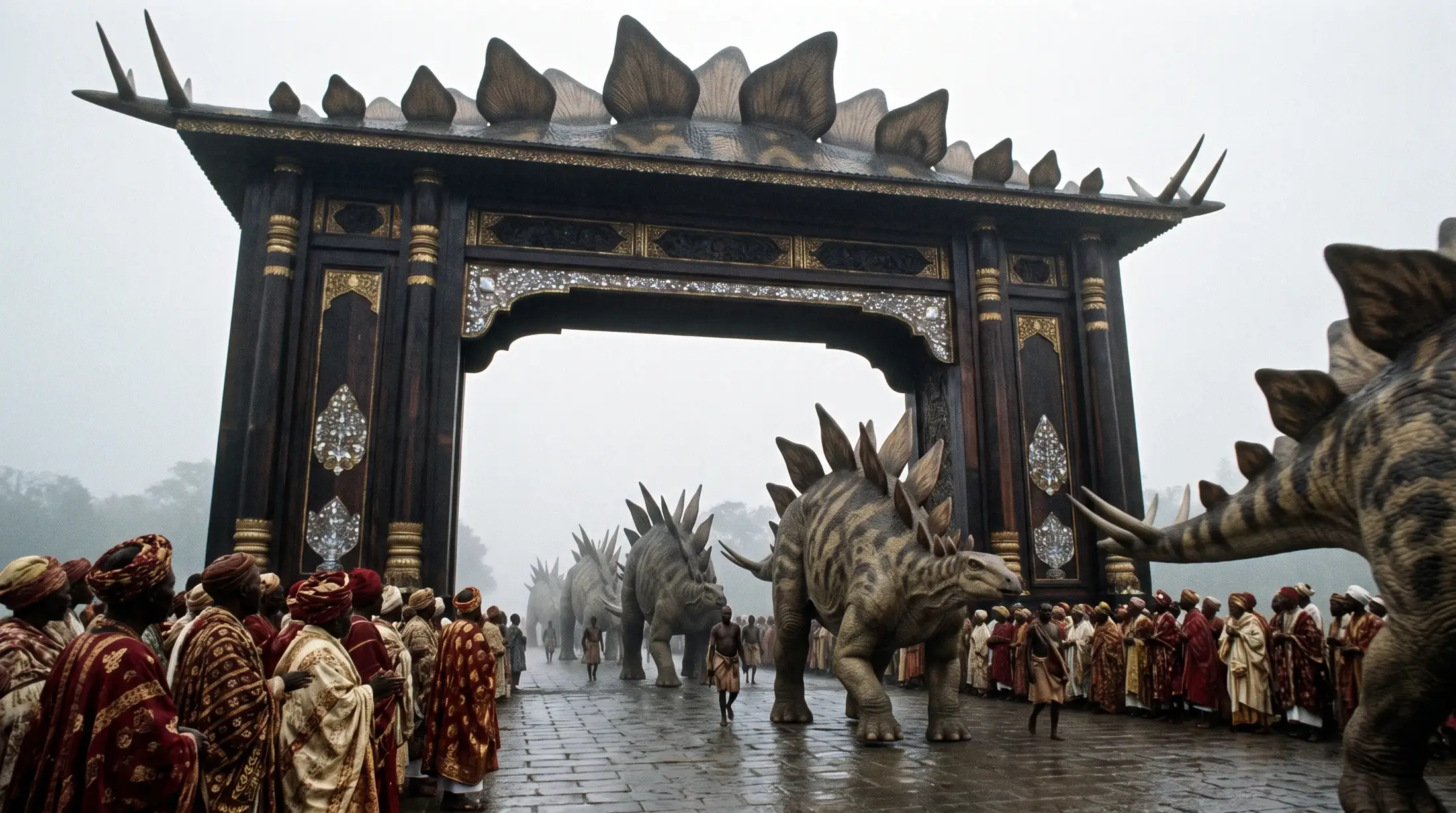
Walls, gates and roofs of Orlantis
Orlantis, the stegosaurid duchy, builds in lacquered fine timber, resin and worn gold. Its double-row walls, fan-shaped caravan gates and plate roofs make up a regional grammar designed around its animals’ armed tails.
Double-row walls
Orlantis’s walls, monumental gates and prestige avenues are arranged in two staggered rows. Baffles, guard walkways, a low palisade and nets complete them, and inlays of amber and resin decorate them. Within reach of the stegosaurids’ tails, forbidden zones protect passers-by.
Imperial stegosaurids belong exclusively to Orlantis, whose emblem they are; none belongs to Velmor. Their presence explains the shape of local architecture: barriers are designed for tails and plates, and forest roads take wide bends.
Caravan gates and fan-shaped streets
At caravan gates, markets and relays, streets open out like a fan: their branches distribute convoys towards several one-way courtyards. Cargo waits on plinths, troughs mark the route, raised refuges protect pedestrians and wide turning pockets take the animals. This plan stays local: it organises a gate or a market, not the whole city. The forest roads leading to it carry tolls and resin halts.
Plate roofs
Orlantis’s palaces, markets, halls, relays and ducal hall share plate roofs. Lacquered teak and ebony, oiled hide, resin and worn gold are their materials; high ceilings and drying lofts go with them, and the overhangs throw rain and resin clear of the roads. The building draws on the animal’s plates without taking any measurement from them.
The guard of the ramparts
Orlantis’s walls have their living guardians. Stegosaurids of the Lomvar Line are permanently posted there, between the two rows of the enclosure, as a mobile wall that is brought wherever a gate is threatened. Their armed tail, which elsewhere requires forbidden zones, here becomes a weapon: a stegosaurid set in the axis of a gate defends its entrance better than a portcullis.
The human guards move along the walkways above the animals and direct them by voice and by signals. The animals are relieved at fixed hours, and their passage along the walls each morning is one of the town’s sights. In peacetime the same animals escort the resin caravans over the first leagues of the road.
Lacquer, resin and fire
An architecture of lacquered wood and resin demands constant upkeep. Every few years the lacquers of the gates and halls are redone by the carpenters of the Mirvane Line and the resin-workers of the Aversin Line; the amber inlays are cleaned, the roof plates replaced when the wood has warped. A well-kept hall keeps the gleam of worn gold for generations.
The main danger is fire. Resin burns, which is why it is always cooked downwind and outside the walls. Within the enclosure, forges are few and watched, lamps are enclosed, and each district has its water reserves and its lookouts. A fire in the drying sheds can halt the whole timber chain for weeks, and the town knows it.
The forest roads
The roads leading to the gates of Orlantis cross the forest in wide curves, because convoys of stegosaurids and logs cannot turn sharply. They carry tolls, elegant relays and resin halts, where resin is stored in sealed jars before being loaded onto the carrying lambeosaurs. Timber, for its part, comes down mostly by water, floated from the cutting grounds to the town’s basins.
The forest has its dangers. Predators of the high forest sometimes attack the convoys, and the Culorn Line, planted by Calaron after the duchy was absorbed, organises the hunts and maps the forest. Its presence is still frowned upon by Orlantine families, who three centuries later still see it as a mark of occupation.
Why two rows
Orlantines readily explain the shape of their walls by their animals. A single enclosure, they say, cannot withstand a panicked stegosaurid sweeping with its tail; two staggered rows force the animal to turn, break its momentum and give the keepers time to step in. The baffles, short walls set in a zigzag, play the same role at the gates.
This architecture also protects the animals. A frightened stegosaurid in a narrow street hurts itself against the walls as much as it hurts passers-by; between the two rows it finds a corridor to its own measure, where it can be calmed without danger. On fair days, when the crowd spills out of the streets, the keepers close the inner gates and send the animals along this corridor rather than through the town.