

Places and landscapes
Routes, stores and safety in Urnok
In Urnok, city and duchies must connect stores, water, convoys and living bodies of different sizes.
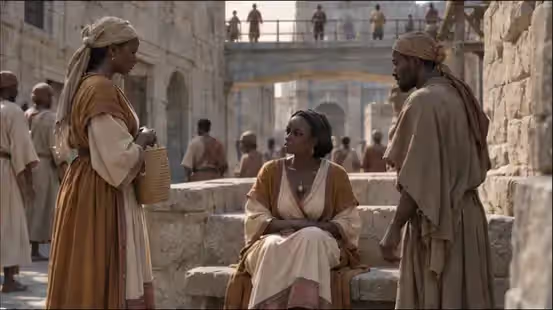
Load-bearing routes and human passages
Load-bearing routes receive large animals and convoys in scheduled slots. Closures, diversions and ground crews are part of the journey. Human movement uses other paths when living mass occupies the street, preventing an ordinary delivery from becoming an exposed crowd.
Water, fodder and inspection at stops
A stop provides water, fodder, rest, inspection and cleaning. Animal needs shape a route as much as the convoy’s destination. These facilities connect the capital Urnok’s streets to granaries, irrigation and the transport Lines working in the duchies.
Stores, seed and rations
Storage distinguishes grain meant to be consumed, seed that extends a harvest, and rations that must be moved. Granary, mill, basin and convoy therefore answer to different responsibilities. A visible store does not reveal who may open it, process it or dispatch it.
Safety networks
Every place that regularly receives animals has, according to its size, a safety network: escape corridors, squares able to absorb a crowd or a herd, buffer pens where an animal can be isolated, bearing roads, human refuges out of reach of a tail or a neck, access to water and care, an exit for waste and carcasses. To these are added a law, trades and a written responsibility for accidents.
These arrangements can be seen in the street. Refuges are raised niches, footbridges or porticoes narrow enough that no great animal will enter them; absorption squares are those widenings readily taken for prestige esplanades; buffer pens line the main crossroads, gates open, ready to receive an animal that has to be taken off the road.
When an animal panics
A panic is fought with signal and space. At the first sign, a foot striking too hard, a neck rearing up, an animal pulling at its straps, the driver blows the conch; this sound, unlike any other, sends passers-by to the refuges. The mass drivers do not try to stop the animal head-on: they guide it towards the nearest absorption square, where it can turn without crushing anything.
After the incident comes the register. It records the hour, the animal, its driver, the line that supplied the harness, the supposed cause and the damage. The injured and the goods destroyed are compensated by whoever answers for the animal, owner or hirer; if the panic came from a broken strap, the strap’s line pays its share. No one is punished for raising the alarm, even wrongly.
A city readable without writing
The capital can also be read by its colours. Smoky ochre marks dirty zones, tanneries, raw markets and districts of waste; lime white signals places of proof, oaths, archives and Houses of Proof; resin green designates places of care and quarantine. A foreigner who cannot read Urnâk thus knows where he may enter with a sick animal, where he must show papers and where it is better not to linger in clean clothes.
The ground completes this code. Light slabs designate clean zones and dark slabs dirty ones, and guards control passage from one to the other at the quarantine gates. The capital’s children learn these colours before their letters.
Who may open a reserve
A reserve is never opened on the sole word of the one who guards it. A silo’s doors require the presence of the silo chief and of the scribe of the line that holds the grain; a ration depot releases goods only to someone who presents a convoy note, for in Sarnor the Tanoris Line owns the right to move the grain without owning the grain itself. Seed reserves, protected by the Law of the Egg and guarded by the Ulmen Line, open only with an additional seal.
Military depots follow another rule: their keys belong to the army’s stewardship, and opening them in peacetime must be justified in writing. This multiplication of keys slows everything down, and that is intended: in an empire born of a famine, no one must be able to empty a granary alone.