

Families and social ties
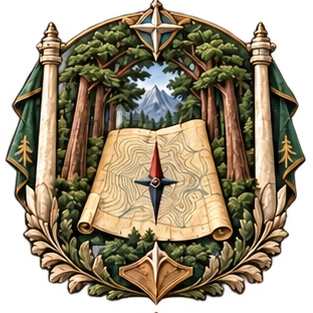
The Culorn Line
Exploring high forest, reading tracks and maintaining a hunting industry in Orlantis.
The forest that is traversed
Culorn is responsible for hunting and exploration in high forest. Hunts, track maps and predator control form its industry. This Line’s forest is therefore read through movement and animal presence, alongside timber, resin and construction industries. Forest trades do not all use the same knowledge of the terrain.
A name from the centre
Culorn is an imperial establishment from Calaron following the absorption of Orlantis. Its name retains the centre’s signature in a duchy where other Lines carry a different layer. The organisation of work thus preserves a trace of imperial incorporation: an Orlantine industry can belong to the local forest landscape while its name recalls the authority that established it there.
One industry among others
Orlantine Lines divide felling, hauling, carpentry, turning and resins among themselves. Culorn’s function adds routes and predators to this productive reading of the forest. Each industry has its registration and responsibility. The duchy is therefore not one trade under one name: it connects different kinds of knowledge about wood, terrain and living animals.
A name of occupation
Three centuries after it was settled, the Line is still looked at askance in Orlantis. Its hard-C name belongs to the layer of the centre, that of Calaris or Curena Ulc, in a duchy whose families carry the proto-Volonian layer: it is a name of occupation, and time has changed nothing. In the order of quarters, the Culorn’s place describes a function, the high forest, rather than a district.
A drive in the high forest
A Culorn drive is prepared several days in advance. Trackers note the prints, the clawed trees, the remains of prey; a valley is chosen where the target animal has its habits. On the day, a line of beaters advances making noise with wooden clappers, while lookouts posted in the trees signal movements with whistles. The archers wait at the mouth of the valley with heavy bows and hunting spears.
The Line does not hunt for the pleasure of nobles: it protects the fellings, the skidding and the roads. The great predators of the forest attack working animals, and an injured stegosaurid costs more than a drive. Some animals are famous on the secondary roads of Orlantis; caravaneers speak of an allosauroid they nickname the Tithe, because it takes one animal and only one from every herd that crosses its territory.
The maps of the forest
The Culorn draw the forest. Their maps, traced on leather or egg paper, show the usable skidding paths, the water points, the nests, the territories of the great predators, the fords and the slopes too steep for a loaded animal. The Berlan use them to choose their fellings, the Lomvar to lay their paths, the caravans to avoid dangerous valleys.
A copy of every map goes to Calaron, where the High Chancellery of the Living Roads files it with the road surveys. This habit, more than anything else, feeds the duchy’s mistrust: in Orlantis they say the Culorn “draw the forest for the Empire”, and suspect their maps of knowing more about the duchy than the duke himself. The Culorn answer that the Chancellery cannot maintain a road it does not know.
Hides, tendons and game
Nothing from a hunt is wasted. The game meat goes to the markets of the forest towns; the hides go to the tanneries, where they receive the bark tannin of the Tanoris of Orlantis before becoming harness leather; the tendons, dried and gauged, become bowstrings and cables. The Empire’s domestic herds are not enough to supply all the leather and tendon the workshops need, and hunting makes up part of the shortfall.
For this the Line holds the hunting grounds in the west of the duchy, which imperial maps call Culvar — a hard-C name, laid down by Calaron like the Line’s own. The claws and teeth of the great predators killed are entered in the Line’s register; a share goes to those who took part in the drive, and some end up as trophies in the hunting hamlets.
Living as an occupation family
Three centuries after their arrival, the Culorn still live somewhat apart. They most often marry among themselves or into families from Calaron, rarely into the duchy’s proto-Volonian Lines, which hesitate to give a daughter to a house people call “the eyes of Calaron”. In the markets their central accent is recognised, and the old jokes of Orlantis readily target them.
Yet they hold a place nobody disputes. Imperial inspectors who come to the duchy have them as guides; caravans pay them to open a road; skidding families often owe them an animal’s life. The mistrust they inspire has less to do with what they do than with what they represent: the visible trace, in a duchy that was once a kingdom, of the authority that absorbed it.