

Places and landscapes
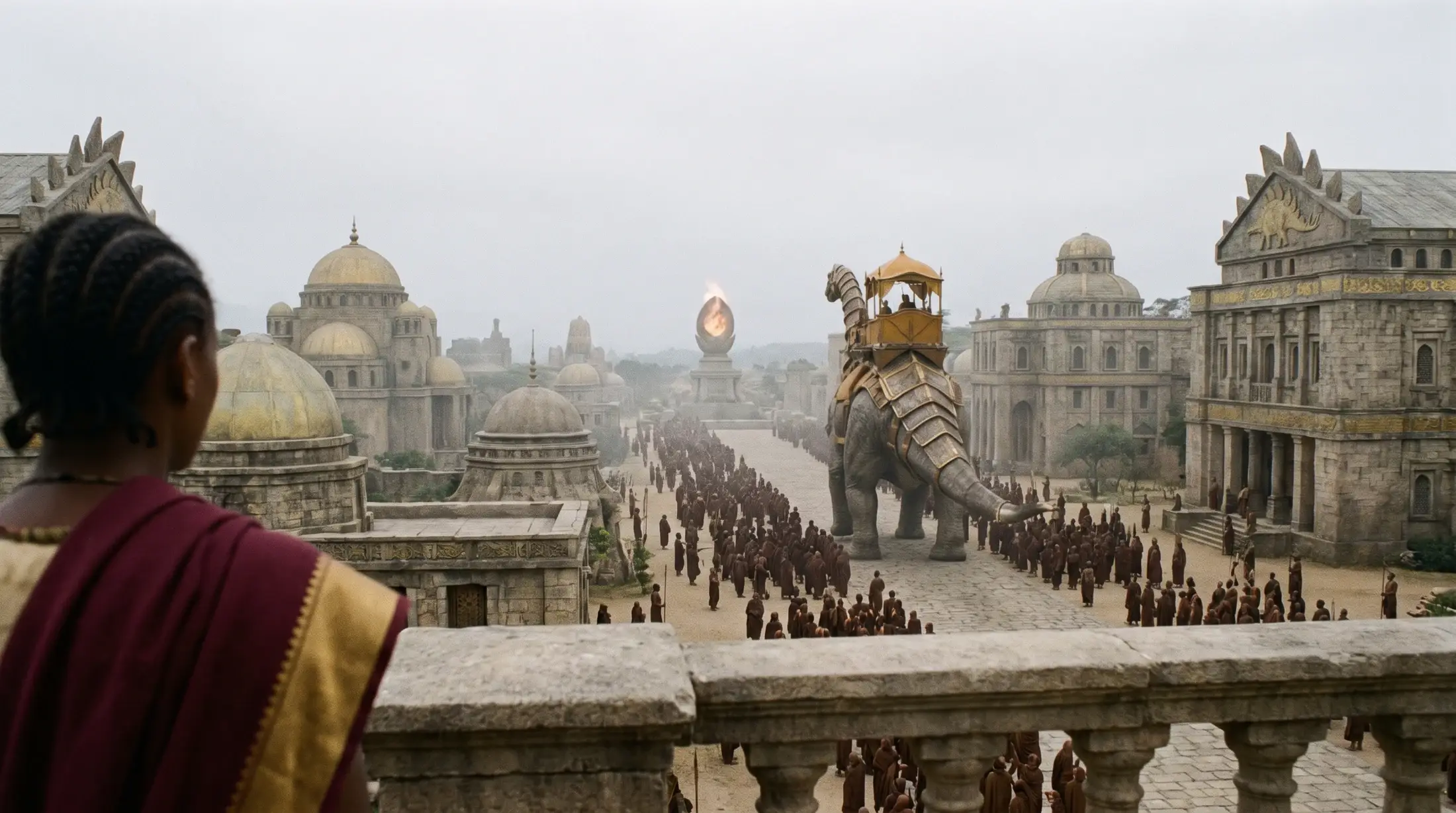
Urnok’s ten styles
Around the Nervure Impériale, ten styles each push one constraint of the colossi into form: load, air, tension, water, the ramp, useful luxury, the colonnade, the ribbon, the scale and fodder. Each can become the signature of a city.
Ten ways of carrying
Each style expresses part of what makes Urnok: load and traction, the comfort of air and smells, harness and tension, water and shade, heavy traffic, administrative luxury, legible flows, the ramp turned façade, the city’s skin and the fodder economy. None is decoration: each form answers a need of the great animals and of those who serve them. The styles coexist within a capital or give their face to a whole city. Their means remain those of the world: stone, lime, timber, rope, leather, bone, bronze and copper, with no structural glass or steel.
Load, air, tension
The Vertebra-Temple turns the city into a monumental skeleton: vertebra-shaped modules lined up in collars of arches, and statues of faceless Bearers. The Imperial Termite Mound builds districts of ventilated mounds, pierced with chimneys, that let the city breathe without machines. The ligament style turns flying buttresses into tendons; its harness cathedral is a sacred workshop where people pray alongside the giants.
Water, the ramp, luxury
The basin style makes the sacred a matter of water and shade: dyke-temples, lake-basins at the heart of districts, stone needles turned harness masts, ventilated, stepped granaries shaped like pyramids. The ramp-palace style lets heavy traffic climb gently sloping temple-palaces whose façade is an engraved traffic map, guarded by long-necked colossi under whose throat one passes. The marble-and-harness style dresses the noble districts in domes and arcades crossed by rings, ironwork and polished winches: the city wears its tools as jewellery.
The colonnade, the ribbon, the scale, fodder
The orders of constraint thicken the column: ribbed shafts cut with grooves for straps, colonnades spaced wide enough for necks and flanks, pediments showing sky charts and animal silhouettes, convoy squares engraved with gutters. The ribbon style makes the city a single stroke: continuous buildings loop into twisted rings, ramps become the façade, turning squares are the knots where the ribbon widens, and twisted monoliths carry engraved numbers.
The scale-and-brass style covers the city in satin black surfaces inlaid with brass: façades of modular scales, opened and closed by hand for air, shade and dust; bridges of ribbed arches with non-slip teeth for traction; harness totems to which straps are really tied during ceremonies. The fodder organ, finally, makes storage the heart of the city: a forest of horizontal and vertical granaries, and fodder stations that are also ceremonial squares.
How a style is born
None of the ten styles was decreed. Each was born in a quarter with a precise problem, heat, water, dust, slope, and from a generation of builders who solved it well enough to be copied. Copying made the style: other quarters, then other cities, took up the same forms, adapted them to their stones and their beasts, and carried them further.
The standards of the High Chancellery of Living Ways fix what must carry, turn and drain; style decides the rest. The Synod graduates who design public works learn the ten styles as one learns languages, and a good builder knows which one to speak in each quarter.
Styles and duchies
Each duchy has its preferences, dictated by its material. Bralnor, a land of stone and counterweights, likes to build in Vertebra-Temple and in orders of constraint, with thick columns in pale limestone. Velmor and Bralnor share the harness cathedrals of the ligamentary style, and Velmor goes on to the black surfaces of the style of scales and brass, where its black stone finds its best use. Sarnor raises fodder organs and ventilated mounds around its silage pits.
The capital gathers almost all of them: Blue Terraces in its basins, marble and harness in its noble quarters, ramp-palaces in its administrative quarters, ribbon in its convoy rings. Orlantis is the exception, with its lacquered walls, plated roofs and thermal gardens, which form a grammar of their own, that of the stegosaurid duchy.
Quarrels of taste
The styles have their supporters and their critics. The capital’s old families find the style of scales and brass too martial, “armour for a city”, and prefer the pale stone of the Nervure; Velmor’s builders judge the domes of marble and harness too soft for a city that must withstand a siege. At the Synod, quarrels between the partisans of mass and those of tension fill whole courses.
These disputes have concrete consequences. When a quarter burns or collapses, the choice of style for rebuilding is debated before the city council, and a city may change its face within a generation. The residents mostly judge by results: a style people love is one whose ramps do not slip and whose vents do not clog.