

Families and social ties
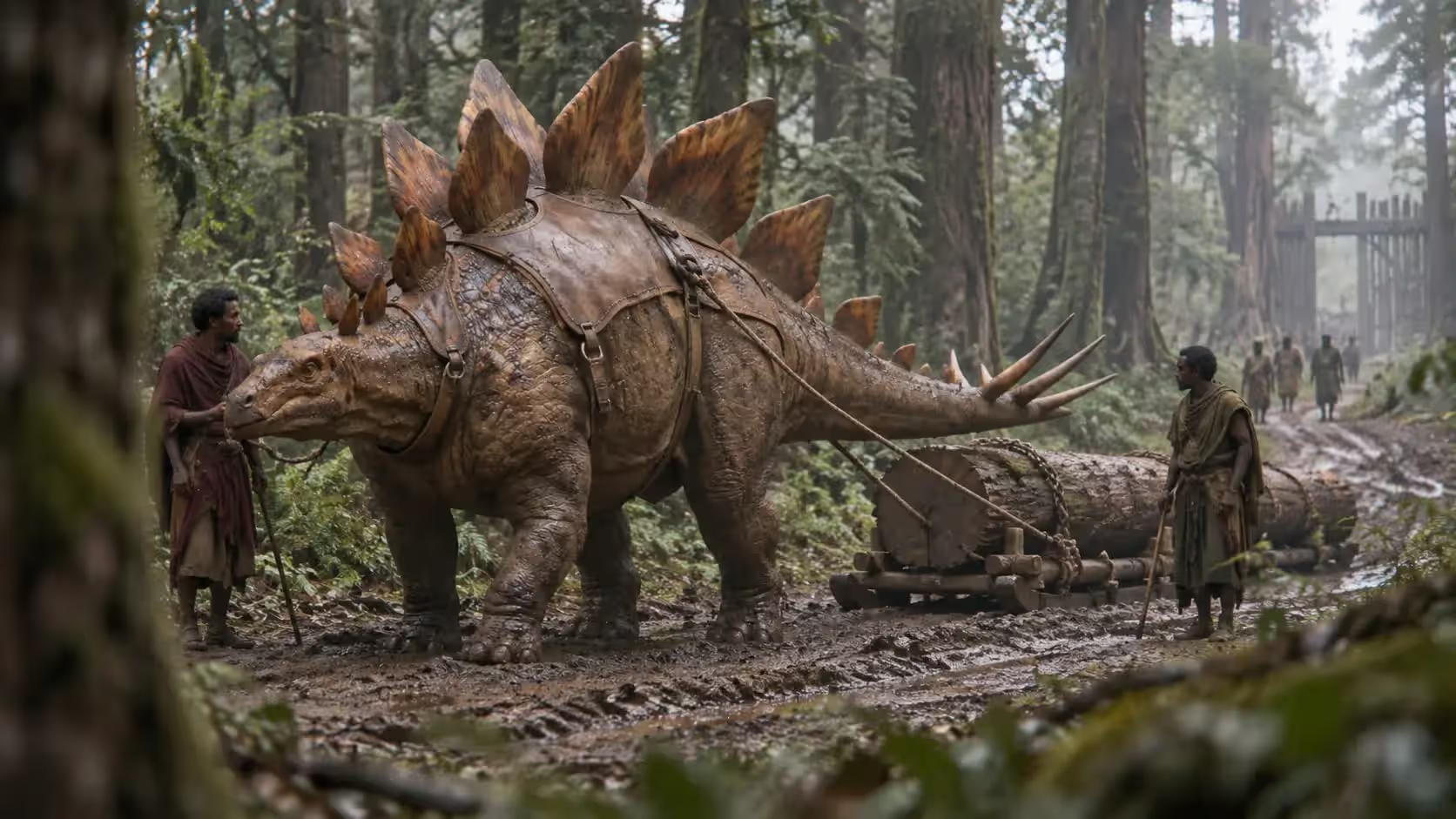
The Lomvar Line
The High Line of the stegosaurids of Orlantis: breeding, training, harnessing and logging. The family that holds the duchy’s emblem is not the ducal family.
The emblem held by a Line
Lomvar holds the stegosaurid chain: breeding, training, harnessing and logging, that is, bringing the logs out of the high forest towards the transport roads. The imperial stegosaurids are exclusively Orlantine, and the stegosaur is the emblem of the duchy.
Yet the family that holds the emblem is not the ducal family. House Voranis governs Orlantis; the Lomvar Line answers for the animals that work for the duchy. The prestige of Orlantis rests on daily work that does not belong to those who represent it.
An animal that goes around the town
The Lomvar enclosures hold an outer belt, with direct access to the forest and the load-bearing road, never the centre: a stegosaurid does not cross a town, it goes around it. The movements of its tail impose no-go zones, refuges for pedestrians and wide turning pockets.
Caring for the plates
The Line’s work includes care. The veterinary basins combine ramps, drains, non-slip floors, inspection platforms, brushes and ointments; water, fodder, rest, inspection and cleaning go with every journey. The exact thermal role of the plates remains little known: nothing proves they serve a universal function.
When these animals go to war, their presence requires infantry able to act in the gaps left by the tails.
The Lomvar stud farms
The Line’s stud farms lie in the country the duchy’s maps call the Lomvaria, “the land of the Lomvar”, near the thermal gardens where the animals are cared for. Orlantis counts a little over four hundred stegosaurids: about two hundred and fifty in the stud farms, between breeders, young animals and skidding beasts, and a little under two hundred assigned to guarding the ramparts, the caravans and escorts.
The three genera raised do not have the same use. The large Stegosaurus haul the heaviest logs and walk at the head of ceremonies; the stockier Dacentrurus are used for skidding on difficult ground; the Kentrosaurus, smaller and bristling with spikes, suit narrow paths and escort work. No breeder leaves the duchy. When another region of the Empire needs a stegosaurid, Orlantis hires out an animal and its handler, never a lineage.
Hauling out a log
Skidding begins before the animal. The Berlan have marked the tree, felled it and lopped it; a crew has cleared the path to the loading point. Then the stegosaurid is brought up, harnessed with a leather collar and Nalen ropes tied to a sledge or directly to the log. The handler walks level with the shoulder, never behind: the tail and its spikes sweep everything behind the hips.
The animal pulls in bursts, to the rhythm of the handler’s voice and the small taps of the pole he gives on its flank to show the direction. A large stegosaur eats close to two hundred kilos of ferns a day and drinks over two hundred and fifty litres of water; skidding days are therefore broken by long feeding pauses, and a Lomvar crew never goes into the forest without its fodder porters.
Becoming a handler
A Lomvar child begins by feeding. He carries the bundles of ferns, fills the troughs, then learns to brush the plates in the thermal gardens, perched on the inspection platforms. The first rule he is taught is that of the tail zone: how far away to stand, where never to pass, how to recognise the slight stiffening of the hips that comes before a blow. Scars on the legs are so common in the Line that they are shown without shame.
Around fifteen, the apprentice walks beside an old animal, under the watch of an experienced handler. A stegosaurid can work for several decades; a handler sometimes keeps the same animal all his life, and his son inherits it. The animals have names, preferences and refusals known to everyone, and the Line keeps a register of each of them from its birth.
In the duchy’s service
Stegosaurids do not only work in the forest. They escort resin caravans on the forest roads, guard the gates and ramparts of the towns of Orlantis, and walk at the head when the duke receives guests or travels in ceremony. Every use goes through a contract between the Line and whoever requests the animal: House Voranis, a neighbouring Line, a caravan or the army.
The contract sets the duration, the load, the fodder due and the rest. A Lomvar handler may report that an animal is not fit to leave; he cannot refuse an order upheld by the authority that requisitioned it, but his opinion is recorded, and responsibility for an injury then falls on whoever overrode it. When stegosaurids go to war, the Line supplies the handlers along with the animals, because no soldier would know how to drive them.