
Places and landscapes
Partir et réinstaller un Village-Mue
Modules flottants, jardins, insectariums et mobilier démontable suivent une communauté vers une autre eau.
Quand l’eau impose le départ
Un Village-Mue se déplace lorsque son eau devient contaminée, pauvre, prédatrice ou politiquement dangereuse. Le départ concerne une communauté et ses moyens de vie : modules flottants, jardins, barges, insectariums et racines cultivées. Il faut déplacer des ressources et des organismes, autant que les pièces du logement. Le village conserve son identité pendant que son emplacement change.
Défaire les modules et alléger le foyer
L’habitat est conçu pour se démonter. Nattes, paniers, cloisons roulables, hamacs et coffres légers accompagnent les structures de bois et de fibres. Les lignes d’ancrage et les passerelles appartiennent aux installations à réorganiser. Un meuble trop lourd peut compromettre la mobilité du village au moment de la mue ; le choix du mobilier participe donc à sa capacité de départ.
Emporter les réserves vivantes
Jardins flottants, insectariums et racines cultivées font partie du village itinérant. Leur transport conserve la possibilité de nourrir, de produire des fibres et de maintenir des services biologiques. Ces éléments doivent rester présents avec les barges de la communauté. Le foyer mobile associe ainsi des objets démontables à des ressources qui continuent de vivre pendant le changement de lieu.
Retrouver des accès dans une autre eau
La réinstallation remet en relation logements, réserves, jardins et voies de circulation. Une eau voisine possède ses propres bactéries, parasites, minéraux et cycles ; elle peut menacer un corps adapté à un autre bassin. Les préparations de route restent elles aussi sensibles à l’eau et à la saison. Déplacer les modules ne dispense donc pas de reconnaître les conditions du nouveau passage.
Une appartenance portée par la flottille
Le nom du village peut rappeler une route, une crue, un animal, un ancêtre ou un événement. Il n’est pas obligatoirement celui d’un site fixe. Les barges peuvent se disposer en cercle pour décider, puis se séparer à nouveau. Cette organisation permet à la communauté de se rassembler et de poursuivre son histoire alors que son habitat migre.
What a Shedding Village looks like
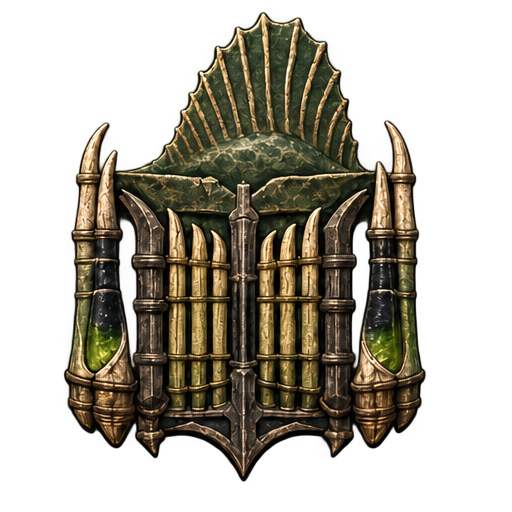
A Shedding Village generally numbers fifteen to sixty floating modules and up to some five hundred inhabitants. The modules are platforms of light wood and bamboo mounted on floats of bound reeds, each carrying one or two houses of fibre and bark. Around them float the gardens on rafts, the village insectary, often set on its own barge, and the nurseries of cultivated roots, sunk in the water in rush baskets.
When at rest, the village arranges itself in a ring around a space of open water where assemblies are held and children learn to swim. The modules are linked by light footbridges and moored to roots or to stakes driven in for the purpose. Seen from the bank, a Shedding Village looks like an island; seen up close, like a permanent worksite, for there is always something to repair, re-tie or replace.
The journey of a shedding
Once the decision is made and the modules formed into a convoy, the village travels slowly, often fewer than two leagues a day. Barges are poled or paddled, floating gardens towed, the heaviest modules drawn in line. Scouts go ahead, often adolescents light enough to walk on the floating mats, to read the water, find the passes and warn of dangers. Each evening the village halts at a place read in advance, moored in a tight circle.
The journey is the most vulnerable moment in a village’s life. Its living reserves suffer from the move, its children and elders tire, and the water at each new halt must be read before anyone draws from it. Villages that move often have their own guides and their contacts at the posts of the Living Mirror; others hire a guide for the length of the shedding, and often pay him in Breath Debt rather than coin.
A shedding in the ritual sense
The name Shedding Village is no figure of speech: departure is lived according to the Mystique of Sheddings and Thresholds. When the village takes itself apart, it enters Closure, like a person in mourning or a chrysalis: festivities are suspended, people speak little, the reserves are tended as one would tend a sick person. Arrival at the new water is an Emergence. It is celebrated with a shared meal on the re-formed ring of barges, and the village sometimes takes a new name then, in memory of the route, the flood or the event that made it leave.
Leaving ahead of war
A water can become dangerous for political reasons, and war is the foremost of them. When a foreign army approaches, the region’s Shedding Villages do not wait for it: they dismantle and leave, taking their gardens, insectaries and reserves, and leave an empty water behind. The invader arrives in a country with no villages to take, no supplies to seize, no inhabitants to question.
This withdrawal is part of the defence. It deprives the enemy of guides and supplies, as the first threshold requires, and it preserves what the Ngoro most fear to lose: their clans, their memory and their living reserves. The villages come back afterwards, or do not; a Shedding Village that has fled an army often carries the memory of that flight in its name.