

Institutions
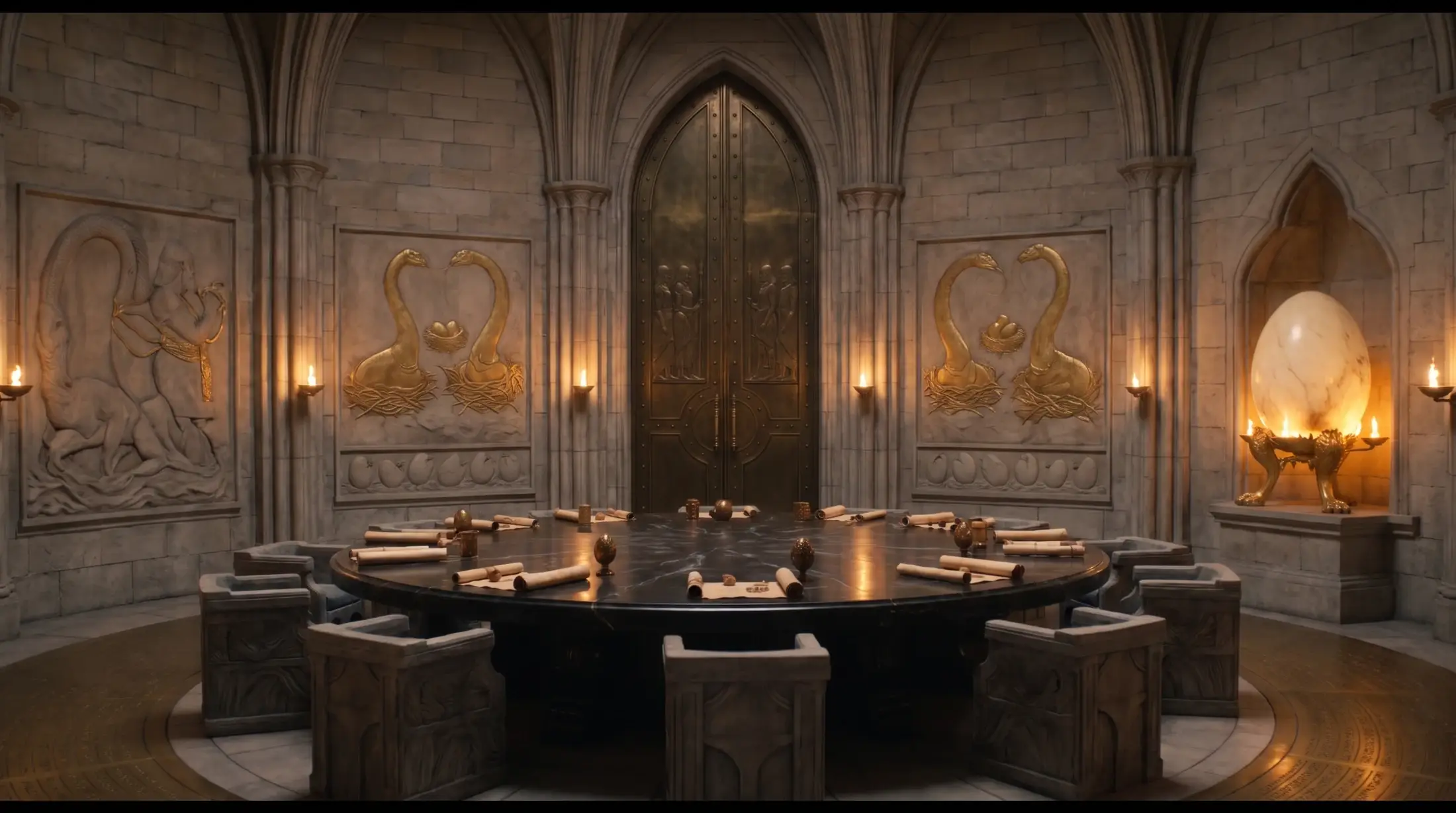
The Houses of Proof
In Urnok, a contract is a built object. The Houses of Proof prevent fraud through their very layout: set routes, seal rooms and sealed deposit chambers. Dressed in white, the colour of proof, they also host the Reading of the Annals.
An architecture against fraud
Where credit, insurance and guarantees circulate, buildings are needed that embody inviolability and traceability. The Houses of Proof are not banks: their architecture itself prevents fraud. Visitors follow a set route; seals are applied in rooms made for that purpose; deposits rest in sealed chambers. Trust becomes material.
These buildings belong to the clean core of the city, with the archives, oaths, temples and treasury. Their lime white is a code: in Urnok, white signals proof.
The contract as a place
The oath has its architecture. Notaries’ cloisters and seal galleries receive it; oath arcades line the squares; oath bridges make the road itself a place of law. Seal houses are inviolable buildings without low windows. A contract is not signed just anywhere: it is signed where the space guarantees its record.
Guarantee galleries and claims hall
A House of Proof works as an organ of circulation for credit, insurance and proof. Its deposit chambers are sealed; its guarantee galleries hold egg chests and tooth chests; its claims hall deals with insured losses of animals, roads and sea. Like all egg storage in Urnok, the egg chests fall under the Egg Law, which requires niches, seals, stands, papers and classified storage.
Workshop markets and certified objects
Proof also goes out into the street. In workshop markets, each stall is linked to a making station, harnesses are repaired on the spot, and objects are certified by seals set into the stone of the buildings. The market is not only a place of exchange: it is a workshop whose quality is proven.
The Reading of the Annals
In the capital, the Reading of the Annals is held in a House of Proof dressed in white, or on the forecourt of a Calaron cathedral granary. Lines of scribes engrave the tablets; families declare; trainers have their animals certified; the Master of the Annals seals the year’s register with one stroke of the seal. A House of Proof can also be a university: in the capital, one of them houses an amphitheatre dominated by the skeleton of a titan.
The path of a deposit
Depositing an act in a House of Proof always follows the same path. One enters by the white door and declares the object of the deposit to a clerk, who writes it in the entry register. One then passes into a room where two sworn witnesses examine the item: a contract, an acknowledgement of debt, a lineage certificate, sometimes an object. In the room of seals the item receives the depositor’s seal and the House’s; great houses seal in amber, ordinary offices in bronze.
The item finally goes to its sealed chamber, and the depositor receives a receipt written in register ink, which cannot be scraped. He leaves by a different door from the one he came in by: no one can thus retrace his steps with an item the witnesses have not seen. The chambers open only with two keys, held by two different keepers.
Those who serve proof
A House of Proof employs keepers of seals, who hold the matrices, the wax and the marks; clerks, who keep the entry and exit registers; sworn witnesses, who pledge their name on what they have seen; and Oath-Braiders, the Empire’s notaries, who tie the sealed cords of sworn knots. Armed guards hold the doors, but they never enter the chambers.
Staff are recruited with care. A sworn witness who has lied loses the right to testify for life, and his name is entered in a register of responsibility that the Bank and the Chancellery consult before entrusting an office or a loan. The trade is often handed down within the same families, who hold a line there in the proper sense of the word.
In the duchies and at the frontiers
Every duchy capital has its House of Proof, and smaller towns a proof chamber fitted out in a road court or a major relay. In Orlantis, where people build in wood, the House of Proof is one of the few stone buildings, and its lime white stands out against the lacquers. In the march of Qor Zaï, the proof chambers of the bone customs receive the certificates of cargoes arriving from Arkhan.
Foreign merchants know these houses. Volonia’s Houses of Endorsement, which insure and exchange, accept an act sealed in an Urnokian House of Proof, and the Empire in return recognises Volonian endorsements. This mutual recognition lets a cargo cross two powers without anyone having to establish the proof again.
What a House proves
A House of Proof attests that an act was deposited, by whom, on what date and under which seals. It does not attest that its content is true: a sealed grain contract says nothing of the real state of the grain, which is a matter for inspectors and probes. Urnok’s jurists insist on this distinction, which the public readily forgets.
Frauds therefore aim at what surrounds the proof: a forged seal, a bought witness, an item swapped before it goes in. Engravers answer by name for every matrix they deliver, and the Court of Responsibilities opens a register in the name of anyone who has deceived a House of Proof. Such an entry closes access to credit for a long time.