
Places and landscapes
The carved cities of Korath
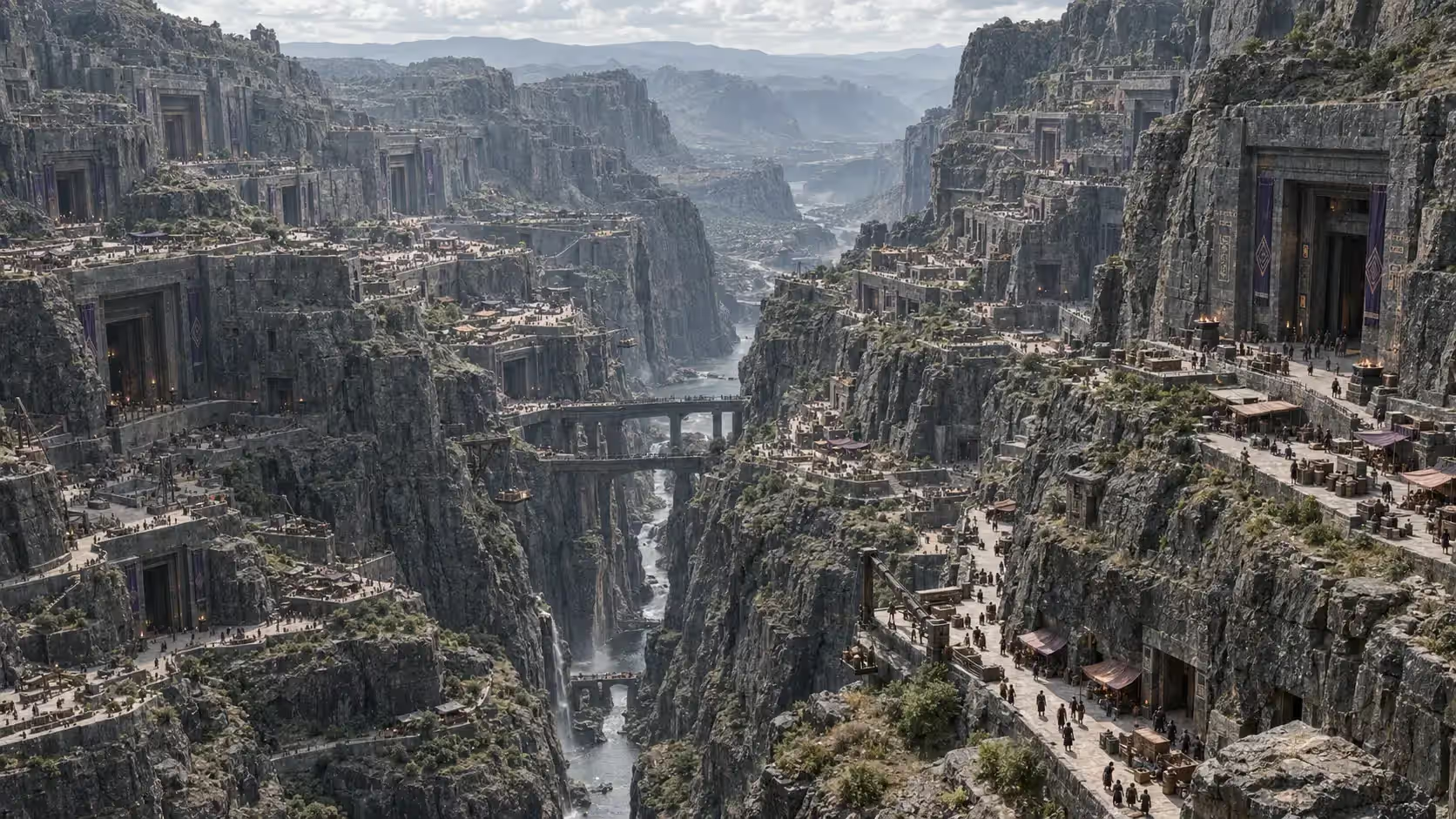
Korath’s cities are carved into the mountain and stacked in layers. Their facade is only the skin of deep settlements, linked by winches, galleries and thermal conduits.
Carving rather than building
Korath’s cities are not set on the mountain: they are carved into it and stacked in layers. Gates, terraces, towers, barracks and markets visible from outside are only the skin of much deeper settlements; a facade shows little of the population, activities and facilities it serves.
Each visible stratum matches a level supported by the mountain; the city does not rise in free-standing towers. Basalt and obsidian provide the material. Walking floors stay rough and polished basalt is kept for walls and inlays, where the black square and the red disc record load lines, workshop rights and patent lineages.
The layers of the city
The warm city occupies the thermally stable zones: homes, baths, workshops, taverns, schools, indoor gardens and markets. Alcoves, built-in benches, stone workbenches and thermal shutters answer to the space available.
Deeper still lie command, cisterns, reserves, archives, arsenals, strongrooms and escape routes. Beneath the active districts, old mines, condemned cities, sanctuaries and abandoned galleries form a historical and strategic underworld. Depth does not guarantee use: shoring, ventilation and upkeep decide what can be occupied.
Going up, going down, closing off
Lifts, winches, galleries, counterweights and funiculars link the layers, and load shafts make the arrangement legible. Pulleys, capstans, hoists and wheels keep an ancient look; rails serve some handling and the batteries without turning the city into an industrial town. Movement is vertical, compartmented and patented: every shortcut has an owner, a protocol and a way of failing.
Passages can be closed. Double doors, airlocks and counterweights seal off a district; a manual emergency closure and reserves of air, water and heat go with it, and the sealed space must still be able to evacuate. A defensive closure can save the city and doom a district. One door has even become legendary, the Dix-Huit Secondes, after a national debate over closing in seventeen or nineteen seconds.
A dual-use city
Almost every major civil infrastructure has a defensive function: lifts, clubs, theatres, taverns, workshops and conduits. Korath, which has no colossi at all, has the highest ratio of active soldiers and reservists among the great powers.
These cities are also a history of techniques. Korath is a civilisation of some seven hundred years, whose human origins go back to N’Goro. Its founding inventions made these cities possible: the Quatre Appuis patent opened the first very large deep halls and founded the carved city; the Souffle Retourné, ventilation driven by differences of heat and pressure, lets the deep cities breathe. About seven million people live in the country.
An address in Korath
In a carved city, one gives not a street but a position within the thickness. A Korathian address states the layer, the load shaft that serves it, the landing and the module: one lives “in the warm city, at the Breath shaft, seventh landing, module twelve”. City plans are not views from above but vertical sections, in which layers, shafts and galleries are read like the floors of an immense building.
This way of finding one’s bearings shapes the language. One goes “up” towards the façade and “down” towards the core; a well-off family is said to live “near the Vein” and a poor district to be “in the cold”. Children learn to find their way by the shafts and by the signs painted on each landing, and a lost foreigner is quickly spotted: he looks for a street where he should be looking for a winch.
A day under the rock
The day begins with the morning gong, which public clockmakers synchronise from one district to the next. They set the time of the doors, workshops, convoys and changes of guard: in a city without visible sun, the public clock stands in for the sky. Thermal shutters open, winches start turning, and galleries fill with apprentices, porters and clerks.
Light comes from oil lamps, from workshop embers and, near the façade, from light shafts where bronze mirrors send daylight down to the upper levels. The markets of the warm city open onto great halls where mushrooms, smoked meats, imported grain, tools and newspapers are sold. In the evening the taverns fill up; later, those old enough go down to the Fault Hearts, while the city lowers the fire until morning.
The forgotten levels
Beneath the active districts stretches an underworld that Korathians call the forgotten levels: old mines, condemned cities, deserted sanctuaries and abandoned galleries. Some date from the civilisation’s first centuries, before the great patents made deep halls and city ventilation possible; others were closed after a collapse, a toxic spring or a change in ventilation.
These levels are not useless. The command keeps passages known only to itself there, along with reserves and fallback routes; archivists find old plaques and tools; teams go down to salvage cut stone or metal. Access is regulated, because the air is uncertain and the supports are no longer maintained. Tales of children lost in the forgotten levels are part of popular culture, and they serve above all to keep children from going there.
Great cities and pass towns
Not all carved cities are the same size. A few great cities gather a large share of the country’s seven million inhabitants, with their Chambers, national forges, Fault Hearts and markets. Around them, dozens of smaller pass towns live from passage, garrison and chain workshops; near the Failles rouges, other cities have organised themselves around furnaces and arsenals.
Each keeps the same principle: a modest façade, an inhabited warm city, a deep core and forgotten levels. What changes is scale and speciality. A pass town counts its shafts on the fingers of one hand and holds together around its gate; a great city has hundreds of shafts and districts their inhabitants almost never leave.