

Places and landscapes
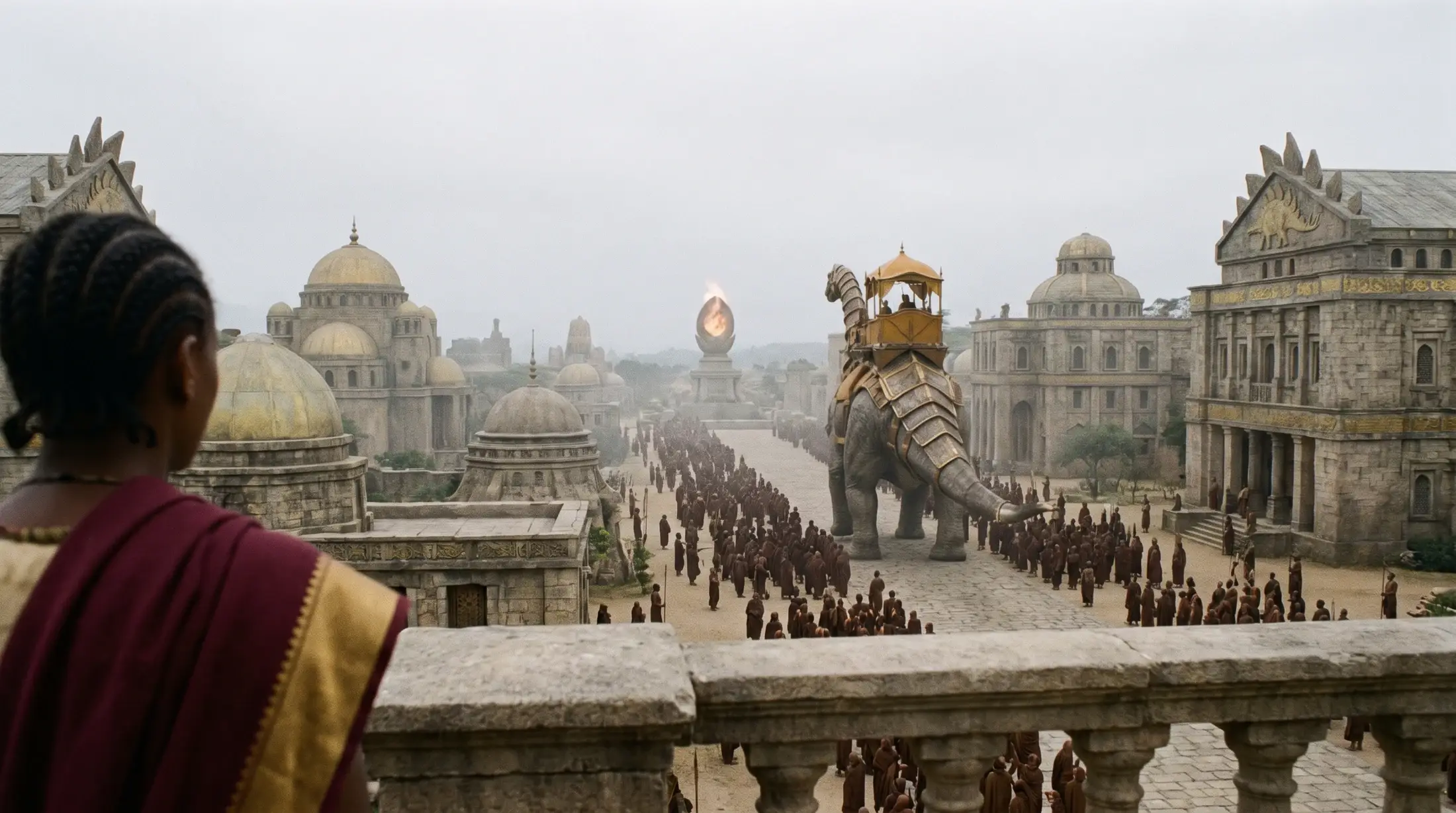
The ligament style and the harness cathedrals
An Urnok style in which tension becomes architecture: taut arches, stays, hollowed buttresses, leather roofs and lashed frames. Its major form, the harness cathedral, is a sacred workshop where people pray alongside the giants; it is found in the noble workshops of Velmor and Bralnor.
Tension made visible
The ligament style takes up the thrust of great naves with flying buttresses, but the flying buttresses become tendons. Everything is stretched, sinewy, tied: taut arches, stays, buttresses hollowed with inner passages. The form expresses a literal tension, that of the harness, the load and traction.
Living materials have their place. Very strong roofs of stretched leather cover lashed frames that flex under shocks. The look stays ribbed, organic yet practical. The same style builds lines into the city: façades carry mooring rings, streets offer regular tie points, and some buildings serve as giant pulleys.
The harness cathedrals
The harness cathedral is a temple-workshop. Its columns serve as mooring masts, its statues as winches, and its beauty comes from taut ropes that cut up the light. People pray alongside the giants there: it is a sacred stable as much as a sanctuary. Its window bays, filled with thinned horn, scales and tinted oiled membranes, show no human figure, but maps of migrations and the family trees of animal lineages. Very slender, almost unsettling statues depict the Strap Weavers, an order at once religious and technical.
Tension towers
In the districts of power and money, the style can reach as far as tension towers: rigid members of bone, bamboo, hardwood or metal, which do not touch one another, held by networks of rope. These towers house archives, counting rooms, guilds and exchanges, linked by suspended bridges. They signal mastery of framing and rope-work, and contrast with the massive terraces of the rest of the city. Votive structures are re-tensioned and rebalanced during ceremonies: stability becomes a rite.
The Strap-Weavers
The order of the Strap-Weavers is both religious and technical. Its members plait, sew and test the colossi’s great straps, those that hold a howdah on a back or a bridge on a neck; they also keep the harness cathedrals, which they serve as clergy. A novice spends years plaiting training straps before being allowed to touch a piece in service, learning at the same time the workshop’s prayers and the load tables.
Their best-known act is the trial. A new strap is hung beneath the cathedral vault and loaded with increasing weights through an entire night, watched in silence by the Weavers; in the morning it is blessed or cut. The very slender statues that depict them in the naves show elongated figures with outsized hands holding a taut strap: the faithful say they watch over every fastening in the city.
Windows of horn
The coloured windows of the harness cathedrals are not made of glass. They are built from plates of horn thinned to translucency, polished scales and oiled membranes, stained with ochre, verdigris and bark juice, then set in latticework of hardwood or bronze. The light passing through them is amber, slightly cloudy, and changes colour through the day.
These panels show migration maps and lineage trees: the seasonal routes of the great herds, the pedigrees of a stable’s famous beasts, the crossings that produced a line of draught animals. They age fast, crack in the sun and must be remade every few years. The workshops that replace them copy the old designs and add the new births, so that a window is also a register kept up to date.
Building in tension
A ligamentary building is never finished: it is tuned. Stretched-leather roofs shrink in the sun and slacken in the rain; the tendon and fibre lashings that hold the frames loosen over time. Teams of tensioners therefore go round the buildings at every change of season, tighten the stays, regrease the leathers and replace tired bindings, following a register that records the tension of each piece.
This suppleness has a reason. A colossus passing shakes the ground, and rigid masonry eventually cracks under repeated jolts; a lashed frame moves and comes back. The builders like to compare their buildings to a body: bones that do not touch, held by tendons, absorbing shocks without breaking.
Blessing the harnesses before war
The harness cathedral takes its most solemn place on the eve of campaigns. A legion’s war harnesses, howdahs, breast straps and the collars of its great beasts are brought in and hung in the nave; the beasts themselves come in through the great doors, and people pray with them, in silence, amid the song of the ropes set humming by the wind. Each driver then ties to a pillar a short strap bearing his name, which he will come back to untie on his return.
The two duchies that carry this style do not live it the same way. In Velmor the cathedrals are of black stone and black leather, and straps still tied after a campaign are left there for years, like a roll of the dead. In Bralnor the stone is pale, and engraved counterweights offered by quarrymen’s families hang beneath the vaults.