

Places and landscapes
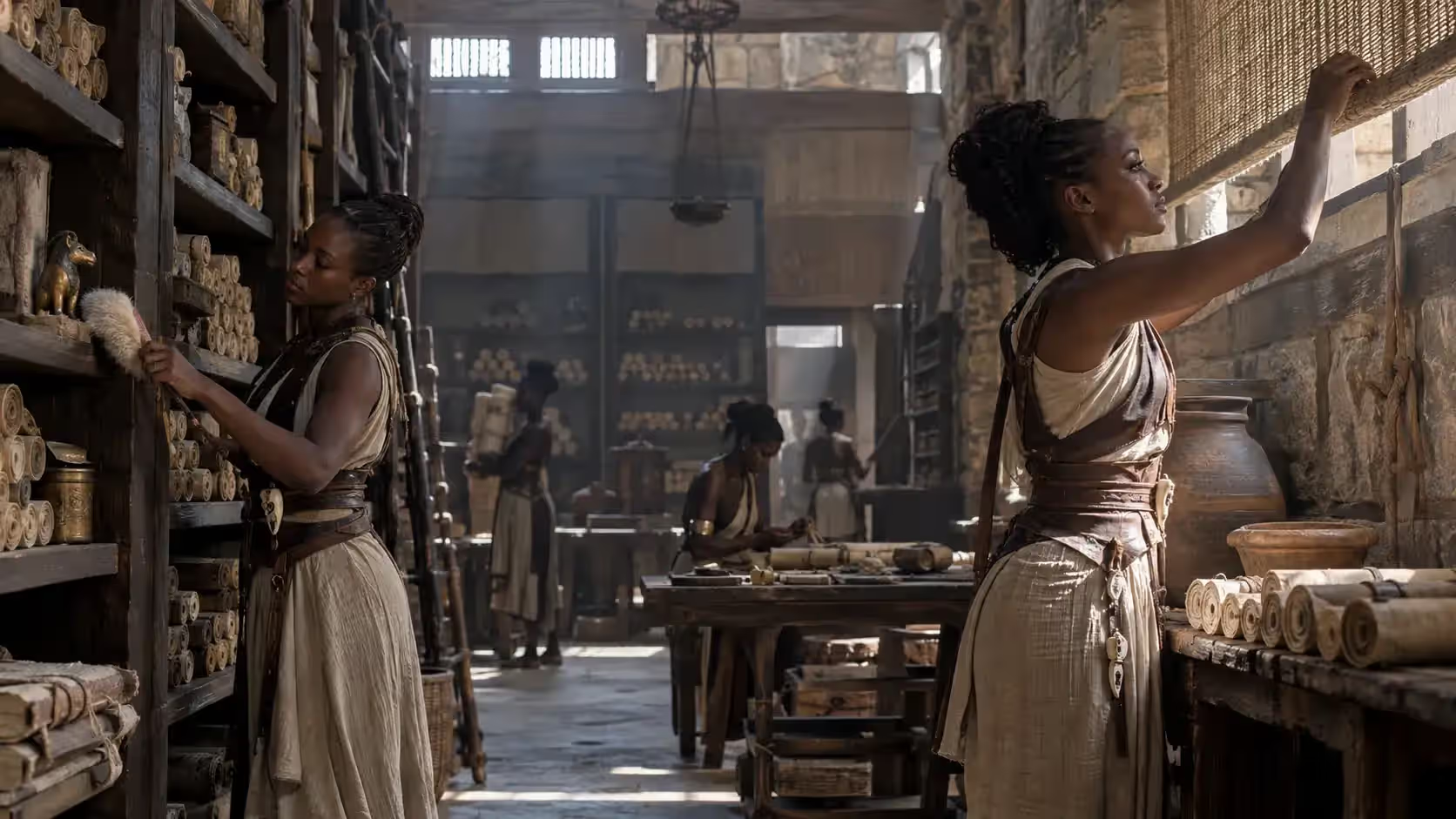
Terraced archives and counting halls
In an empire of registers, archives are buildings of climate: cool rooms, passive ventilation and filtered access. Their gardens drink up water, their hanging galleries overlook the courtyards, and their counting halls open beneath ribbed domes.
Keeping paper cool
In the capital, archives occupy the heights, with the palaces and banks. They rise in terraces: cool rooms, passive ventilation, filtered access. Air there is a tool of preservation as much as of comfort; dust, damp and heat are the enemies of the register. The paper they keep is often egg paper, made of egg membranes, plant fibre, fine lime, glues and wax: a durable medium for contracts, titles and accounts, the emblematic material of the duchy of Calaron.
Archive gardens
In the imperial district, the universities and the seats of the great families, archives surround themselves with geometric gardens. These filtering gardens absorb water, limit mud and filter the canals. Above the courtyards, very slender hanging galleries serve as inspection walkways for people, while the ground is left to heavy loads.
Counting halls open beneath ribbed domes lit by oculi, in the dust and over floors polished by countless steps. Laws are engraved there on spiral steles, like musical scores.
Four materials of memory
The imperial archives do not keep a single medium. Egg paper, supple and durable, carries contracts, titles and leather-bound registers; it occupies the coolest and driest rooms. Oiled clay tablets, heavier, keep long-term accounts and rest on wooden racks. Engraved bones and boards, inherited from the oldest registers, are stored apart, in chests that are opened only to copy them.
Each material has its keepers. Binders re-sew worn registers, engravers recut tablets whose signs are fading, copyists copy out what a medium can no longer hold. The laws, for their part, are not stored away: they remain engraved on the spiral stelae of the counting halls, where anyone can read them.
Consulting a register
The archives’ filtered access is no empty phrase. Anyone wishing to consult a register presents himself at an entrance lodge, shows his seal, his safe-conduct or an office’s letter, and states what he is looking for. An archivist fetches the item and presents it in a reading room, under watch; nothing leaves, and a copy, when granted, is made by one of the house’s copyists and sealed as such.
Some registers are more in demand than others. The lineage register, which gives each animal its degree of domestication and its legal status, and the register of responsibility, opened in the name of those who have committed a serious fault, are consulted every day by the Bank, the Chancellery and the customs before entrusting a loan, an office or a cargo. Archivists note every consultation: knowing who read what is also part of memory.
The enemies of the register
Damp, mould, insects and fire are the enemies of the archives. The terraced rooms are oriented to catch the wind and shed the heat; the chests are varnished with Orlantis resin, and small bags of lime that drink up moisture are slipped between the sheets. No lamp enters the conservation rooms: work is done there by the light of the oculi, and the doors are closed at nightfall.
An archive never keeps alone what matters. Important registers exist in several copies, in the capital and in the duchies concerned, so that no fire or flood can make a debt or a lineage disappear. The great recopyings are done at fixed intervals, and a generation of scribes spends part of its life copying out what the previous one wrote.
Archives and war
In war, the archives become fortresses. The Register of the Dead opened for each campaign records there the responsibility for animal losses: which great animal fell, under which commander, in the service of which legion. Compensation, promotions and sometimes trials follow from it. An enemy who burns a register destroys more than paper: he wipes out the proof of what the Empire owes and of what is owed to it.
The treaties themselves rest in the archives on the heights, beside the frontier maps and the old acts of the absorbed Crowns. A claim several centuries old may sleep in a chest and resurface at the moment of a negotiation: in Urnok, an archive is a weapon held in reserve.