
Places and landscapes
Basalt, chains and blades: the Korath style
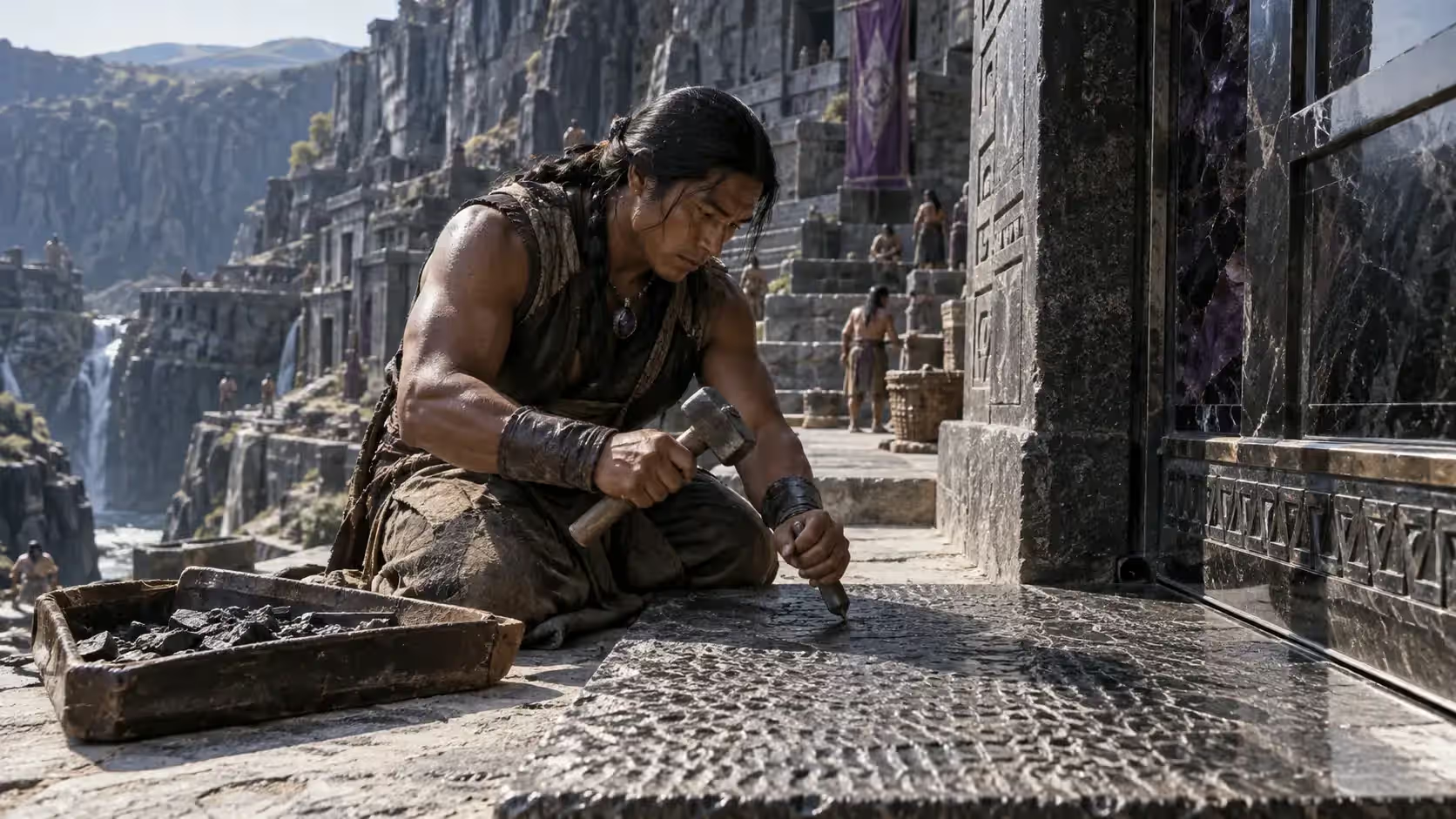
In Korath, the mountain imposes a functional verticality: hanging platforms, chain bridges, blade forts on the ridges, stairs for people and ramps for pack animals. Basalt, obsidian and the basalt mosaic form its language.
A functional verticality
In Korath’s mines and passes, the mountain dictates a functional verticality. Hanging platforms and chain bridges link the rock walls; blade forts hold the ridges. Stairs are kept for people, ramps for pack animals. Imported animals stay in the lower marches: they structure neither the deep cities nor sovereignty.
Moving about in Korath means passing from one device to the next: stair, shaft, winch, funicular, corridor, timed gate. Every shortcut has an owner, a protocol and a failure, and a defensive closure can save the city while condemning a district.
Obsidian and blades of light
Obsidian gives a sharp-edged aesthetic. Slabs are dark and throw glassy reflections; windows are blades, thin openings in the depth of the rock; heat channels warm the floors. That heat comes from the massif itself, which the Warm Vein distributes to homes, greenhouses, baths and workshops. In the obsidian cavities, a polished, split rock stays dark outside and luminous inside.
The basalt mosaic
The basalt mosaic is Korath’s common language at every scale: the Great Chamber of Patents, markets, workshops, taverns, funicular stations, temples and streets. The black square, the red disc and the load lines record workshop rights and patent genealogies there. Walking floors stay rough, for footing; polished basalt is kept for walls and inlays. Furniture follows: square, refined and modular.
The layers of the mountain city
A great Korath city reads in layers. In the lower marches, rounded forts set within a square grid let animals turn and keep clear the arc of their tails. The visible terraces form the skin of a carved city, each stratum matching a level supported by the mountain. In the warm core, forges and arsenals line up stone workbenches, crucibles, moulds, gauges, patent plates and slag drains, ventilated without factory chimneys. Finally, the lock districts close their double doors and counterweighted airlocks over reserves of air, water and heat; a district that can be sealed must also be able to evacuate.
The colours of Korath
Korathian style is recognised first by its colours. Black dominates: the matt basalt of walls, the polished obsidian of inlays, dark leathers. It is lifted by ember tones, the orange of forges and of magma reflected on stone, and by shades of plum and purple, those of rock lit by crucibles at night. Luxury plays on these contrasts: black obsidian veined with orange or purple, warm bronze against basalt.
Coats of arms and emblems take up this range, black, ruby red and bronze, and the national symbol sums up all the rest: a red disc inscribed in a black square. It is found on doors, plaques, seals, workshop banners and even on the tableware of the great houses.
Cast bronze, hammered bronze
Korathian metal is not factory metal. Parts are cast in bronze or copper in stone moulds, then reworked with the hammer, filed and fitted by hand; their surfaces keep the mark of the tool and take on a dark patina over time. No riveted sheet metal is seen on Korathian works: assemblies are made by interlocking, pins, hinges and parts cast in a single piece.
The style likes to show how things work. A door shows its counterweights, a table its ironwork, a jewel its joint, and the patent plaque is often fixed in plain view, like a signature. Journeymen sum up this taste in a workshop phrase: forge, not factory. A Korathian object must look made by precise hands, not turned out by a machine.
Dressing in the mountain
Korathian clothing answers the cold of the ridges, the heat of the forges and the narrowness of the galleries. People wear thick, tightly woven fabrics, fine dinosaur leathers, short cloaks that do not catch in winches, work gloves and boots with rough soles for basalt floors. Workers’ clothes are dark and without needless ornament; those of the bourgeois take up the same cuts in finer materials.
Jewellery speaks of rank and taste. Obsidian, bronze and copper dominate, often with a visible mechanism: a hinged buckle, a spring clasp, a ring whose bezel opens. Workshop supporters wear their club’s colours as a scarf or armband, and on a derby day the partisans of each side can be told apart in a street without a word.
Style can be heard too
A Korathian city can be recognised with one’s eyes closed. By day, workshop hammers strike in polyrhythm, steam is released in bursts, and the breathing of the furnaces, the giant bellows of the forges, gives the whole city a continuous bass. In the set-square taverns, chalk can be heard squeaking on slate while customers redo a calculation, and press debates are shouted from one table to another. At night, the percussion of the Fault Hearts rises through the rock in opposing patterns.
Smells complete the picture: hot metal, a faint sulphur drifting from the faults, machine oil, wet black stone and forge beer. Foreigners who studied in Korath often say this is what they miss most when they return home.