

Armies
Arkhan — Arsenaux et matières du vivant
De l’atelier au terrain d’exercice, les os, les tendons, les cuirs et les cornes deviennent des pièces choisies pour une fonction précise.
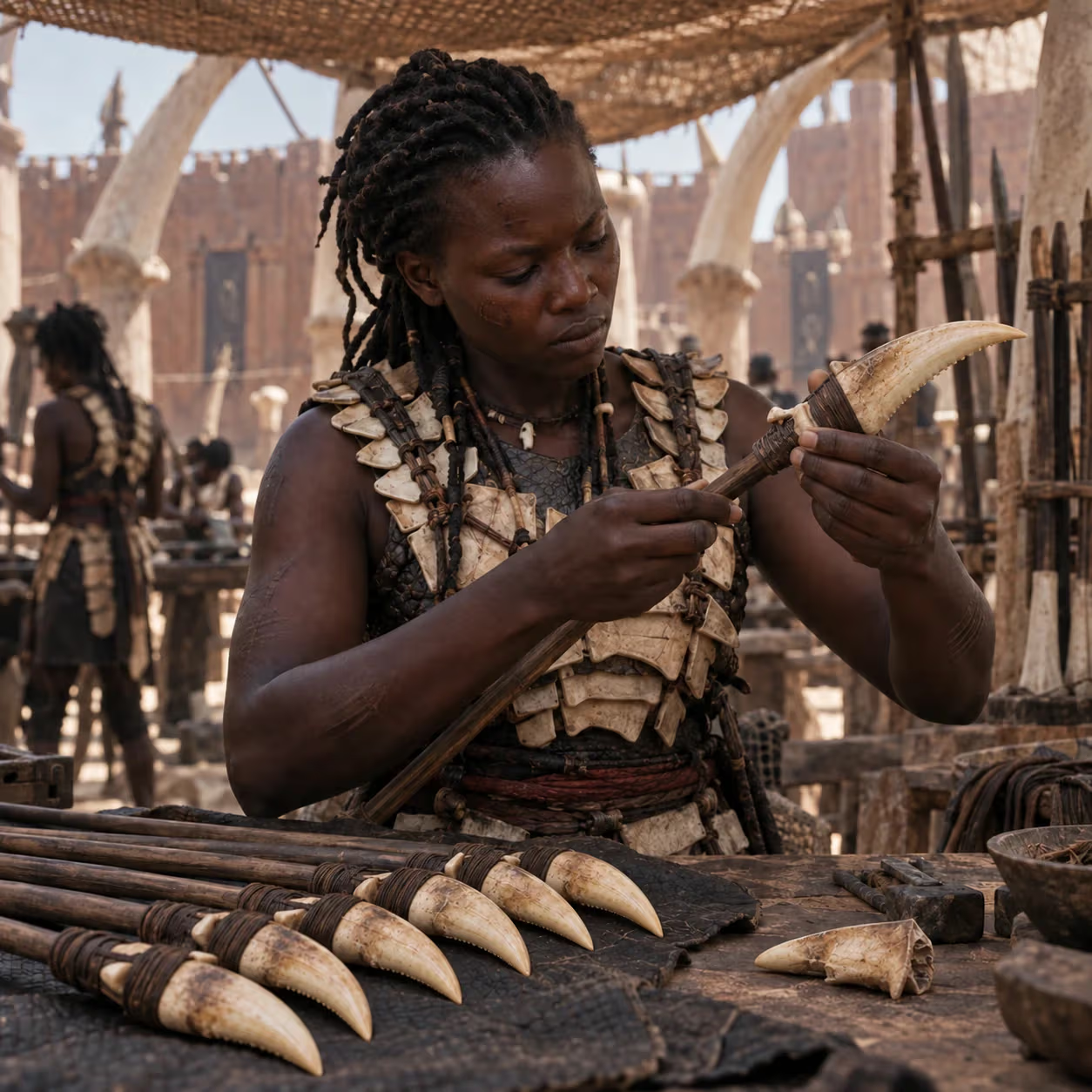
Choisir, assembler, réparer
This extended reading is currently available in French.
Os, dents et tendons forment des filières distinctes. Les préparer ne revient pas à employer indifféremment les restes d’un animal : leurs propriétés, leurs usages et leur entretien comptent. Le travail de Vashkar et les métiers du vivant situent les armes dans une économie de la matière. Une pièce achevée doit rencontrer un corps, une prise, une charge ou un mouvement ; son aspect ne suffit pas à expliquer sa fonction.
Prendre la sangle
Cour d’entraînement · exercice au crochet.
Les matières biologiques ne rendent pas toute arme supérieure au métal. Une doublure doit rester souple, une protection laisser respirer et une pièce usée pouvoir être remplacée. Les plaques dorsales décoratives se distinguent des pointes adultes destinées à l’armement.
Éprouver le matériel
Inspection, manipulation et entraînement révèlent la place de ces équipements dans une formation. Les gaines de griffes et les couronnes d’Apex restent des prototypes ; les équipements scellés gardent le secret de leur fabrication.
Observe gestures and materials · 2 images
Quatre couronnes pour l’Apex
Cour de soin et d’essai · examen d’un prototype importé.
La courbe du tendon
Cour des archers · entraînement à l’arc composite.
Animal bone: supporting, sorting, joining
The boundary comes before the workshop
Human bone is forbidden in Arkhan crafts, weapons, armour and objects. The ban covers enemies, slaves and condemned people. After battle, human remains are separated from recovered animal materials. The bone chain therefore begins with a distinction that yields neither to a batch’s value nor to the brutality of its context.
Animal bone: supporting, sorting, joining
A part does not bear loads in every direction
Cortical bone serves compression, frames, beams, columns and armour parts. Poorly oriented, it gives way in bending, and it needs treatments and resins. These limits explain the importance of sorting and joining.
Animal bone: supporting, sorting, joining
A chain for walls
A material that pulls
Sinew serves in bows, ballistae, cables, harnesses, traps and cliff ropes. Its fineness, volume and strength are graded by animal origin, though this grading does not guarantee the performance of every piece. Sinew is worked according to its intended use and load.
An armourer joins several materials
A biocomposite armourer works in the Stone Teeth sphere: bone, leather, sinew, resins and metal enter his armour. Sinew is not an isolated curiosity but a component within workshops and an animal-recovery economy. Expertise concerns assembly; bone is not forged like iron.
Tensile work needs maintenance
Moisture, decay and fatigue limit sinew. Adhesives and anti-rot treatments contribute to its durability. It is exported to Korath workshops, and these purchases depend on roads and suppliers. A precision weapon thus depends on organic material remaining usable from animal to workshop to service.
Dents, griffes et petites pièces
Percer, scier, signaler
Les dents peuvent devenir inserts, pointes, scies, harpons ou signes de prestige. Leur dureté ne les rend pas universelles : une pièce cassante, mal orientée ou mal liée échoue. La forme de l’objet et le travail de montage comptent autant que l’origine animale.
Dents, griffes et petites pièces
Une petite pièce dépend d’une grande chaîne
Collecte, sélection, supports, ligature et réparation précèdent l’usage. Cette production occupe plusieurs ateliers arkhans ; chaque dent n’appartient pas pour autant à une Maison, un chef ou un trophée individuel.
Dents, griffes et petites pièces
Transportable ne veut pas dire sans règle
Ces matières compactes circulent plus aisément que des cadres ou du fourrage, mais leur valeur et leur circulation dépendent de la provenance, du montage et des règles locales.
Material before symbol
Vashkar combines selected bone with leather, sinew, horn, resins, adhesives, metal and cushioning textiles. His judgement concerns fibres, thickness, fracture, fastening and weight. The social term bone smith does not mean that he heats a rib like iron.
A craftsman with workshops
His business provides moderate prosperity, staff, apprentices and stocks. He prioritises function and availability and dislikes shoddy work. He employs someone to handle the accounts he hates and can be late despite his thriving enterprise.
The human boundary
Human bone is absolutely excluded from craft, even when it comes from an enemy. Identifying a human piece stops the work chain. This boundary belongs to Arkhan’s material culture as much as the expertise that identifies a bone by touch.
Maintaining Arkhan’s living animals
The body before capability
A jaw, tooth, skin, tendon or joint creates material needs before any use. Care work begins by assessing a condition and preventing an injury from spreading. For Apex animals, the oral care practised by Veska Sarr offers a precise example.
Maintaining Arkhan’s living animals
Equipping the outside does not heal the inside
Arkhan’s composites combine bone, leather, tendon, resins, textiles and reinforcement. Preparing them requires skills different from caring for a living body: select material, assemble it, test its hold and preserve mobility. Armour repair can support movement; it does not replace diagnosis or surgery.
Maintaining Arkhan’s living animals
The chain does not become a caste
Care, workshop, driving and command are distinct skills. Their coordination makes it possible to accompany animals, maintain equipment and organise movements.
War leather
Leather is half of an Arkhan armour, and it is worked according to precise techniques. Memory leather is moulded hot and damp on the very body of the person who will wear it, so that a borrowed cuirass never quite fits. Soft-core leather has hardened faces and a centre left flexible, which absorbs the blow instead of passing it on; grooved leather is given pleats before it hardens, so that the shoulder or the knee bends where it should.
The sacrificial thread is the rule of saddle harness: certain seams are made to give way first, so that a strap or a piece comes away before it breaks the rider’s body when the beast falls. An armourer judges a harness by those seams more than by its plates.
Bone and iron
Where Arkhan touches Korath, bone meets iron. The border armourers buy iron, steel, rivets and chains from the Korathi forges and marry them to calibrated bone: bone-cored iron-shod lances, iron-ringed bone axes, riveted bone armour in which bone lamellae are sewn onto leather and held by rivets, ballista points combining both materials. The principle is simple: bone takes compression, iron holds the joints and the edges.
The most famous hybrid weapon is an old one: the Ashkhandi, great tooth of the champions, has a core of very-great bone, carcharodontosaur teeth and a tyrant tooth, all held by Korathi rivets and black tendon. The purists of the old trails despise these mixtures, and buy them as soon as a campaign is announced.