

Culture
Eating in the empire of reserves
Grain, pulses and river produce give meals an agricultural depth.
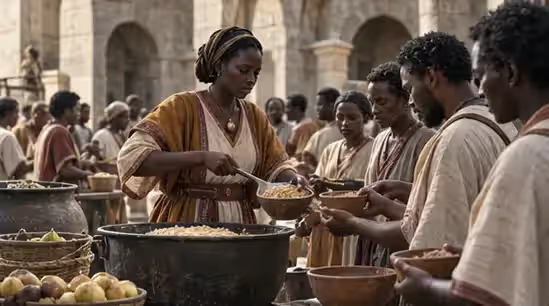
The meal begins in the fields
Grain, pulses, fruit and table eggs form the basis of Urnok’s human diet. Food eggs are lawful; clutches intended for lineages and ritual remain protected. Harvests also meet distinct needs: feeding a person, preserving seed and sustaining a draught animal involve different reserves.
The river reaches the table
River fish complement agricultural produce; meat belongs to a controlled food supply. These varied resources mean the imperial table cannot be reduced to a sack of grain. Fields, waters and animal keeping provide different foods, while reserves and transport determine what can actually reach a neighbourhood.
The work between harvest and meal
A day’s meals
The Urnok day begins with a porridge of grain or pulses, eaten hot before work. At midday people have a flatbread, a piece of bread and whatever the market offers: vegetables, fruit, smoked fish. The evening meal is the only one a family truly shares: a stew of dried pulses, sometimes with a little farm meat, bread, and for the children table eggs hardened in brine. The bread of relays and barracks, scored into twelve equal parts, has given its name to a way of sharing: “making twelve” means serving everyone without scales and without quarrels.
The eldest at the table serves, and the portions are counted aloud before the meal begins. The habit comes, it is said, from times of dearth, when everyone wanted to see that nobody received more than the others.
The tables of the duchies
Each duchy has its cuisine. Sarnor eats the whitest bread in the Empire, drinks grain beer and, in its marshy south, serves taro cakes. Orlantis, a land of forests and estuaries, eats estuary fish, mushrooms and fruit candied in honey, which it ships as far as Volonia. Bralnor, with its hard winters, prefers what keeps: dry flatbreads, dried pulses, salted meat. In Qor Zaï several houses begin the year with a hard flatbread, without salt, eaten in memory of hunger. The capital, finally, mixes everything that comes in by its roads, and its lower quarters live on fish smoked on racks above the canals.
Velmor eats like a garrison country: solid food, served quickly, eaten standing on manoeuvre days. Its nobles keep the habit even at their banquets, where much is served and little time is spent.
Drinking and feasting
The most common drink is barley beer, brewed in cool cellars under the capital’s great avenues and in every town of Sarnor. Fruit wines come from the valleys of Orlantis; herbal infusions are drunk everywhere, hot in winter. The most Urnok of spirits is Ruminal, made from fermented fodder and aged several winters in a silo cellar: the legions receive a share of it with their pay, and the capital’s taverns serve it in small cups, because it goes to the head quickly.
On festival days the streets fill with sellers of flatbreads, fritters and candied fruit. The Reading of the Annals is celebrated with a family meal at which people drink to those born during the year; the Kindling of the Forges with flatbreads baked on the hot iron sheets of the armouries.
What the neighbours think
Foreigners often find the Urnok table sober to the point of boredom: lots of bread, lots of dried pulses, few spices, and an attention to quantities that makes them smile. Volonians, used to seafood and the spices of their ports, joke about an empire that eats what it can store. The real shock comes from Arkhan, where eggs are eaten without distinction: to see an Arkhan crack the egg of a great beast into a pan is, for an Urnokian, a nightmare scene.
Urnokians, for their part, distrust cuisines that do not keep. A dish that cannot be made again in winter, they say, is not a dish but a season.