

Institutions
Korath : apprendre par la preuve
À Korath, l’école, le tribunal, l’atelier et l’archive se rencontrent autour de ce qu’une méthode peut démontrer et corriger.
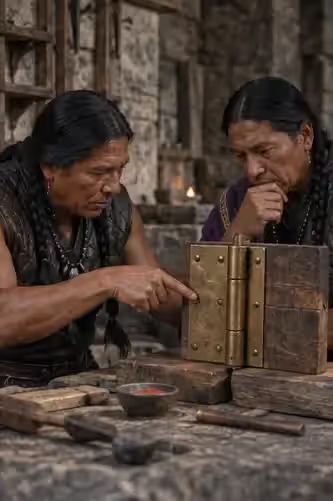
Un enfant apprend à vérifier
Les brevets d’enfance donnent aux jeunes un cadre pour observer, fabriquer et démontrer un petit usage pratique. L’objet doit pouvoir être regardé, testé et expliqué avant de servir. L’éducation installe donc très tôt le droit à la méthode et à la correction.
La concurrence a une fonction civique
Un brevet majeur devient complet après reproduction et attaque méthodique par un atelier rival. La contrepreuve protège moins une institution abstraite qu’un usage réel : elle force une idée à rencontrer la matière, l’usure et l’objection. Une erreur honnête peut être corrigée ; dissimuler une limite ou falsifier un essai touche à la confiance publique.
La correction reste signée
L’inventeur conserve son nom et la trace des corrections même lorsqu’un brevet sort de son exclusivité temporaire ou fait l’objet d’une réquisition. La mémoire publique ne glorifie donc pas seulement l’objet final : elle conserve les limites, les accidents et les amendements qui ont permis de l’employer sans mentir.
What a childhood patent looks like
A childhood patent concerns a small practical use: a wedge that stops a door from slamming, a lamp hook that no longer turns, a gauge that tells when the water jug is empty, a chest latch the youngest cannot open. The child files a plan, makes the object, then demonstrates it before the class and the schoolmaster, who play the three seals for the occasion: does the plan hold, does the object resist, does it really serve someone?
Classmates are invited to attack the object, on the model of the counterproof: making it fail honestly is as valued an exercise as inventing it. The child thus learns very early the difference between failing and lying. A latch that gives way in front of the whole class is no humiliation if it is declared; a rigged demonstration, on the other hand, is punished as a first fault of false precision. Many families keep these little objects, with their childhood plaque, beside the household tools.
Reading before counting
Korathians are the people who read the most, for a very concrete reason: in a carved city, reading a signal can save a life. Children learn the signs of the shafts, the load marks of the winches, the instructions of the airlocks and the meaning of the gong strokes that announce a closure, often before the great lessons in arithmetic. Knowing where one’s district’s evacuation route runs is among the very first things taught.
Reading also prepares for public life. An adult must understand a published protocol, a counterproof report, a workshop standard or the plaque of a public work, and even the general press publishes diagrams. The Korathian school therefore does not train a separate class of scholars: it trains inhabitants able to check what they are told.
The Trial of the Crack, up close
The Trial of the Crack marks the passage to adulthood. The young person receives a damaged object whose history they do not know: a warped door mechanism, a split gauge, a kitchen utensil whose hinge has given way. They must understand why the part failed, repair it and write a short declaration of the gap: what was corrected, what was not, and under what conditions the object may still fail.
The repair matters, but the declaration matters just as much. A youth who repairs perfectly without being able to explain the cause barely passes; one who fails to repair but describes exactly the limit of their work is often judged better. The trial applies to the letter the maxim that perfection belongs to the plan and dignity to whoever declares the gap.
The First Glass
Entry into adulthood is sealed by the First Glass, which brings together three objects: a tool, a watch and a glass. The tool stands for work, the watch for the right moment, the glass for intoxication and the ability to come back from it. The young adult drinks in public, often in their workshop’s tavern, and must then report on time to the workbench the next morning.
The rite sums up Korathian life: a day of precision, a night of intoxication and an exact return to work. Families most often give the tool and the watch; the workshop gives the glass.
The mechanism no one tests
The culture of proof stops at one door. A Korathian may freely think through every mechanism except the one that governs society. Schools know this and pass it on through a story every pupil eventually hears: a patent proposing a mechanism for revoking the sovereign was once presented to the Chamber, and refused. Its author is said to have answered the judges: “Then why are you afraid to test it?”
The story does not teach revolt; it teaches the limit. It shows children that method, counterproof and the right to error organise all of the country’s knowledge, and that a single question remains outside the workshop. Korathians learn to live with this contradiction: an almost boundless technical freedom, and a sovereignty that cannot be demonstrated.